

TL;DR:
- Authority in SEO reflects a website’s perceived credibility, trust, and influence within its niche, impacting rankings and AI citations. It is a composite signal built from backlinks, content depth, technical health, and entity clarity, with modern search and AI systems prioritizing these factors. Building long-term authority involves technical excellence, deep topical content, quality backlinks, and structured data, rather than relying solely on vanity metrics or link volume.
Authority in SEO is defined as a website’s perceived credibility, trust, and influence within its niche, evaluated by search engines and AI systems through a combination of backlinks, content depth, technical health, and entity recognition. It is the single most reliable predictor of whether your site ranks on page one or disappears into the digital ocean. Tools like Moz Domain Authority, Ahrefs Domain Rating, and Semrush Authority Score attempt to quantify it. Google’s E-E-A-T framework (Experience, Expertise, Authoritativeness, Trustworthiness) formalizes it. And AI-powered search engines like ChatGPT and Perplexity now use it to decide which sources they cite. If you want to rank and get cited, authority is the current you need to ride.
What is authority in SEO and why does it matter?
Authority in SEO is a website’s perceived credibility, trust, and influence within its niche, evaluated by search engines and AI. It is not a single score or a checkbox. It is a composite signal built from every interaction your site has with the web: who links to you, what you publish, how fast your pages load, and whether AI systems can clearly identify what your brand represents.
The importance of authority in SEO cannot be overstated. High-authority sites act as SEO insurance, making them more resilient to algorithm updates and allowing them to rank new content faster. Less established sites see far more volatility after Google core updates. That gap between stable and volatile is almost always an authority gap.
Two distinct types of authority matter here. Domain authority reflects the overall strength of your entire website. Topical authority reflects how deeply and comprehensively you cover a specific subject. A newer site with a modest backlink profile can still challenge broader high-authority domains by deeply covering a narrow, winnable niche. That is a realistic path for most marketing professionals and growing businesses.
Understanding the SEO authority definition also means recognizing what it is not. It is not a vanity metric. It is not a number you chase for its own sake. It is the compound result of doing the right things consistently across your entire digital presence.
What factors contribute to authority in SEO today?
Authority is a system, not a checklist. Weakness in any key area limits overall ranking performance regardless of strengths elsewhere. A site with 500 backlinks but slow load times and thin content will consistently underperform a site with 100 quality backlinks, fast pages, and deep topical coverage. Here are the core factors affecting SEO authority:
- Backlink quality and relevance. A single link from a trusted, topically relevant publication carries more weight than dozens of links from unrelated or low-quality sites. Focus on earning links from sources your audience already trusts.
- Content depth and topical coverage. Search engines reward sites that demonstrate genuine expertise. Publishing one article on a topic is not enough. Content clusters and internal linking show Google the breadth and depth of your knowledge, reinforcing topical authority across your entire site.
- Technical SEO health. Site speed, mobile-friendliness, crawlability, and structured data all send trust signals to search engines. A technically broken site cannot fully benefit from strong content or backlinks.
- Entity clarity. AI systems and search engines need to clearly understand who you are. Consistent brand representation across your website, social profiles, and third-party mentions helps search engines and AI models place you accurately in their knowledge graphs.
- User experience signals. Bounce rate, dwell time, and click-through rate all reflect whether real users find your content credible and useful. Search engines pay attention.
Pro Tip: Build your backlink strategy around relevance first, volume second. One link from a respected industry publication does more for your authority than ten links from unrelated directories.
These factors do not operate in isolation. Brands that align content strategy, technical structure, and external reputation consistently dominate rankings. Think of it as a ship: the hull (technical SEO), the sails (content), and the wind (backlinks) all need to work together to move forward.

How do popular SEO authority metrics compare?
Google does not publish an official authority score. Every metric you see in third-party tools is a proxy, not a direct ranking factor. Understanding what each one measures helps you use them correctly.
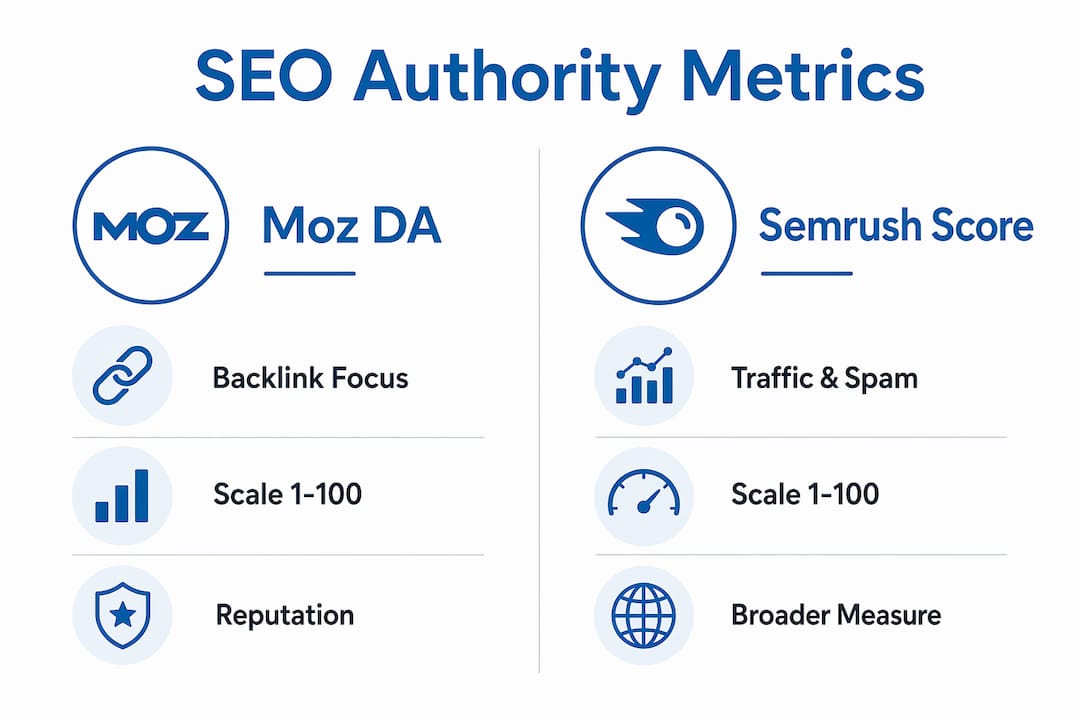
| Metric | Provider | Primary inputs | Best used for |
|---|---|---|---|
| Domain Authority (DA) | Moz | Backlink profile, linking root domains | Comparing competitive strength at a glance |
| Domain Rating (DR) | Ahrefs | Backlink quantity and quality | Evaluating link profile relative to competitors |
| Authority Score | Semrush | Link power, organic traffic, spam signals | Holistic domain health assessment |
Moz DA and Ahrefs DR both operate on a scale of 1 to 100 and focus heavily on backlink profiles. They are useful as comparative benchmarks, not as absolute ranking guarantees. A site with a DA of 60 does not automatically outrank a DA 45 site if the lower-authority site has stronger topical relevance and better technical health.
Semrush Authority Score adds organic traffic and spam detection to the equation, making it a slightly broader measure of domain health. That extra layer makes it useful for identifying sites that have inflated link profiles but low real-world traffic.
The most important thing to understand about all three metrics: none are official Google ranking signals. Strong topical relevance and technical SEO health matter beyond backlink counts. Use these scores to track progress and benchmark competitors, not to declare victory.
Pro Tip: Track your DA or DR over time as a directional indicator. A steady upward trend over six months tells you your authority-building efforts are working, even if rankings haven’t fully caught up yet.
What is the role of AI and entity clarity in SEO authority?
AI-powered search engines assess authority differently than traditional Google algorithms. AI search engines prioritize sources that are machine-readable, entity-clear, and factually verifiable, shifting authority signals well beyond traditional backlinks. This is one of the most significant changes in SEO authority in 2026.
Entity clarity means that AI systems can definitively answer: who is this website, what do they specialize in, and are they a recognized authority on this topic? If your site lacks clear entity signals, AI tools like ChatGPT, Perplexity, and Google’s AI Overviews are far less likely to cite you, regardless of your backlink count.
Here is how to improve your AI-readiness and entity clarity:
- Implement Organization schema. Add JSON-LD markup using Schema.org’s Organization type to your homepage. Include your name, URL, logo, contact information, and social profiles. This gives AI systems a structured, machine-readable identity for your brand.
- Add Person schema for authors. Every content creator on your site should have a structured author profile with credentials, expertise areas, and links to their professional presence. This directly supports Google’s E-E-A-T signals.
- Use Article and FAQ schema on content pages. Structured markup helps AI systems extract and verify your claims, increasing the probability of citation in AI-generated answers.
- Maintain brand consistency across the web. Your business name, address, and description should be identical across your website, Google Business Profile, LinkedIn, and any third-party directories. Inconsistency creates entity ambiguity.
- Publish factually verifiable content. AI systems favor sources they can cross-reference. Citing credible data, naming specific tools and methodologies, and linking to authoritative sources all increase your citability.
Comprehensive schema markup correlates with significantly more citations in AI-generated answers. That is a direct, measurable advantage you can build right now. For a deeper look at the technical side, Bigfinseo’s technical SEO guide covers schema implementation in detail.
How can you build and sustain SEO authority in 2026?
Building SEO authority is a long-term investment, not a sprint. The sites that dominate search results in 2026 treat authority as a compound asset, where every piece of content, every earned link, and every technical improvement adds to a growing foundation. Here is how to build that foundation deliberately:
- Earn high-quality, relevant backlinks. Pursue digital PR, guest contributions on respected industry publications, and partnerships with complementary brands. Avoid link schemes and paid links, which can trigger penalties and erode trust.
- Build content clusters around core topics. Pick the subjects most relevant to your audience and publish comprehensive, interconnected content on each one. A pillar page supported by ten related articles signals topical authority far more effectively than ten disconnected posts.
- Prioritize technical SEO excellence. Core Web Vitals, mobile performance, clean site architecture, and proper indexing are the hull of your ship. Without them, everything else leaks.
- Invest in long-form, expert-driven content. Comprehensive content that covers a topic thoroughly earns more backlinks, more time-on-page, and more AI citations than thin, surface-level articles.
- Implement structured data across your site. Schema markup for your organization, authors, articles, products, and FAQs makes your content machine-readable for both search engines and AI systems.
- Monitor authority metrics and AI visibility. Track Moz DA, Ahrefs DR, or Semrush Authority Score monthly. Use tools like Perplexity and ChatGPT to test whether your brand appears in AI-generated answers for your core topics.
Pro Tip: Use trust-building strategies that combine content authority with brand credibility signals. Reviews, case studies, and expert bylines all reinforce the E-E-A-T signals that both Google and AI systems reward.
Establishing website authority is not about any single tactic. It is about building a system where every signal reinforces the others. When your technical foundation is solid, your content is deep, your backlinks are relevant, and your entity is clear, authority compounds over time.
Key takeaways
SEO authority is a composite, system-level asset built from backlinks, content depth, technical health, and entity clarity, and it directly determines your ability to rank in search and get cited by AI.
| Point | Details |
|---|---|
| Authority is a system | Weakness in technical SEO, content, or backlinks limits overall ranking, even if other areas are strong. |
| Third-party metrics are proxies | Moz DA, Ahrefs DR, and Semrush Authority Score are useful benchmarks but are not official Google ranking signals. |
| AI readiness is now required | Schema markup and entity clarity directly increase the likelihood of being cited in AI-generated answers. |
| Topical authority is attainable | Smaller sites can compete by deeply covering narrow niches rather than trying to match large domains broadly. |
| Authority compounds over time | Consistent investment in content, links, and technical health builds a resilient, long-term ranking advantage. |
Why I think most marketers are still building authority the wrong way
After working with dozens of businesses on their SEO, I keep seeing the same pattern. A company invests heavily in backlink outreach, watches their Ahrefs DR climb from 20 to 40, and then wonders why their rankings barely moved. The answer is almost always the same: they treated authority as a backlinks problem when it is actually a systems problem.
The shift from backlinks-only thinking to systemic authority building is the most important mental shift in modern SEO. I have watched sites with modest link profiles outrank competitors with twice the DR, simply because their technical foundation was clean, their content was genuinely deep, and their entity signals were clear. That is not luck. That is a well-sailed ship.
The other mistake I see constantly is over-reliance on third-party authority scores. A high DA does not mean you will rank. A high DA with weak topical relevance and poor technical health means you have a strong hull but no sails. The score feels good, but the ship is not moving.
My honest advice: treat authority as a long-term, compound asset. Every piece of expert content you publish, every quality link you earn, and every schema markup you implement adds to a foundation that gets harder for competitors to displace. Start with your technical health, layer in topical content clusters, and let the backlinks follow from genuine quality. That is the course worth charting.
— Big
Ready to build real SEO authority with Bigfinseo?
Understanding authority is the first step. Putting it into practice is where most sites stall.
At Bigfinseo, we work with businesses and marketing professionals to build authority the right way: starting with a solid technical foundation, developing deep topical content, earning quality backlinks, and implementing the structured data that AI systems need to recognize and cite your brand. Whether you are just getting started or looking to accelerate an existing SEO program, our SEO for beginners resource is the perfect place to anchor your strategy. You can also explore our website optimization guide for practical steps you can apply right now.
FAQ
What is SEO authority in simple terms?
SEO authority is a measure of how credible and trustworthy a website appears to search engines and AI systems. It is built through backlinks, content quality, technical health, and entity clarity.
Is Domain Authority an official Google ranking factor?
No. Moz Domain Authority, Ahrefs Domain Rating, and Semrush Authority Score are all third-party metrics. Google does not use any of them as direct ranking signals, though the underlying factors they measure, like backlink quality and content relevance, do influence rankings.
How long does it take to build SEO authority?
Building meaningful authority typically takes six to twelve months of consistent effort across content creation, link earning, and technical optimization. High-authority sites compound their advantage over time, so starting early matters.
Can a new website compete with high-authority domains?
Yes, through topical authority. A newer site that deeply covers a narrow niche can outrank broader, higher-authority domains for specific queries. Focusing on winnable topics is the most realistic path for newer sites.
How does structured data affect SEO authority?
Structured data, particularly JSON-LD schema markup, makes your content machine-readable for both search engines and AI systems. Sites with comprehensive schema markup are significantly more likely to be cited in AI-generated answers, which is a growing source of organic visibility in 2026.

Michael Fleischner is the founder of Big Fin SEO, a New Jersey-based local SEO agency helping service-area and multi-location businesses increase visibility, generate qualified leads, and drive measurable revenue from search.
He is a TEDx speaker, Amazon-published author of The 7 Figure Freelancer, and a frequent speaker on SEO, AI-driven marketing, and personal branding.



 Corine R.
 Laura A.