

TL;DR:
- Growing website traffic involves optimizing site health, creating intent-matched content, and promoting across multiple channels. Focusing on technical performance and quality content builds sustainable growth and improves conversion rates over raw visitor numbers. Combining SEO, paid tactics, and regular content updates maximizes online visibility and revenue potential.
Increasing website traffic is defined as the strategic process of combining search engine optimization, content marketing, and multi-channel promotion to attract qualified visitors and grow your online presence. The industry term for this discipline is organic traffic acquisition, and it sits at the core of every effective digital marketing plan. A site drawing 2,000 daily visitors can generate roughly $10,000 in annual display ad revenue for small businesses. That number sets a concrete benchmark worth charting a course toward. This guide covers the exact methods business owners and marketers use to get there.
How to increase website traffic with foundational site optimization
Your site’s technical health is the hull of the ship. Without it, every marketing effort leaks. Page load time is the single most punishing technical factor: a page that takes 3 seconds to load sees a 32% higher bounce rate than one that loads in 1 second. Push that to 5 seconds and the bounce rate hits 90%. That means nearly every visitor you paid to attract leaves before seeing your offer.
Three technical areas demand your attention before anything else:
- Site speed: Compress images, use a content delivery network, and enable browser caching. Tools like Google PageSpeed Insights give you a free baseline score and specific fixes.
- Mobile-friendliness: Google indexes the mobile version of your site first. If your layout breaks on a phone, your rankings suffer regardless of your content quality.
- HTTPS security: An unsecured site triggers browser warnings that drive visitors away. SSL certificates are free through most hosts and non-negotiable for trust.
- On-page SEO: Write descriptive title tags under 60 characters, craft meta descriptions that match search intent, and build a clean URL structure. Internal linking between related pages passes authority and keeps visitors reading longer.
Reviewing your technical optimization checklist regularly catches issues before they compound into traffic drops.
Pro Tip: Run a crawl with Google Search Console at least once a month. It flags broken links, crawl errors, and indexing problems that silently kill your rankings.
How does targeted content attract and retain website visitors?
Content is the current that carries visitors to your site. Google prioritizes results that match actual searcher needs, which means content written for a broad audience rarely ranks for anything specific. The most effective content starts with a clear understanding of what your ideal visitor types into a search bar and then answers that question better than any competing page.
The content types that consistently drive organic traffic include:
- Blog posts targeting long-tail keywords: These are specific, lower-competition phrases like “best CRM for landscaping companies” rather than “CRM software.” They attract visitors who are closer to making a decision.
- Evergreen pillar pages: A comprehensive guide on a core topic in your industry can rank for years. Update it annually and it keeps pulling traffic without starting from scratch.
- FAQ pages: These capture voice search queries and featured snippet positions. Structure answers in 40–60 words for the best chance at a snippet.
- Free tools and calculators: A mortgage calculator or ROI estimator earns backlinks naturally because other sites reference it. AI-assisted tools built with human editorial oversight build topical authority far more effectively than bulk AI-generated articles.
Content freshness matters more than most marketers realize. Updating existing pages with current data, better examples, and tighter keyword targeting can produce quick traffic gains without creating a single new URL. A page ranking on page two for a competitive term often needs a content refresh, not a replacement. Pair this with a topic cluster approach: build one strong pillar page and support it with several related posts that link back to it. This signals topical authority to Google and lifts the entire cluster in rankings.
For deeper guidance on structuring this work, the SEO content creation guide from Bigfinseo walks through the full process for marketers in 2026.

Which promotional channels accelerate traffic growth fastest?
Organic SEO is the most durable traffic source, but it takes 3–6 months to produce sustainable results. Promotional channels fill that gap and amplify what SEO builds over time. The most effective channels for business owners are:
- Social media: Post content natively on the platforms where your audience spends time. LinkedIn works for B2B. Instagram and Facebook work for local and consumer brands. Short-form video on platforms like YouTube Shorts drives significant referral traffic when tied to a clear call to action pointing back to your site.
- Email marketing: Your email list is the only audience you own outright. A weekly or biweekly newsletter that links to your latest content drives consistent, high-intent traffic. Segment your list by interest to improve open rates and click-through rates.
- Paid search (PPC): Pay-per-click advertising delivers immediate traffic while your organic rankings build. Target high-intent keywords with specific landing pages, not your homepage. Set a clear cost-per-acquisition target before spending a dollar.
- Online communities: Reddit threads, LinkedIn groups, and niche forums reward genuine participation. Answer questions thoroughly and link to your content only when it directly helps. Spam gets you banned; expertise gets you traffic.
Multi-channel promotion compounds the effect of each individual channel. A blog post promoted via email, shared on LinkedIn, and targeted with a small paid budget reaches far more qualified visitors than any single channel alone.
Pro Tip: Do not run paid ads to a slow or poorly designed landing page. Fix the technical foundation first. A 5-second load time can erase your entire ad budget through abandoned sessions.
Common mistakes to avoid: posting on every social platform without a focused strategy, sending emails without segmentation, and running paid campaigns without conversion tracking. Each of these burns budget without producing measurable results.
How do you measure and optimize traffic for sustainable growth?
Raw traffic is a vanity metric unless it converts into leads, sales, or meaningful engagement. The metrics that actually tell you whether your traffic strategy is working are:
| Metric | What it tells you |
|---|---|
| Bounce rate | Whether visitors find what they expected when they land |
| Pages per session | Whether your content earns continued reading |
| Conversion rate | Whether traffic turns into business outcomes |
| Organic click-through rate | Whether your title tags and meta descriptions attract clicks |
| Time on page | Whether your content holds attention long enough to build trust |
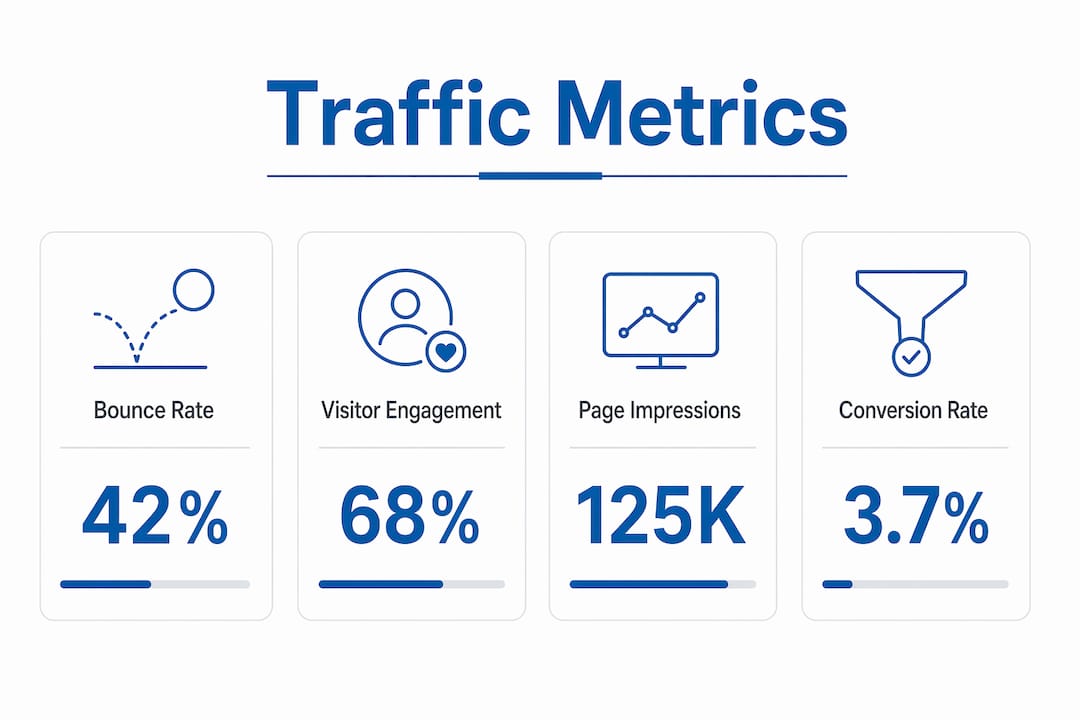
Analytics tracking through Google Analytics 4 and Google Search Console gives you the data to answer each of these questions. GA4 shows you how visitors behave on your site. Search Console shows you which queries bring them there and where your pages rank. Use both together.
When traffic drops or stagnates, start with Search Console. Look for pages that lost impressions or clicks in the last 90 days. Check whether Google has flagged any manual actions or coverage issues. Then audit those pages for content quality, internal linking, and page speed. Most traffic drops trace back to one of three causes: a Google algorithm update, a technical issue, or a competitor publishing better content on the same topic.
Tracking the right metrics is covered in depth in Bigfinseo’s guide on why SEO metrics matter for sustainable growth.
Key Takeaways
The most effective way to grow website traffic combines technical site health, intent-matched content, and multi-channel promotion measured against conversion metrics rather than raw visitor counts.
| Point | Details |
|---|---|
| Fix technical health first | A 5-second load time produces a 90% bounce rate, erasing every marketing effort. |
| Match content to search intent | Google ranks pages that answer what searchers actually want, not broad topic coverage. |
| Promote across multiple channels | Email, social, and paid search together reach more qualified visitors than any single channel. |
| Measure conversion, not just clicks | Bounce rate, conversion rate, and time on page reveal whether traffic creates business value. |
| Refresh existing content regularly | Updating older pages with current data drives quick ranking gains without new page creation. |
What I have learned from years of charting traffic growth
Most business owners I work with arrive focused on one question: how do we get more visitors? My honest answer is always the same. Volume is the wrong starting point. I have seen sites with 50,000 monthly visitors generating less revenue than sites with 8,000, because the smaller site attracted people who were ready to buy and the larger one attracted people who were just browsing.
The shift that changes everything is targeting niche, qualified visitors over broad volume. A local New Jersey contractor ranking for “commercial roofing contractor Bergen County” will outperform a national site ranking for “roofing tips” every time, because the intent behind that local search is specific and transactional.
Speed and user experience are the two factors I refuse to compromise on. I have watched businesses spend thousands on paid ads and see zero return because their site took 6 seconds to load on mobile. Fix the ship before you set sail.
The other thing I advocate consistently is combining organic SEO with paid tactics from the start, not treating them as separate strategies. Paid search tells you which keywords convert before you invest months in organic content. That data shapes your content calendar and saves you from writing articles nobody clicks on.
AI tools are genuinely useful for content research and drafting, but they need human oversight to build real topical authority. Generic AI content ranks poorly and erodes trust. The sites winning in 2026 use AI to work faster, not to replace editorial judgment.
— Big
Bigfinseo helps you build traffic that actually converts
Growing website traffic requires the right mix of technical work, content strategy, and promotion. Bigfinseo, based in New Jersey, helps business owners and marketers put all three together without the guesswork of figuring it out alone.
Whether you are starting from scratch with beginner SEO services or ready to run targeted pay-per-click campaigns that deliver immediate visitors, Bigfinseo builds the strategy around your specific goals. The team also handles website optimization to make sure your site is fast, secure, and ready to convert the traffic you earn. If you want sustainable growth backed by real data, Bigfinseo is ready to crew up with you.
FAQ
How long does it take to increase website traffic?
Organic SEO takes 3–6 months to produce sustainable traffic growth. Paid advertising generates immediate visitors but stops when the budget runs out.
What is the fastest way to boost website visitors?
Pay-per-click advertising delivers traffic the same day a campaign launches. Pair it with a fast, well-designed landing page to convert those visitors into leads.
Why is my website traffic dropping?
Traffic drops most often trace to a Google algorithm update, a technical crawl error, or a competitor publishing stronger content on the same keywords. Google Search Console identifies the cause in most cases.
How many visitors does a website need to generate revenue?
A site drawing roughly 2,000 daily visitors can generate approximately $10,000 per year from display advertising alone. Revenue from leads and sales scales with conversion rate, not just visitor volume.
Does updating old content really improve site traffic?
Refreshing existing pages with current data and better keyword targeting produces quick ranking gains without creating new content. It is one of the highest-return tactics available to sites with existing published pages.

Michael Fleischner is the Founder and CEO of Big Fin SEO, a New Jersey-based digital marketing and SEO agency helping service-area and multi-location businesses increase visibility, generate qualified leads, and drive measurable revenue from search.
He is a TEDx speaker (“The Freelance Journey”), and the author of multiple marketing and SEO books, including SEO Made Simple and The 7 Figure Freelancer. He served as President of the American Marketing Association’s Professional Chapters Council (2022–2023), founded CapitalQuest AI, and has over 20 years of experience in marketing and search.


 Corine Rigby
 Laura Ayres
 Michael Fleischner