
TL;DR:
- AI-driven search and brand authority signals shape SEO in 2026.
- Success now depends on building multi-platform presence, structured content, and Verified expertise.
SEO trends in 2026 are defined by three forces: AI-driven search, brand authority signals, and a new generation of performance metrics. Google’s AI Overviews and AI Mode have fundamentally changed how search results are delivered, shifting the goal from ranking on page one to being recognized and cited by AI systems. Marketers who still measure success by keyword position alone are charting a course with an outdated map. The professionals pulling ahead are those who understand E-E-A-T standards, structure content for Retrieval-Augmented Generation (RAG), and build brand presence across every platform where their audience searches.
What are the top SEO trends in 2026?
Search has evolved into an answer engine. Search engines now prioritize delivering correct, direct answers over sending traffic to websites. That single shift rewrites the rules for every marketer and business owner trying to grow online.

AI Overviews, AI Mode, and zero-click searches
Google’s AI Overviews and AI Mode pull answers directly into the search results page. Users get what they need without clicking through to any website. This has accelerated zero-click searches and forced a hard rethink of what “winning” in search actually means.
The new win is being the source AI cites. Top sites now prioritize brand-query volume growth over traditional keyword rank tracking. Brand-query volume measures how often people search for your brand by name. When that number grows, it signals to AI systems that your brand is a recognized authority worth citing.
Retrieval-Augmented Generation and content structure
RAG is the technical process AI search systems use to pull facts from the web and assemble answers. Structuring content into fact-dense entities supports RAG optimization and makes your content easier for AI to cite. That means writing short, declarative statements packed with specific data, named entities, and clear definitions rather than long, vague paragraphs.
Think of it this way: AI systems scan your content looking for anchors. If your page is full of filler text and general observations, the AI skips it. If your page leads with direct claims and specific facts, it becomes a reliable source.
- Write every section with a direct claim in the first sentence.
- Use named standards, statistics, and techniques throughout.
- Avoid padding words that add length without adding meaning.
- Structure headings as literal questions users ask.
Pro Tip: Run your existing top pages through a fact-density check. Count how many sentences contain a named entity, statistic, or defined concept. If fewer than one in five sentences qualifies, rewrite for density before any other optimization.
Why E-E-A-T is the cornerstone of SEO in 2026
E-E-A-T stands for Experience, Expertise, Authoritativeness, and Trustworthiness. Google’s quality rater guidelines have always referenced these signals, but algorithm updates in 2025 and 2026 have made them measurable ranking factors, not just guidelines. Understanding how E-E-A-T affects rankings is now a baseline requirement for any serious SEO strategy.
The data makes the case clearly. Content with verified user-generated insights ranks 40% higher in YMYL (Your Money or Your Life) categories than generic AI-synthesized content. YMYL covers health, finance, legal, and safety topics where accuracy directly affects people’s lives. That 40% gap shows that Google’s systems can detect the difference between real expertise and AI-generated filler.
Here is what E-E-A-T compliance looks like in practice:
- Experience: Include first-person accounts, case studies, and real project outcomes. A financial advisor writing about retirement planning should reference actual client scenarios, not textbook definitions.
- Expertise: Attribute content to named authors with verifiable credentials. Author bios with LinkedIn profiles, published work, and professional history carry measurable weight.
- Authoritativeness: Earn mentions and links from recognized publications in your industry. A single citation from a respected trade journal outweighs dozens of low-quality backlinks.
- Trustworthiness: Publish accurate, up-to-date information. Outdated statistics and broken citations actively hurt your trust score.
Generic AI content fails on Experience and Expertise by default. It has no lived perspective and no verifiable author. Pairing AI drafting tools with human expert review and attribution is the standard that wins in 2026.
How do you optimize for search everywhere in 2026?
Multi-platform SEO means targeting brand visibility across TikTok, Reddit, YouTube, and other platforms where AI-fragmented search results now live. Google is no longer the only search engine that matters for your brand footprint.
A strong brand presence across social media, podcasts, and publications is required for recognition from AI-driven search algorithms. AI systems train on the entire web. If your brand appears consistently across multiple credible platforms, AI systems recognize it as authoritative. If your brand only exists on your website, AI systems treat it as a minor player.
| Platform | Primary search behavior | Optimization tactic |
|---|---|---|
| YouTube | How-to and review queries | Optimize titles, descriptions, and chapters with exact-match questions |
| Community validation and comparisons | Participate authentically in relevant subreddits; earn organic mentions | |
| TikTok | Short-form discovery and trends | Use keyword-rich captions and on-screen text; post consistently |
| Broad informational and transactional | E-E-A-T content, RAG-friendly structure, brand-query growth | |
| Podcasts | Authority and trust building | Guest appearances on industry shows; transcripts published on your site |
Pro Tip: Search your own brand name on TikTok, Reddit, and YouTube right now. If you find little or no content, that is a gap AI systems notice. Start filling it with consistent, platform-native content before your competitors do.
The goal is a brand footprint so wide that when an AI system assembles an answer about your topic, your brand appears in multiple source layers. That is the modern definition of search engine authority.
What metrics actually measure SEO success in 2026?
Traditional rank tracking measures one thing: where your page appears for a specific keyword. That metric is losing relevance fast. SEO practitioners must shift to query fan-out metrics that aim to dominate diverse user intents from a single broad topic, rather than chasing a single top-10 position.
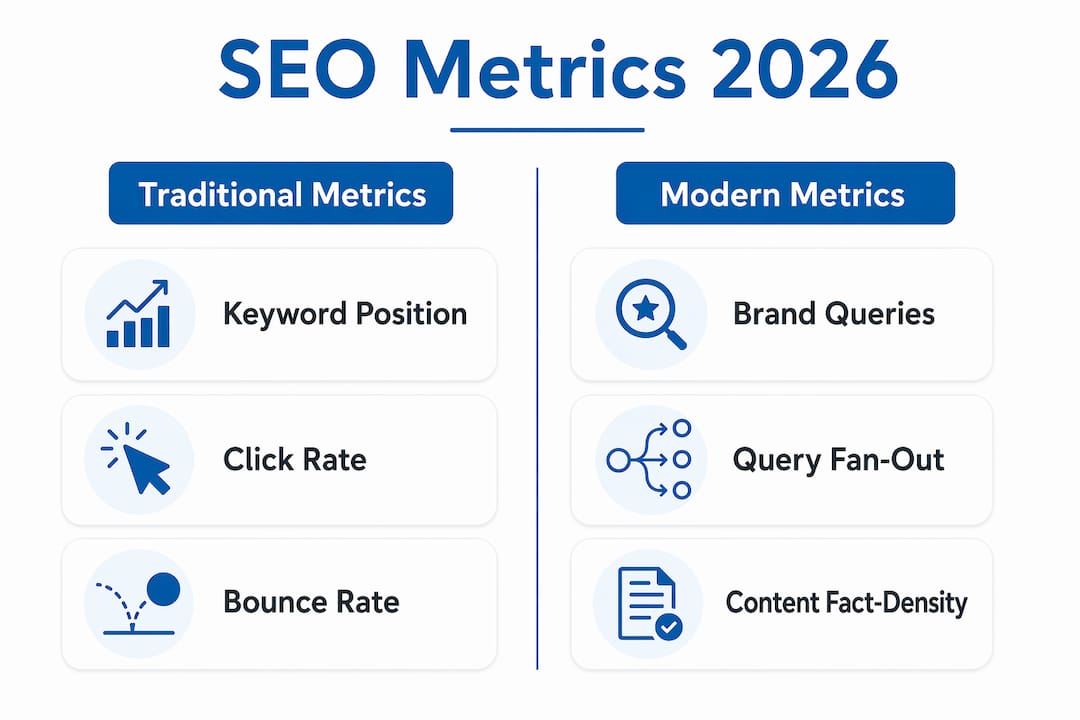
Query fan-out tracking works like this: instead of targeting one keyword, you map all the related questions, comparisons, and subtopics that branch off a core subject. A page about “business insurance” should also capture “how much does business insurance cost,” “business insurance for freelancers,” and “best business insurance for LLCs.” Owning the full cluster signals topical authority to both Google and AI systems.
| Traditional metric | Modern equivalent | Why it matters more |
|---|---|---|
| Keyword position | Brand-query volume growth | Measures real audience recognition, not just algorithm placement |
| Page-level traffic | Topic cluster coverage | Shows whether you own a subject area, not just one URL |
| Backlink count | Authority mention quality | One mention in Forbes outweighs 500 low-quality directory links |
| Click-through rate | AI citation frequency | Measures how often AI systems pull your content as a source |
Brand-query volume is the clearest signal of SEO health in 2026. When people search for your brand by name, they are expressing trust. That trust is exactly what AI systems are trained to recognize and reward.
One technical note worth adding: blocking aggressive LLM scrapers through server log analysis preserves your crawl budget and protects site performance. Some AI crawlers consume crawl budget at a rate that slows Google’s own indexing of your pages. Reviewing your server logs monthly and blocking non-beneficial bots is now standard technical SEO practice.
Key Takeaways
Mastering SEO in 2026 requires shifting from keyword rankings to brand authority, RAG-friendly content, and multi-platform visibility as the core pillars of any effective strategy.
| Point | Details |
|---|---|
| Brand-query volume is the new rank | Grow the number of people searching your brand name to signal authority to AI systems. |
| RAG structure wins citations | Write fact-dense, entity-rich content so AI systems can pull and cite your pages accurately. |
| E-E-A-T compliance is measurable | Verified expertise and named authors outperform generic AI content by a wide margin in trust-sensitive categories. |
| Multi-platform presence matters | Build brand visibility on YouTube, Reddit, TikTok, and podcasts so AI systems recognize you across source layers. |
| Query fan-out beats single keywords | Map full topic clusters to dominate broad subjects rather than chasing one keyword position. |
What I’ve learned from watching SEO shift in real time
The hardest part of this transition is not technical. It is psychological. Marketers who built careers around keyword rankings feel like the ground shifted under their feet, and honestly, it did. The instinct is to find a new set of tactics and apply them the same way. That instinct leads you straight into the next trap.
What I have seen work, time and again, is treating your brand like a publication. The brands that are winning in AI-driven search are not gaming algorithms. They are building genuine authority by publishing real expertise, showing up consistently across platforms, and earning mentions from sources that matter. That is not a new idea. It is just finally the idea that the algorithm rewards.
The other thing I would flag: do not let the complexity of RAG optimization paralyze you. You do not need to rebuild your entire site. Start with your five highest-traffic pages. Rewrite the opening paragraph of each one as a direct, factual claim. Add a named author with a real bio. Check that every statistic links to a credible source. Those five pages, done right, will teach you more about AI-optimized content than any course or webinar.
Stay curious, stay agile, and keep your crew informed. The shoreline keeps moving, but the fundamentals of trust and expertise never go out of style.
— Big
Bigfinseo can help you stay ahead of 2026 SEO trends
The shift to AI-driven search, E-E-A-T standards, and multi-platform visibility is a lot to manage alongside running a business. Bigfinseo works with marketers and business owners across New Jersey and nationally to build SEO strategies that are built for where search is heading, not where it has been.
Whether you are starting from scratch with SEO fundamentals or ready to go deep on AI optimization services that get your brand cited by ChatGPT, Perplexity, and Google’s AI systems, Bigfinseo has the expertise to help you chart a course that works. Reach out to the team to talk through where your current strategy stands and what it takes to compete in 2026.
FAQ
What is the biggest SEO change in 2026?
The biggest change is the rise of AI Overviews and AI Mode, which deliver direct answers without sending users to websites. SEO success now depends on being cited by AI systems, not just ranking on page one.
How does E-E-A-T affect rankings in 2026?
E-E-A-T signals, especially verified authorship and real-world experience, directly influence ranking in trust-sensitive categories. Content with verified user-generated insights ranks measurably higher than generic AI-synthesized content in YMYL topics.
What is query fan-out in SEO?
Query fan-out is the practice of targeting multiple related user intents that branch from a single broad topic. It replaces the single-keyword focus with full topic cluster ownership, which signals deeper authority to both Google and AI search systems.
Why does brand-query volume matter for SEO?
Brand-query volume measures how often people search for your brand by name. Growth in this metric signals to AI-driven search algorithms that your brand is a recognized authority, making it more likely to be cited in AI-generated answers.
How do I optimize for platforms beyond Google?
Build consistent, platform-native content on YouTube, Reddit, TikTok, and podcasts. A wide brand footprint across credible platforms signals authority to AI systems that train on the full web, not just Google’s index.

Michael Fleischner is the Founder and CEO of Big Fin SEO, a New Jersey-based digital marketing and SEO agency helping service-area and multi-location businesses increase visibility, generate qualified leads, and drive measurable revenue from search.
He is a TEDx speaker (“The Freelance Journey”), and the author of multiple marketing and SEO books, including SEO Made Simple and The 7 Figure Freelancer. He served as President of the American Marketing Association’s Professional Chapters Council (2022–2023), founded CapitalQuest AI, and has over 20 years of experience in marketing and search.


 Corine Rigby
 Laura Ayres
 Michael Fleischner