

TL;DR:
- Most business owners underestimate their website’s issues until a comprehensive SEO audit reveals underlying technical, content, and authority problems. An audit diagnoses root causes of poor rankings and guides prioritized fixes to improve search visibility and business goals. Regular, AI-aware audits ensure competitiveness in a rapidly evolving search landscape by focusing on both traditional and generative AI-driven signals.
Think your website is performing as well as it should be? Most business owners assume their site is fine until they look under the hood and find a very different story. A proper SEO audit is a structured diagnostic process that examines your site’s technical health, content quality, and search visibility all at once. It’s not a quick scan or a one-time report. It’s the kind of deep review that shows you exactly why your site isn’t ranking, where you’re losing traffic, and what to fix first to move the needle on real business goals.
Key Takeaways
| Point | Details |
|---|---|
| Audits are diagnoses | An SEO audit reveals the root causes of poor rankings rather than offering an instant fix. |
| Three core pillars | Every audit covers technical health, content quality, and authority signals to get the full picture. |
| Prioritization is everything | Use an Impact, Effort, and Risk framework to focus fixes on what will actually move traffic and revenue. |
| AI readiness matters now | Modern audits must assess content for GEO and AEO visibility, not just traditional ranking factors. |
| Ongoing audits win | One full annual audit plus quarterly check-ins keeps your site competitive as search algorithms evolve. |
What an SEO audit really is
An SEO audit is a structured diagnostic review of a website across three interconnected pillars: technical health, content quality, and authority signals. Each pillar feeds into the others. A technically broken site will suppress even your best content. Thin content undermines great technical performance. Weak authority limits how far good content travels in search results.
The goal is not to generate a report. The goal is to shift you from guessing about SEO to knowing exactly which improvements drive traffic and revenue. That distinction matters more than most people realize when they first commission one.
Here’s what each pillar actually covers:
- Technical health: Crawlability, indexability, page speed, Core Web Vitals, mobile responsiveness, HTTPS security, and structured data markup
- Content quality: Keyword relevance, topical depth, duplicate content, thin pages, internal linking structure, and metadata accuracy
- Authority signals: Backlink profile quality, referring domain diversity, toxic link detection, and brand mention signals
A common misconception is that an SEO audit and an SEO service are the same thing. They are not. An audit is the diagnosis. SEO services are the treatment. You cannot prescribe the right treatment without an accurate diagnosis first. Skipping the audit and jumping straight into content creation or link building is like prescribing medication before running any tests.
Pro Tip: Before your first audit, make a list of your three most important business goals, whether that’s leads, phone calls, or sales. A good audit should map every finding back to at least one of those goals.
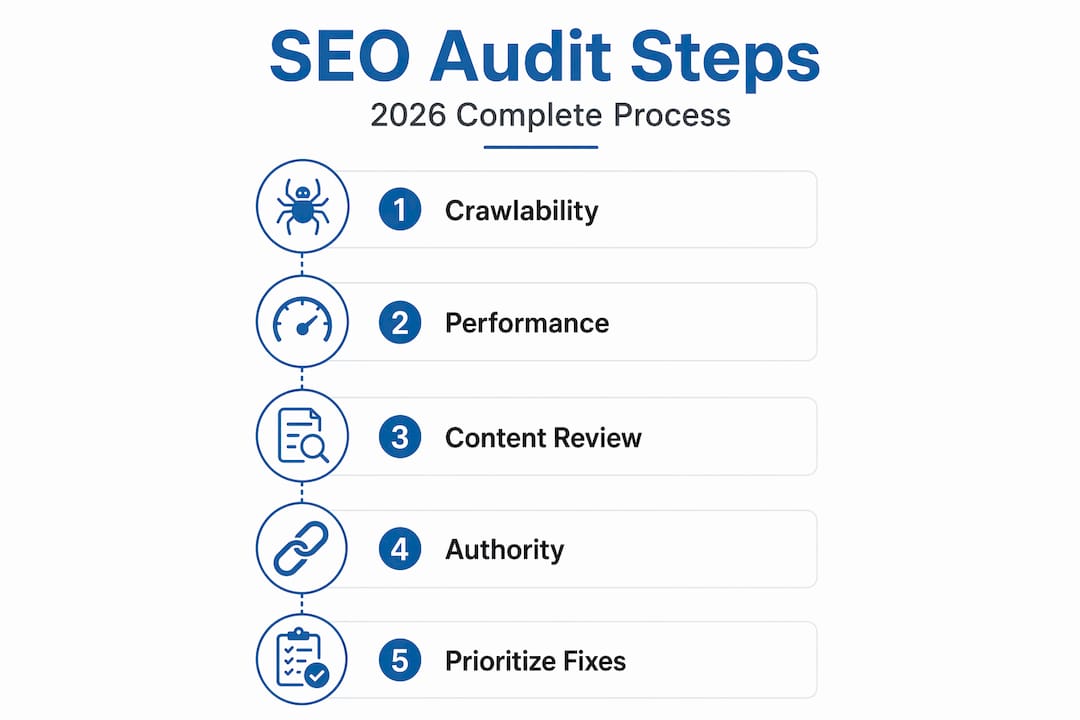
The SEO audit process, step by step
A thorough audit in 2026 covers over 200 checkpoints across all three pillars. That sounds like a lot, but the process follows a logical sequence that builds from the foundation outward. Here is how to approach it systematically.
- Crawlability and indexability check. Use a tool like Screaming Frog or Sitebulb to crawl your site and identify pages blocked by robots.txt, noindex tags, or broken redirects. If Google cannot find your pages, nothing else matters.
- Core Web Vitals and performance audit. Pull your site’s performance data from Google Search Console and PageSpeed Insights. Focus on Largest Contentful Paint, Interaction to Next Paint, and Cumulative Layout Shift. These are direct ranking signals.
- Mobile responsiveness review. Over half of all web traffic is mobile. Check that layouts, font sizes, tap targets, and load times all meet Google’s mobile-first indexing standards.
- Content quality and relevance assessment. Review each page for topical depth, keyword alignment, and duplication. Thin pages with fewer than 300 words that serve no clear user intent are candidates for consolidation or removal.
- Backlink and authority analysis. Use tools like Ahrefs or Google Search Console to map your backlink profile. Flag toxic or spammy links that could trigger a manual penalty.
- Structured data and schema review. Confirm that your schema markup is valid, properly implemented, and relevant to your page types, whether that’s local business, FAQ, product, or article schema.
- AI search readiness check. Assess whether your content is structured to appear in AI Overviews, featured snippets, and generative search answers. This is where GEO and AEO factors now belong in every audit workflow.
To understand where tools fit in this process, here is a quick reference:
| Audit Phase | Recommended Tools |
|---|---|
| Crawlability | Screaming Frog, Sitebulb |
| Performance / Core Web Vitals | Google Search Console, PageSpeed Insights |
| Backlink analysis | Ahrefs, Google Search Console |
| Content quality | Surfer SEO, Clearscope |
| Structured data validation | Google Rich Results Test |
| AI readiness | Manual SERP review, SGE tracking tools |
Pro Tip: Effective SEO auditing blends quantitative tool data with qualitative judgment. A tool can flag a thin page, but only a human can determine if that page actually serves a real user need.
How to interpret results and prioritize fixes
The audit is done. You have a spreadsheet with hundreds of issues, warnings, and opportunities. Now what? This is where most business owners stall. The report feels overwhelming, so nothing gets fixed.

The answer is a structured prioritization framework. The Impact, Effort, and Risk framework is the most practical approach. Score each issue on these three dimensions and sort accordingly. High impact, low effort, low risk fixes go first every time.
| Priority Level | Criteria | Example Fix |
|---|---|---|
| P1: Act immediately | High impact, low effort, low risk | Fix broken redirects, submit updated sitemap |
| P2: Schedule soon | High impact, moderate effort, medium risk | Rewrite thin service pages, fix Core Web Vitals |
| P3: Plan for later | Lower impact, high effort, or high risk | Site architecture restructuring, domain migrations |
Beyond the framework, a few common pitfalls deserve attention:
- Treating the report as the outcome. The real value of an audit lies entirely in executing the fixes, not in having the document. A report that sits in a folder does nothing.
- Ignoring business alignment. Not all SEO issues are equal for your specific goals. A local plumber should prioritize local schema and Google Business Profile issues long before worrying about international hreflang tags.
- Chasing volume over conversion. Audit findings should also connect to your conversion rate health. A page ranking on page one but converting at 0.5% is as much of a problem as a page not ranking at all.
The smartest move is to take your P1 fixes and assign them to a specific person with a deadline. That turns an audit from a document into a plan.
SEO audits in 2026’s AI-driven search world
Search in 2026 looks genuinely different than it did three years ago. AI Overviews now appear in over 50% of Google results, and organic clicks account for roughly 40.3% of US searches. That shift changes what audits need to measure.
The modern SEO audit has become a hybrid process. It still covers every traditional technical checkpoint. But it now also assesses whether your content is structured to be cited by generative AI models and featured in AI-generated answers. Industry experts call this the shift toward hybrid audits that evaluate both traditional signals and AI-driven metrics together.
Here is what the AI-focused layer of an audit now examines:
- GEO readiness: Does your content demonstrate E-E-A-T signals (Experience, Expertise, Authoritativeness, and Trustworthiness) that AI models use to assess citation worthiness?
- AEO structure: Are your pages formatted with clear, direct answers to specific questions? FAQ schemas, concise definitions, and structured headers all help AI systems extract and surface your content.
- AI citation signals: Is your brand mentioned across authoritative third-party sources? AI models weight citations from recognized publications, industry directories, and high-authority domains.
- Zero-click optimization: Does your content capture value even when users don’t click through? Structured data and well-written meta descriptions become even more critical in this environment.
How you monitor matters just as much as what you measure. A full deep-dive annually combined with quarterly mini-audits gives you the cadence to catch algorithm shifts before they erode your rankings. Monthly or quarterly reviews are no longer optional for competitive businesses. They are part of staying visible in a search environment that changes faster than ever. Tools like Bigfinseo’s AI optimization services are specifically designed to help businesses track and respond to these AI-driven shifts.
My take on what most people get wrong
I have worked with enough business owners to know the pattern. They get an SEO audit, see a 47-page report, and expect rankings to climb within weeks. When nothing moves, they conclude that SEO does not work.
What actually happened is that the diagnosis was completed but the treatment was never started. Technical foundations are multipliers. Fixing crawlability issues, page speed, and structured data can make your content and link-building efforts two to five times more effective. But those fixes have to actually be implemented.
The second thing I see constantly is businesses treating an audit as a one-time event. Search algorithms update dozens of times per year. Your competitors are publishing content. Your own site changes. An audit from 18 months ago is practically a historical document at this point. The businesses that stay ahead of the curve are the ones that treat auditing as a rhythm, not a project.
The third misunderstanding is the assumption that every audit issue is equal. I have seen businesses spend months rebuilding their site architecture while ignoring a single broken redirect that was bleeding 30% of their organic traffic. Prioritization is the skill that separates effective SEO from expensive activity that goes nowhere.
Start with the foundations. Fix what breaks Google’s ability to find and understand your site. Then build from there. That sequence works. Skipping it does not.
— Big
Ready to chart your SEO course?
Understanding what an SEO audit is gets you pointed in the right direction. Actually executing one, and acting on the results, is where real growth happens.

At Bigfinseo, we work with business owners who are ready to stop guessing and start building on solid ground. Whether you are just getting started or want a full picture of where your site stands today, our SEO resources for beginners walk you through every step in plain language. For businesses ready to go deeper, our team delivers audits that cover both traditional SEO and AI citation readiness so you are visible wherever your customers are searching. Explore how to optimize your site in 2026 and see what a real audit-to-action plan looks like for your business.
FAQ
What is an SEO audit in simple terms?
An SEO audit is a detailed review of your website that identifies technical problems, content weaknesses, and authority gaps preventing your site from ranking well in search results.
How often should you perform an SEO audit?
Most businesses benefit from one full audit per year combined with quarterly mini-audits to catch algorithm changes, site errors, and new competitive shifts before they impact rankings.
What does an SEO audit checklist include?
A thorough SEO audit checklist covers crawlability, Core Web Vitals, mobile performance, content quality, backlink health, structured data, and increasingly, AI search readiness factors like GEO and AEO.
How long does an SEO audit take?
A surface-level automated audit can complete in hours, but a thorough audit covering all 200-plus checkpoints typically takes several days to a week when combined with proper analysis and prioritization.
What are the main benefits of an SEO audit?
The primary benefits of an SEO audit are knowing exactly which fixes will drive traffic and revenue, avoiding wasted effort on low-impact work, and building a prioritized roadmap grounded in real site data rather than guesswork.

Michael Fleischner is a marketing strategist, entrepreneur, author, and TEDx speaker with more than 20 years of experience helping businesses grow. As Founder and CEO of Big Fin SEO, he advises small and midsize businesses on marketing strategy, SEO, paid advertising, customer acquisition, and Generative Engine Optimization (GEO).
Michael works directly with business owners and leadership teams through half-day marketing strategy intensives, full-day workshops, and ongoing strategic advisory engagements, including fractional CMO support.
He is the author of SEO Made Simple and The 7 Figure Freelancer, and has served in national leadership roles with the American Marketing Association.
Learn more about Michael at https://michaelfleischnermedia.com or explore his marketing strategy services at https://bigfinseo.com/marketing-strategy/.



 Corine Rigby
 Laura Ayres
 Michael Fleischner