

TL;DR:
- Content marketing involves creating valuable content that attracts and retains a targeted audience to build trust and generate leads. It moves prospects through stages like attract, engage, nurture, and convert using various formats such as blog posts, videos, and case studies. Successful programs require patience, strategic planning, collaboration, and consistent measurement to leverage long-term organic growth.
Content marketing is defined as the strategic practice of creating and distributing valuable, relevant content to attract, engage, and retain a clearly defined audience. Unlike traditional advertising, it earns attention rather than buying it. In 2026, 87% of marketers report that content marketing has increased brand awareness, and 76% confirm it aids lead generation across the buyer journey. Those numbers reflect a fundamental shift in how brands build trust. Tools like Mailchimp for email distribution and platforms like WordStream for performance tracking have made content marketing measurable and scalable for businesses of every size. The core promise is simple: publish content your audience actually wants, and they will come to you.
How does content marketing work?
Content marketing works by moving prospects through four stages: Attract, Engage, Nurture, and Convert. Each stage requires a different type of content, and the sequence matters.
- Attract — Blog posts, social media content, and videos pull in new visitors by answering questions they are already searching for.
- Engage — Once someone lands on your site, in-depth guides, case studies, and webinars keep them reading and exploring.
- Nurture — Email newsletters and drip sequences build familiarity over time, so prospects trust you before they ever speak to your sales team.
- Convert — Testimonials, product comparisons, and free trials push a warm lead to a final decision. 70% of marketers state that high-quality content directly influences final buying decisions.
Content marketing is a subset of inbound marketing designed to fit naturally into a customer’s online experience. It answers questions and builds credibility without a hard sell. That distinction matters because it means content compounds. A blog post published today can generate traffic for years. A paid ad stops the moment your budget does.
Content also works best when it does not operate in isolation. Pairing a strong blog with PPC advertising amplifies reach during the early months before organic traffic builds. Repurposing one article into a podcast episode, a LinkedIn post, and an email newsletter multiplies its value without multiplying your workload.

Pro Tip: Repurpose every long-form piece into at least three shorter formats. One article can become a newsletter, a social post, and a short video script with minimal extra effort.
What are the main types of content marketing?
The format you choose determines who you reach and when. Different content types serve different stages of the buyer journey, and the strongest programs use several in combination.
- Blog posts and articles are the backbone of most content programs. Long-form educational content targeting 1,500 or more words and high-intent keywords performs best for B2B marketers.
- Videos build brand authority and are especially effective at the awareness stage, where a viewer may not yet know your brand exists.
- Podcasts grow audiences slowly but create deep loyalty. Listeners who follow a show for months develop a level of trust that a banner ad cannot replicate.
- Email newsletters are the highest-converting format for nurturing. Mailchimp data consistently shows email outperforming social media for direct conversions.
- Ebooks and whitepapers signal authority and work well as lead magnets, trading detailed knowledge for a prospect’s contact information.
- Case studies are the most persuasive format at the decision stage. A real story with real numbers removes doubt faster than any sales copy.
- Social media posts extend reach and drive traffic back to deeper content on your site.
The table below maps each format to its primary use case, key benefit, and main challenge.
| Content Type | Best Stage | Key Benefit | Main Challenge |
|---|---|---|---|
| Blog posts | Awareness, Consideration | Drives organic search traffic | Requires consistent publishing |
| Video | Awareness | High engagement and shareability | Production time and cost |
| Podcast | Consideration, Loyalty | Deep audience trust | Slow audience growth |
| Email newsletter | Nurture, Convert | High conversion rate | List building takes time |
| Ebook / Whitepaper | Consideration | Strong lead magnet | Requires significant research |
| Case study | Decision | Builds credibility with proof | Needs client cooperation |
| Social media | Awareness, Engagement | Broad reach and low cost | Short content lifespan |
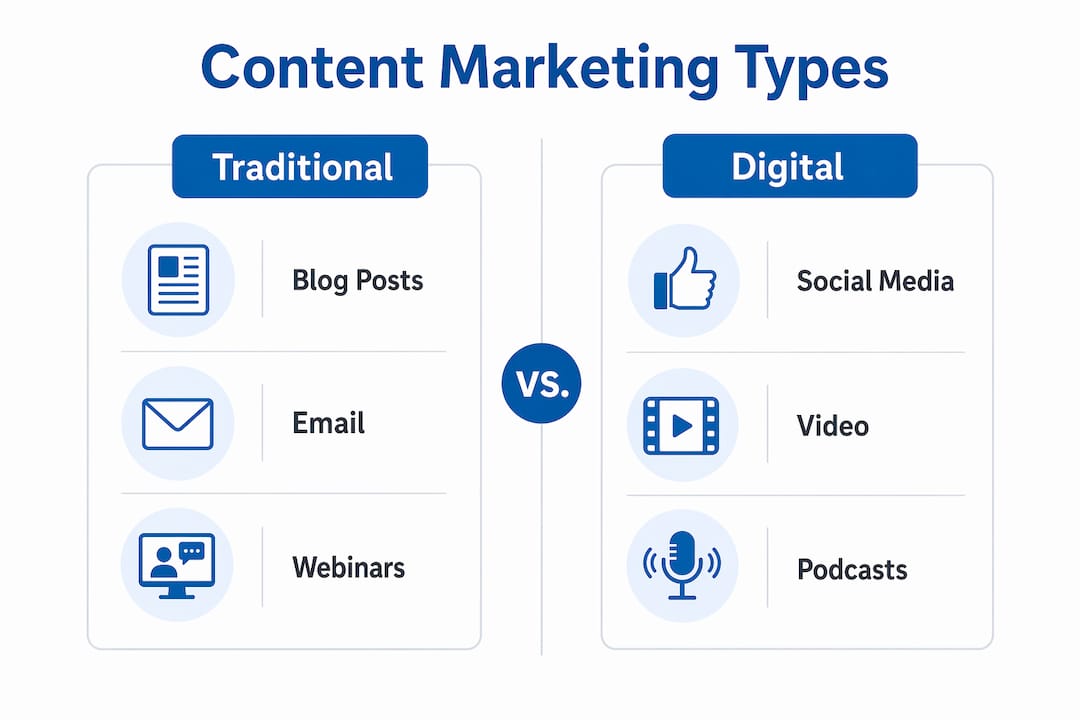
Real-world examples sharpen this picture. HubSpot built its entire brand on free educational blog content and became the benchmark for B2B content marketing. Red Bull produces original video and event content so compelling that its media arm operates like an independent publisher. Both brands prove that the best content marketing does not feel like marketing at all.
Why invest in content marketing?
Content marketing generates up to 3x more leads than outbound marketing at 62% lower cost. For businesses watching every dollar, that ratio is the strongest argument for shifting budget toward content.
Companies with active blogs generate 67% more leads monthly than those without one. That output replaces expensive pay-per-click campaigns where competitive keywords carry cost-per-click rates of $50–$100. The math favors content for any business playing a long game.
The compound growth effect is the real advantage. A well-optimized article published today will continue attracting traffic in 2027 and 2028 without additional spend. Paid ads deliver traffic only while the budget runs. Content builds an asset. That distinction reshapes how you should think about your marketing budget.
“Most B2B content marketing programs require 6–12 months to see compounding traffic and lead growth. The primary constraint is patience, not funding.”
For startups and small businesses with limited budgets, this timeline is actually an advantage. You can compete with larger brands on search rankings through quality and relevance, not just ad spend. Explore marketing on a budget to see how content fits alongside other low-cost tactics.
Beyond leads, content marketing builds brand loyalty. Customers who learn from your content before buying are more likely to return and refer others. That loyalty reduces churn and increases lifetime customer value, two metrics that paid advertising rarely moves.
Pro Tip: Track organic traffic and keyword rankings from day one. You will not see dramatic results in the first 90 days, but the data will show you which topics are gaining traction so you can double down early.
How is content marketing different from other digital strategies?
Content marketing differs from traditional advertising by educating or entertaining rather than delivering overt sales pitches. That distinction places it in a separate category from most other digital tactics.
Here is how it compares to the three most common alternatives:
- Social media marketing is a distribution channel, not a strategy. You can share content marketing through social media, but posting on Instagram without a content strategy behind it is not content marketing. Social media amplifies content; it does not replace it.
- PPC advertising delivers immediate traffic but stops the moment spend stops. Content marketing builds organic visibility that compounds over time. The two work best together, with PPC filling the gap while organic content gains traction.
- Traditional advertising (TV, print, radio) interrupts an audience. Content marketing earns attention by being genuinely useful. A how-to guide on your website pulls in a reader who searched for help. A TV commercial interrupts a viewer who did not ask for it.
Content marketing also supports SEO in ways that no other tactic does. Publishing consistent, high-quality content signals authority to Google and earns backlinks from other sites. Those signals improve your rankings across all keywords, not just the ones you target directly. For a deeper look at how these strategies connect, the types of SEO strategies guide covers the full picture.
The result is a longer, more durable customer relationship. Buyers who discover your brand through helpful content arrive with trust already established. That trust shortens sales cycles and increases close rates.
How to build a content marketing strategy that works
A successful content program follows a clear sequence. Skipping steps early creates problems that are expensive to fix later.
- Research your audience and keywords. Identify the questions your ideal customers are asking on Google, Reddit, and LinkedIn. Tools like Google Search Console, Semrush, and AnswerThePublic surface real search demand. Build your content plan around topics with proven interest.
- Plan your content calendar. Choose your primary formats based on your team’s strengths and your audience’s preferences. Commit to a publishing schedule you can sustain. Two quality articles per month beats eight rushed ones.
- Create with depth and specificity. Generic content ranks poorly and converts worse. Write for a specific reader with a specific problem. Include data, examples, and original perspective. Long-form content of 1,500 or more words targeting high-intent keywords consistently outperforms shorter pieces in B2B search results.
- Distribute across channels. Publish on your site, share on social media, include in your email newsletter, and pitch to relevant publications for backlinks. Each distribution channel extends the reach of every piece you create. Use your lead generation strategy to capture visitors before they leave.
- Measure and adjust. Track organic traffic, time on page, email open rates, and conversion rates. Review performance monthly. Drop formats that underperform and expand what works.
Content marketing is a team effort requiring strategy, writing, SEO, distribution, and analytics. Assigning it to one person who enjoys writing typically leads to failure. Plan for the full skill set from the start, whether that means hiring, partnering, or outsourcing specific functions.
Key takeaways
Content marketing succeeds when it delivers genuine value consistently, builds trust over time, and integrates with SEO and distribution to compound its impact across months and years.
| Point | Details |
|---|---|
| Core definition | Content marketing attracts and retains customers by publishing valuable, relevant content rather than direct sales pitches. |
| Four-stage mechanism | Effective programs move prospects through Attract, Engage, Nurture, and Convert with tailored content at each step. |
| ROI advantage | Content generates up to 3x more leads than outbound marketing at 62% lower cost, with compounding returns over time. |
| Format selection matters | Match content type to buyer stage: blogs for awareness, case studies for decisions, and email for nurturing. |
| Patience is required | Most B2B programs need 6–12 months before traffic and leads compound meaningfully. |
Content marketing in 2026: what i have learned
After years of watching businesses launch content programs with high expectations and abandon them after 90 days, I have one consistent observation: the constraint is almost never budget. It is patience.
The businesses that win with content are the ones that treat it like a long-term asset, not a short-term campaign. They publish consistently, measure honestly, and resist the urge to pivot every time a piece underperforms in its first month. The compound growth effect is real, but it requires time to activate.
The other pattern I see is underestimating the team requirement. Content marketing requires strategy, writing, SEO, distribution, and analytics working together. Handing it to one generalist and expecting results is like sending one crew member to sail a ship that needs five. The roles are distinct, and each one matters.
In 2026, the quality bar has risen sharply. AI-generated content has flooded the web with generic, surface-level articles. The brands that stand out are publishing content with genuine expertise, original data, and a clear point of view. If your content could have been written by anyone, it will not rank, and it will not convert. Write from experience. Cite real sources. Take a position.
— Big
Ready to get more from your content?
Great content without visibility is a ship anchored in the harbor. At Bigfinseo, we help business owners and marketing teams make sure their content actually gets found.

Our SEO for beginners service is built for businesses that are ready to grow their organic traffic but are not sure where to start. We pair your content with the technical SEO and keyword strategy it needs to rank. Whether you are publishing your first blog or scaling an existing program, Bigfinseo charts the course so your content reaches the audience it deserves. Optimize your website and start turning your content into a lead-generating asset today.
FAQ
What is the simplest definition of content marketing?
Content marketing is the practice of creating and distributing valuable, relevant content to attract and retain a defined audience without relying on direct sales pitches. The goal is to build trust that leads to profitable customer action.
How long does content marketing take to show results?
Most B2B content programs require 6–12 months before traffic and leads begin compounding meaningfully. The first 90 days typically show minimal gains, so consistency and patience are critical.
What types of content work best for lead generation?
Long-form blog posts targeting high-intent keywords, case studies, and email newsletters consistently drive the strongest lead generation results. Companies with active blogs generate 67% more leads monthly than those without one.
How is content marketing different from social media marketing?
Social media marketing is a distribution channel; content marketing is a strategy. You use social media to share content, but social posting alone without a content strategy behind it does not constitute content marketing.
Do small businesses benefit from content marketing?
Content marketing is especially well-suited for small businesses because it generates leads at 62% lower cost than outbound marketing. It allows smaller brands to compete on search rankings through quality and relevance rather than ad spend.

Michael Fleischner is the founder of Big Fin SEO, a New Jersey-based local SEO agency helping service-area and multi-location businesses increase visibility, generate qualified leads, and drive measurable revenue from search.
He is a TEDx speaker, Amazon-published author of The 7 Figure Freelancer, and a frequent speaker on SEO, AI-driven marketing, and personal branding.



 Corine R.
 Laura A.