
TL;DR:
- Entity SEO focuses on structuring content around well-defined concepts with schema, internal links, and authoritative profiles to enhance Google’s understanding and ranking within the Knowledge Graph. It enables pages to rank broadly for related queries and supports AI-powered search systems that rely on entity recognition. Implementing one clear entity per page and connecting it through schema and internal links boosts semantic authority and future-proofs your content against search engine evolution.
Entity SEO is the practice of optimizing content around distinct, well-defined concepts called entities, including people, organizations, places, and products, so search engines understand your pages through context and relationships rather than keyword repetition alone. This approach, also called entity-based search optimization, sits at the core of how Google and AI-powered retrieval systems interpret meaning today. HubSpot defines entities in SEO as things with unique identities and relationships inside the Knowledge Graph, not just strings of text. If you are still building your strategy around exact-match phrases alone, you are optimizing for a version of search that no longer exists.
What is entity SEO and how does it differ from keywords?
Entity SEO is defined as the method of structuring and signaling your content so that search engines recognize the specific concept your page represents, connect it to related concepts, and surface it for semantically relevant queries. The standard industry term for the broader discipline is semantic SEO, and entity SEO is its most technical and precise expression.

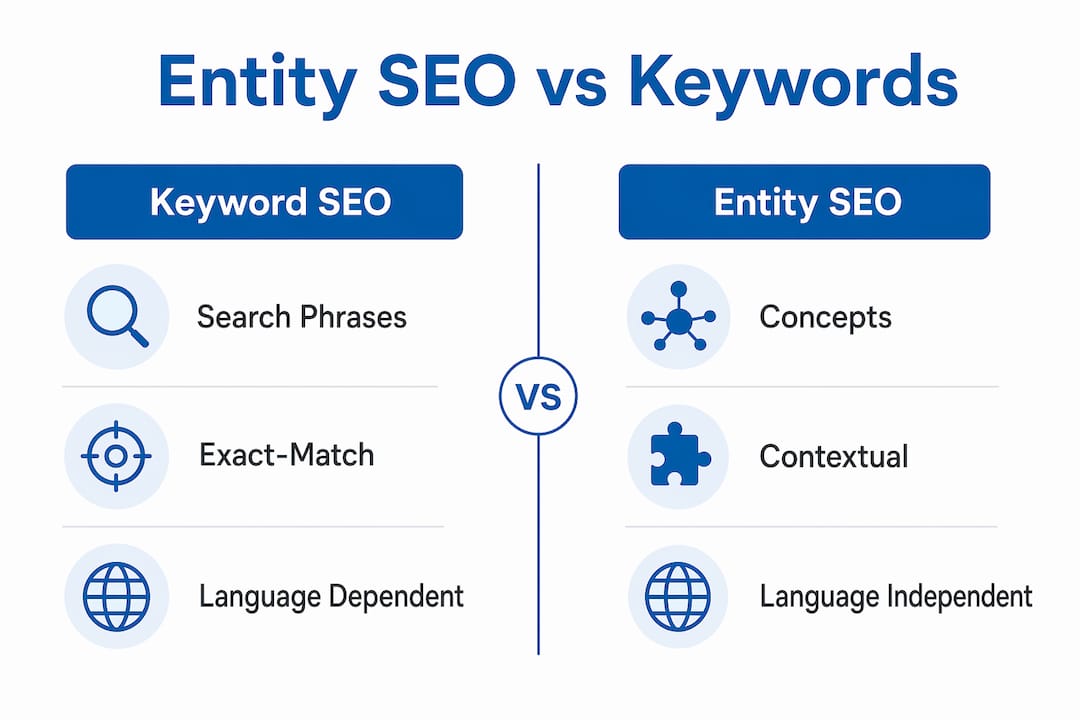
A keyword is a string of characters. An entity is a concept with attributes, relationships, and a unique identity independent of language. The word “Apple” as a keyword tells a search engine nothing without context. The entity Apple Inc., with attributes like headquarters in Cupertino, products including the iPhone, and affiliations with the App Store, tells a search engine everything it needs to place that concept accurately inside a semantic network.
Entities carry context and relationships that help search engines interpret meaning beyond exact-match phrases. This is why a page optimized as an entity can rank for dozens of related queries it never explicitly targets. Keyword optimization answers one question at a time. Entity optimization answers a category of questions simultaneously.
The practical difference shows up in content planning. A keyword-first approach produces pages targeting “best running shoes 2026” and “running shoe reviews” as separate targets. An entity-first approach builds one authoritative page around the entity “running shoe” with attributes, comparisons, and semantic connections, then lets the Knowledge Graph do the distribution work.
How do entities influence modern search engines and AI systems?
Google’s Knowledge Graph is the infrastructure that makes entity SEO matter. Google’s Knowledge Graph) contains over 500 billion facts about 5 billion entities, forming the backbone of how the search engine interprets queries and ranks results. That scale means Google is not reading your page the way a human does. It is pattern-matching your content against a vast relational database of known concepts.
When Google crawls your page, it performs entity recognition: identifying which concepts your content represents, what attributes you assign to them, and how they connect to other entities. A page about “Tesla” requires disambiguation. Is this the electric vehicle company, the historical inventor Nikola Tesla, or the band? Your schema markup, internal links, and content signals collectively resolve that ambiguity for the crawler.
AI-powered search systems, including Google’s Search Generative Experience and platforms like Perplexity AI, rely even more heavily on entity knowledge. These systems surface answers based on the entities behind queries, not the surface text of the query itself. Entity SEO allows AI retrieval systems to surface content based on entities behind queries, improving topical authority and citation likelihood. For marketers focused on AI search visibility, entity clarity is not optional.
Here is what entity recognition in SEO actually evaluates on your pages:
- Entity identity: Is there one clear, named concept this page represents?
- Entity attributes: Does the content describe properties like location, category, affiliation, or function?
- Entity relationships: Does the page connect to related entities through internal links and schema?
- Entity disambiguation: Do your schema markup and sameAs profiles distinguish your entity from similar ones?
- Entity consistency: Do your title, H1, and structured data all signal the same canonical entity?
Each of these signals contributes to how confidently Google places your page inside its semantic network.
What are the key principles and techniques for implementing entity SEO?
Entity-first SEO requires precision, coverage, and connectivity. Search Engine Land frames these three principles as the operational core of any entity optimization workflow. Precision means one canonical entity per page. Coverage means your content addresses the full attribute set of that entity. Connectivity means your schema and internal links tie that entity to the broader semantic web.
Here is a step-by-step framework for implementation:
- Define the canonical entity for each page. Every page should represent one primary concept. Align your title tag, H1, and the schema "mainEntityOfPage` property to that single concept. Mixed signals fragment entity recognition.
- Implement Organization or relevant schema markup. Use schema.org types like
Organization,Person,Product, orArticleto formally declare your entity to search engines. - Add sameAs profiles to your schema. The
sameAsproperty connects your entity to authoritative external profiles like Wikipedia, Wikidata, LinkedIn, or Crunchbase. Practitioner docs recommend at least 3 and ideally 5 or more sameAs entries to strengthen entity disambiguation. More authoritative connections mean less ambiguity for the crawler. - Build entity-rich internal links. Internal linking with entity-rich anchor text reinforces relationships and connectivity across your site. Link from supporting pages to your canonical entity page using anchor text that names the entity directly.
- Use entity extraction tools for auditing. Google’s Natural Language API and the Google Knowledge Graph API both allow you to test how Google reads your content. Run your key pages through these tools to see which entities are recognized and at what confidence level.
Pro Tip: Separate your organization’s entity schema from any personal brand schema for founders or executives. Mixing organization and personal identities in the same schema block confounds entity resolution and weakens both signals.
The table below maps each technique to its primary function in the entity SEO workflow:
| Technique | Primary function |
|---|---|
| Canonical entity per page | Prevents entity fragmentation and mixed signals |
| schema.org mainEntityOfPage | Formally declares the page’s primary concept to crawlers |
| sameAs property (5+ entries) | Connects entity to authoritative external profiles for disambiguation |
| Entity-rich internal links | Builds semantic relationships across the site’s content network |
| Google NLP API audit | Validates which entities Google recognizes on each page |
How does entity SEO compare to traditional keyword-based SEO?
Keyword SEO and entity SEO are not competing strategies. They are different layers of the same optimization system, and you need both. The distinction matters because they solve different problems.
Entities have context, relationships, and unique identities independent of language, while keywords are language-dependent strings. A keyword strategy optimizes for what people type. An entity strategy optimizes for what people mean. Google’s algorithm has been shifting toward meaning since the Hummingbird update in 2013, and the shift accelerated with BERT in 2019 and the integration of large language models into search ranking.
The practical implication is ranking breadth. Pages optimized for entities rank for multiple related queries, not just exact keyword matches. A page that Google recognizes as the authoritative source on the entity “content marketing” will surface for queries like “how to create a content strategy,” “content marketing examples,” and “what does a content marketer do,” even without targeting each phrase individually.
Here is how the two approaches compare across key dimensions:
| Dimension | Keyword SEO | Entity SEO |
|---|---|---|
| Optimization target | Specific search phrases | Concepts with attributes and relationships |
| Ranking scope | Exact and close-match queries | Broad semantic query clusters |
| Search engine signal | Text matching | Knowledge Graph placement |
| Content structure | Keyword density and placement | Entity coverage and connectivity |
| AI search visibility | Limited | High, through entity recognition |
The common misconception is that entity SEO replaces keyword research. It does not. Keyword data tells you which entities your audience searches for and how they phrase those searches. Entity optimization tells you how to structure your content so Google understands which concept you represent. Use keyword research to identify entities worth targeting, then use entity SEO to own those concepts in the Knowledge Graph.
What practical steps can digital marketers take to leverage entity SEO?
Adopting entity SEO does not require rebuilding your site from scratch. It requires a structured audit and a shift in how you plan and tag content going forward. Aligning schema, editorial tone, and internal links creates a feedback loop of semantic clarity that compounds over time.
Follow this roadmap to get started:
- Run an entity mapping audit. List your top 20 pages and identify the primary entity each one represents. If a page has no clear canonical entity, that is your first problem to fix.
- Align metadata to the canonical entity. Update title tags, H1 headings, and meta descriptions to name the entity explicitly. Vague titles like “Our Services” give Google nothing to work with.
- Implement and enrich structured data. Add schema markup to every key page. Prioritize
Organization,LocalBusiness,Article, andProducttypes depending on your content. Add sameAs links to Wikipedia, Wikidata, LinkedIn, and your Google Business Profile. - Build a semantic internal linking structure. Map which pages support which canonical entities and create links between them using anchor text that names the entity. A Google Knowledge Panel is one signal that your entity has been successfully recognized at scale.
- Monitor entity-level performance. Track rankings across semantic query clusters, not just individual keywords. If your entity page starts ranking for queries you never explicitly targeted, your entity signals are working.
- Develop content clusters around related entities. Group pages by semantic relationship. A hub page on “email marketing” should link to supporting pages on “email automation,” “email list segmentation,” and “email deliverability,” each representing its own entity within the cluster.
Pro Tip: Future-proof your content for AI search by writing entity attributes explicitly into your copy. State the category, location, function, and relationships of your subject in plain language. AI retrieval systems extract these attributes directly from your text, and clear attribute statements increase citation likelihood in generative search responses.
For a broader view of how these tactics fit into a full optimization plan, the SEO for marketing managers guide from Bigfinseo covers the workflow from audit to execution.
Key takeaways
Entity SEO is the practice of optimizing content around clearly defined concepts with schema, sameAs profiles, and semantic internal links so search engines place your pages inside the Knowledge Graph with precision and authority.
| Point | Details |
|---|---|
| Entities beat keywords alone | Entities carry context and relationships that drive rankings across broad semantic query clusters. |
| Knowledge Graph scale matters | Google’s Knowledge Graph holds over 500 billion facts, making entity clarity a direct ranking factor. |
| sameAs profiles are non-negotiable | Use 5 or more sameAs entries per entity to strengthen disambiguation and Knowledge Graph placement. |
| One entity per page | Assign one canonical entity per page and align title, H1, and schema to that single concept. |
| Entity SEO serves AI search | AI retrieval systems surface content based on entity recognition, making entity signals critical for future visibility. |
Why entity SEO is the next frontier I keep coming back to
I have worked with enough sites to know that keyword rankings can be deceptive. A page can rank for a high-volume phrase and still have almost no semantic authority. The moment Google updates its understanding of a topic, that page drops and the team scrambles to figure out why. Entity SEO solves that instability at the root.
What I find most compelling is the compounding effect. Once Google recognizes your site as the authoritative entity for a concept, it starts surfacing your content for queries you never planned for. That is not luck. That is the Knowledge Graph doing exactly what it was designed to do, and it rewards the sites that gave it clear, consistent signals.
The integration with AI search is where this gets genuinely exciting. Voice assistants, Perplexity AI, and Google’s AI Overviews all pull answers from entity-resolved content. If your page is not entity-optimized, it is effectively invisible to these systems regardless of how well it ranks in traditional results. That gap will only widen as AI-driven search grows.
My honest advice: start with the entity mapping audit before you touch anything else. Most sites have 10 to 15 pages doing real work, and half of them have no clear canonical entity. Fix those first. The schema and internal linking work is straightforward once you know which entities you are actually trying to own. Charting that course early saves months of reactive optimization later.
— Big
Ready to anchor your SEO strategy around entities?
At Bigfinseo, we help digital marketers and business owners build SEO strategies that work with how search engines actually think, not how they worked five years ago. Our approach integrates entity-first content planning, schema markup, and semantic internal linking from day one.
Whether you are just getting started or looking to audit an existing site, our SEO for beginners program walks you through entity optimization, structured data, and topical authority in plain language. We also offer AI optimization services for brands that want to get cited by platforms like ChatGPT and Perplexity. If you want to understand why businesses need SEO built on semantic foundations, we have the resources and the crew to get you there.
FAQ
What is entity SEO in simple terms?
Entity SEO is the practice of optimizing your content so search engines recognize the specific concept your page represents, rather than just matching keywords. It uses schema markup, sameAs profiles, and internal linking to place your content inside Google’s Knowledge Graph.
How is entity SEO different from semantic SEO?
Semantic SEO is the broader discipline of optimizing for meaning and context. Entity SEO is its most precise application, focusing specifically on declaring and connecting named entities through structured data and content signals.
What tools help with entity recognition in SEO?
Google’s Natural Language API and the Google Knowledge Graph API are the most direct tools for testing entity recognition on your pages. They show which entities Google identifies in your content and at what confidence level.
How many sameAs entries does my schema need?
Practitioner documentation recommends a minimum of 3 sameAs entries, with 5 or more considered the threshold for strong entity disambiguation. Link to authoritative profiles like Wikipedia, Wikidata, LinkedIn, and your Google Business Profile.
Does entity SEO replace keyword research?
No. Keyword research identifies which entities your audience searches for and how they phrase those searches. Entity SEO determines how to structure and signal your content so Google understands which concept you represent. Both are required for a complete strategy.

Michael Fleischner is a marketing strategist, entrepreneur, author, and TEDx speaker with more than 20 years of experience helping businesses grow. As Founder and CEO of Big Fin SEO, he advises small and midsize businesses on marketing strategy, SEO, paid advertising, customer acquisition, and Generative Engine Optimization (GEO).
Michael works directly with business owners and leadership teams through half-day marketing strategy intensives, full-day workshops, and ongoing strategic advisory engagements, including fractional CMO support.
He is the author of SEO Made Simple and The 7 Figure Freelancer, and has served in national leadership roles with the American Marketing Association.
Learn more about Michael at https://michaelfleischnermedia.com or explore his marketing strategy services at https://bigfinseo.com/marketing-strategy/.



 Corine Rigby
 Laura Ayres
 Michael Fleischner