
TL;DR:
- PPC advertising is a structured, measurable model that quickly generates qualified traffic and revenue when managed effectively. It involves bidding on relevant keywords across diverse platforms, using various ad formats, and continuously monitoring key metrics to optimize campaigns. Integrating AI tools and aligning PPC with SEO strategies enhances overall marketing performance and ROI.
If you’ve ever wondered what is PPC advertising and whether it actually moves the needle for your business, you’re not alone. 55% of small US businesses use online advertising, yet many treat PPC as little more than paying for clicks and hoping for the best. That’s not a strategy. It’s a wager. PPC, or pay-per-click advertising, is a structured, measurable model that puts your brand in front of the right people at the exact moment they’re searching. When it’s managed well, it’s one of the fastest ways to generate qualified traffic and real revenue.
Key Takeaways
| Point | Details |
|---|---|
| PPC is performance-based | You pay only when someone clicks your ad, giving you direct control over spend. |
| Keyword bidding drives placement | Ad auctions determine which ads appear based on bid amount and Quality Score. |
| Multiple ad formats exist | Search, display, shopping, and video ads serve different goals and audiences. |
| Metrics determine success | Monitoring CPC, CTR, ROAS, and CPA helps you optimize and protect your budget. |
| PPC and SEO work together | Combining paid and organic strategies produces better results than either alone. |
What is PPC advertising and how it works
At its core, PPC advertising means you pay a fee each time someone clicks one of your ads. You are essentially buying visits to your website rather than earning them organically. But the mechanics behind that simple exchange are worth understanding, because they determine whether your budget works hard or gets wasted.

When someone types a query into Google, an automated auction runs in milliseconds. Advertisers who have bid on relevant keywords compete for available ad slots. The winner is not simply the highest bidder. Google factors in your bid amount alongside a Quality Score, which reflects the relevance of your ad, your expected click-through rate, and the experience on your landing page. A sharper ad with a lower bid can beat a sloppy ad with a higher one.
Small businesses can start PPC campaigns with as little as $5 a day, with no minimum spend required. You set a daily or monthly budget cap, and once that limit is reached, your ads simply stop running until the next cycle. That level of budget control is genuinely rare in traditional advertising.
The most prominent PPC platforms include:
- Google Ads: The largest search network, reaching users across Google Search, Google Shopping, and the Display Network.
- Microsoft Advertising (Bing): Often overlooked, but reaches a desktop-heavy audience with lower average CPCs than Google.
- Meta Ads (Facebook and Instagram): Interest and behavior-based targeting, ideal for brand awareness and retargeting.
- LinkedIn Ads: Best for B2B businesses targeting by job title, industry, or company size.
Pro Tip: Don’t assume Google Ads is always the right starting point. If your audience is professional and B2B, LinkedIn’s targeting precision can deliver a better cost-per-lead even at a higher CPC.
PPC ad formats and where they appear
PPC goes well beyond the text links you see at the top of Google’s search results. Understanding the full range of formats helps you match the right ad type to your specific marketing goal.
| Ad Type | Best Use Case | Key Platform |
|---|---|---|
| Search ads | Capturing high-intent buyers actively searching | Google Ads, Bing |
| Display ads | Brand awareness across websites and apps | Google Display Network |
| Shopping ads | Showcasing products with images and prices | Google Shopping |
| Video ads | Engaging storytelling and retargeting | YouTube, Meta |
| Social media ads | Interest-based audience building | Meta, LinkedIn, TikTok |
Here is how each type serves a different purpose in practice:
- Search ads appear at the top and bottom of search results pages. They target users who are already looking for what you offer, making them high-intent and close to a buying decision.
- Display ads are the banner ads you see while reading articles or checking weather apps. They trade click-through volume for broad awareness and work well in retargeting sequences.
- Shopping ads pull your product title, image, price, and store name directly into the search results. For e-commerce businesses, they are often the highest-converting format available.
- Video ads on YouTube can run before or during content. They build familiarity at scale and work particularly well at the top of the funnel.
- Remarketing ads follow users who visited your site but did not convert, keeping your brand visible while they consider their options. Studies show remarketed visitors are significantly more likely to convert than cold traffic.
The channel you choose should follow the buyer’s journey. A user researching a purchase for the first time needs a different touch than someone who already visited your pricing page twice.
Metrics and optimization strategies that matter
Running a PPC campaign without monitoring the right metrics is like sailing without checking the compass. You might be moving, but not necessarily toward where you want to go. These are the numbers that matter most.
- Cost-per-click (CPC): The average amount you pay each time someone clicks your ad. Lower is generally better, but only if the traffic quality is high.
- Click-through rate (CTR): The percentage of people who see your ad and click it. A low CTR signals that your ad copy or targeting needs work.
- Quality Score: Google’s 1-10 rating of your ad’s relevance, landing page experience, and expected CTR. Higher scores lower your CPC.
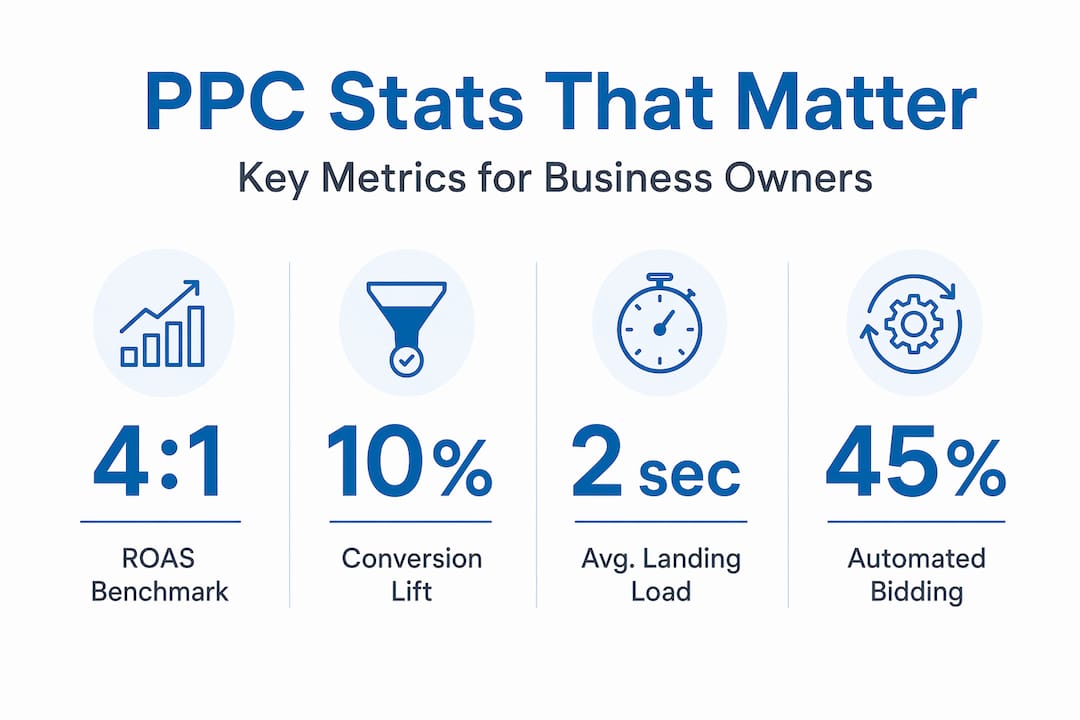
- Return on ad spend (ROAS): Revenue generated for every dollar spent on ads. If you spend $1,000 and generate $5,000 in revenue, your ROAS is 5:1.
- Cost-per-acquisition (CPA): The total cost to acquire one customer or conversion. This is the metric that most directly measures campaign profitability.
Regular monitoring of these metrics is what separates campaigns that grow from ones that drain budgets. Optimization is not a one-time task. You refine ad copy, adjust bids, pause underperforming keywords, and test new creative on a continuous cycle.
One of the most impactful changes you can make is improving your landing pages. Directing traffic to optimized landing pages rather than your homepage consistently improves conversion rates and lowers CPA. A landing page built specifically for the ad’s promise, with one clear call to action, removes friction and guides the visitor toward the decision you want them to make.
Pro Tip: Run A/B tests on your landing pages before scaling your ad spend. Even a 10% improvement in conversion rate can dramatically reduce your cost-per-acquisition across a larger budget.
Bidding strategies have also grown more sophisticated. Google Ads now offers automated strategies like Target CPA, Target ROAS, and Maximize Conversions. These use machine learning to adjust bids in real time based on signals like device, location, time of day, and user behavior. Manual bidding gives you more control early on, but automated strategies tend to outperform once you have enough conversion data in the system.
AI and automation in modern PPC management
The way PPC campaigns are managed has shifted fundamentally over the past two years. AI is no longer a feature. It’s the engine running behind most high-performing campaigns.
Generative AI automates bid adjustments, ad creation, and real-time optimization at a scale no human team can match manually. What that means for you as a business owner is speed and precision that simply were not possible before. Here is what AI-powered PPC actually does in practice:
- Automated bid management: AI evaluates thousands of auction signals simultaneously and adjusts bids up or down within milliseconds to hit your target CPA or ROAS.
- Dynamic ad creation: AI-powered tools generate multiple versions of ad copy and test them automatically, surfacing the best-performing combinations without manual effort.
- Audience refinement: Machine learning identifies which user segments convert at the highest rate and shifts budget toward them in real time.
- Predictive performance: AI forecasts how changes to bids, budgets, or keywords will affect future results before you make them.
- Structured AI workflows: Developing standardized AI workflows for keyword research and testing creates consistent, scalable results rather than one-off experiments.
The role of the PPC manager is shifting as a result. Rather than manually adjusting bids, a skilled practitioner now focuses on strategy, creative direction, and interpreting AI-generated data. For small businesses with limited marketing budgets, this shift is good news. Scaling a campaign doesn’t require proportionally scaling the hours spent managing it. If you’re exploring marketing on a budget, AI-driven PPC tools make sophisticated campaign management accessible without a full-time specialist.
Integrating PPC into your broader marketing strategy
PPC and SEO are often framed as rivals. They are better understood as crew members on the same ship, each handling a different part of the voyage.
SEO builds authority and organic rankings over months and years. PPC delivers traffic today. When you run them together, PPC and SEO integration enables better revenue attribution and a more complete picture of how your audience behaves across the funnel. You can read more about the specific tradeoffs at PPC vs SEO for businesses if you want to weigh where to invest first.
PPC data also informs organic strategy in practical ways. The keywords that convert well in paid campaigns tell you exactly what language your buyers use. That insight sharpens your content, your metadata, and your product descriptions across your whole site.
Businesses that integrate PPC into a multi-channel strategy consistently see stronger ROI than those running it in isolation. PPC also serves brand awareness beyond direct response. When someone sees your ad repeatedly in search results, even without clicking, they become more familiar with your name. That familiarity makes every other marketing touch more effective.
Pro Tip: Use your PPC campaigns as a testing ground for messaging before you commit to it across your website or email marketing. If an ad headline drives strong CTR, you have data-backed evidence that the language resonates with your audience.
My honest take on PPC after years in the water
I’ve watched business owners approach PPC in two very different ways. One group sets up campaigns, checks results after 90 days, and is disappointed. The other group treats it as an ongoing system that needs reading, adjustment, and patience. The second group almost always wins.
The most common mistake I see is treating the ad as the whole product. In reality, the ad is just the hook. The landing page, the offer, the follow-up sequence, and the conversion path are equally responsible for the result. I’ve seen brilliant ad copy send traffic to a confusing page and produce zero conversions. I’ve also seen average ads convert well because the landing page was focused and the offer was clear.
Another misconception I encounter often: that more budget automatically equals more results. It doesn’t. Spending $10,000 a month on poorly structured campaigns produces worse outcomes than spending $2,000 on tightly targeted ones. The structure matters more than the budget, especially in the early stages.
Where AI changes the equation is in the refinement cycle. The tools now available can compress months of manual testing into weeks. But AI still needs a human setting the right goals, reading the data intelligently, and making creative decisions. The captain still steers. The tools just make the engine more powerful.
— Big
Ready to put PPC to work for your business?
Understanding the theory behind PPC advertising is the first step. Putting it into practice is where results actually happen.
At Bigfinseo, we manage paid search campaigns for businesses that want real ROI, not just clicks. Our approach combines precise keyword strategy, AI-powered bid management, and landing page optimization to build campaigns that perform from day one and improve over time. Whether you’re launching your first campaign or want a second opinion on an existing one, there are 594 PPC agencies in the US to choose from. We think our results speak for themselves. Explore our PPC advertising services and see how we can help you chart a smarter course forward.
FAQ
What does PPC stand for in advertising?
PPC stands for pay-per-click. It’s an advertising model where you pay a fee only when someone clicks your ad, rather than paying for ad impressions or placements upfront.
How does a PPC ad auction work?
When a user enters a search query, an automated auction runs instantly to determine which ads appear and in what order. Google evaluates each advertiser’s bid amount alongside their Quality Score, which measures ad relevance and landing page experience.
What is a good ROAS for a PPC campaign?
A healthy ROAS benchmark varies by industry, but a 4:1 return, meaning $4 in revenue for every $1 spent, is a commonly cited starting target. Profit margins and business model determine what ROAS is actually sustainable for your specific operation.
How is PPC different from SEO?
PPC delivers paid traffic immediately by placing ads in search results for a fee per click, while SEO builds organic rankings over time without paying per visit. Both approaches work best when used together to cover the full funnel.
Do small businesses benefit from PPC advertising?
Yes. Small businesses can start PPC campaigns with as little as $5 a day, and the targeting controls mean even limited budgets can reach the right audience. The key is tight keyword selection and optimized landing pages to get the most from every dollar spent.

Michael Fleischner is a marketing strategist, entrepreneur, author, and TEDx speaker with more than 20 years of experience helping businesses grow. As Founder and CEO of Big Fin SEO, he advises small and midsize businesses on marketing strategy, SEO, paid advertising, customer acquisition, and Generative Engine Optimization (GEO).
Michael works directly with business owners and leadership teams through half-day marketing strategy intensives, full-day workshops, and ongoing strategic advisory engagements, including fractional CMO support.
He is the author of SEO Made Simple and The 7 Figure Freelancer, and has served in national leadership roles with the American Marketing Association.
Learn more about Michael at https://michaelfleischnermedia.com or explore his marketing strategy services at https://bigfinseo.com/marketing-strategy/.


 Corine Rigby
 Laura Ayres
 Michael Fleischner