

TL;DR:
- Effective SEO copywriting integrates search optimization with persuasive messaging to convert visitors into leads. It emphasizes structured content, relevant keywords, and clear calls to action aligned with search intent to maximize conversions. Treating SEO copywriting as a unified conversion system improves both search rankings and business results.
Most business owners assume SEO copywriting is just writing with keywords sprinkled throughout. That assumption costs them leads every single day. SEO copywriting combines SEO best practices with persuasive messaging designed to drive a specific action, whether that’s a call, a form submission, or a purchase. It’s not enough to rank on page one if visitors land on your page and leave without converting. In this guide, we’ll show you exactly what SEO copywriting is, how its components work together, and how New Jersey businesses can use it as a genuine lead generation engine.
Key Takeaways
| Point | Details |
|---|---|
| SEO copywriting blends goals | It unites search visibility with persuasive messaging to drive leads, not just rankings. |
| Structure drives conversion | Title tags, meta descriptions, and CTAs all work together to turn visitors into customers. |
| Clarity trumps keywords | Modern SEO copywriting focuses on clear answers and helpful structure, not stuffing keywords. |
| Page-specific details matter | Tailored meta descriptions and accurate content summaries improve both click-throughs and SERP snippet quality. |
| Treat content as a conversion asset | Design your SEO content with the user’s entire journey in mind for better lead generation. |
SEO copywriting explained: What it is and why it matters
There’s a common mix-up worth clearing up right away. SEO writing and SEO copywriting are not the same thing. SEO writing focuses on earning rankings, getting your content indexed, and building topical authority. SEO copywriting does that and persuades visitors to take action. It’s the difference between a page that shows up in search results and a page that actually generates revenue.
“SEO copywriting is writing content that combines SEO best practices (e.g., keyword research and structure) with persuasive messaging intended to drive a specific action.”
That distinction matters enormously for lead-driven businesses in New Jersey. If your website reads like a Wikipedia article with no direction for the reader, you’ll earn traffic and lose conversions. If it reads like a sales brochure with no structural optimization, you’ll earn great copy that nobody finds.
Effective SEO copywriting anchors both goals simultaneously. Here’s what gets misunderstood most often:
- Myth 1: More keywords mean better rankings. In reality, overuse hurts readability and signals poor quality to Google.
- Myth 2: Persuasive copy and SEO-friendly copy are opposites. They work together when structured correctly.
- Myth 3: A high word count guarantees depth. Length without intent relevance produces filler, not results.
- Myth 4: Ranking on page one is the finish line. It’s actually the starting line for conversion.
Think of your webpage like a ship pulling into a harbor. SEO gets you into the harbor, but copywriting guides your prospects safely to the dock. Both matter. Neither works alone. Understanding the website conversion essentials behind this dual approach is the first step toward building pages that genuinely perform.
Core elements of SEO copywriting: Structure and conversion triggers

Now that you know what SEO copywriting is, let’s pinpoint the elements you must master to capture traffic and leads. Each component plays a specific role in the journey from search query to conversion.
On-page SEO elements commonly optimized in SEO copywriting include title tags, headings, body content depth, meta descriptions, URLs, internal links, and image alt text. Together, these form the architecture of a high-converting page.
| On-page element | Primary SEO purpose | Conversion impact |
|---|---|---|
| Title tag | Signals page topic to search engines | Sets expectations that attract the right visitors |
| H1 and H2 headings | Establish content hierarchy | Guide readers through your value proposition |
| Body content | Demonstrates topical authority | Builds trust and reduces friction before a CTA |
| Meta description | Influences click-through rate | Acts as a first pitch to potential leads |
| URL structure | Improves crawlability | Signals relevance and professionalism |
| Internal links | Distributes authority across pages | Moves leads deeper into your funnel |
| Image alt text | Helps with image search | Reinforces message for all readers |
| Calls to action | Direct user behavior signals | Convert interest into concrete next steps |
Google’s own guidance on meta descriptions makes clear that they function like a short pitch. Higher-quality, page-specific descriptions improve both the quality and quantity of search traffic you attract. That means your meta description is both an SEO tool and a micro-ad.
Applying solid on-page SEO techniques requires treating each element as a layer in your persuasion system. Your title tag captures attention. Your heading structure builds a logical case. Your body copy educates and builds trust. Your CTA closes the deal.
Pro Tip: Write your meta description last. After you’ve drafted the full page, you’ll understand exactly what your strongest promise is. Lead with that promise in 150 to 160 characters, and make it specific enough that a searcher immediately knows this page was built for them.
Understanding website optimization tips that connect technical structure with human persuasion is what separates average pages from high-converting ones. You’re not just optimizing for an algorithm. You’re optimizing for a person with a problem who needs to trust you fast.
How SEO copy drives leads: From user search to action
With the core components in mind, let’s walk through how these work together to turn searchers into real leads. The journey isn’t complicated, but most businesses short-circuit it somewhere along the way.
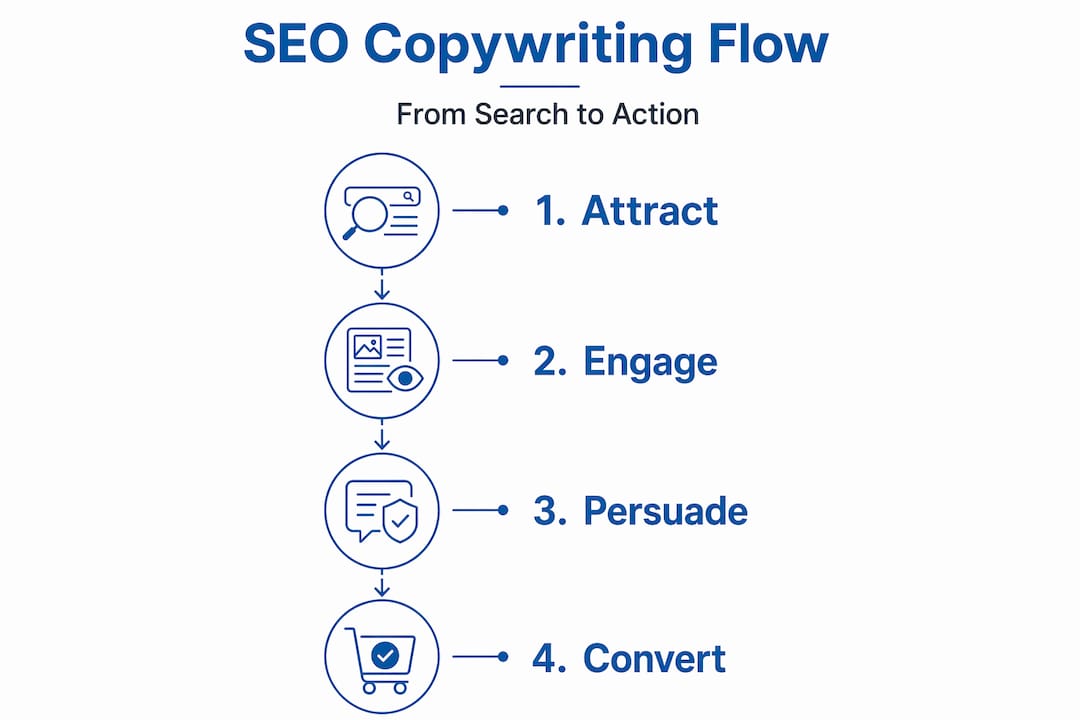
SEO copywriting in a lead-generation context should treat content as a conversion asset, not only a ranking asset. That means pairing intent-relevant copy with clear next steps. Here’s how that journey looks in practice:
- Search intent triggers the query. A business owner in Hoboken types “commercial roofing contractors near me.” That search signals strong purchase intent.
- Your optimized title and meta description earn the click. If your headline matches their intent and your description is compelling, they click yours over a competitor’s.
- Your opening content confirms they’re in the right place. Within the first 100 words, the visitor should feel understood. Name their problem, acknowledge the stakes, and promise a solution.
- Structured content builds trust gradually. Use headings to organize information logically. Answer their key questions before they have to ask. This reduces friction and builds credibility.
- A relevant, clear CTA converts interest into action. “Request your free inspection” works better than “Contact us” because it’s specific to what they came looking for.
- Follow-up pathways keep warm leads engaged. Internal links to related resources, case studies, or service pages extend the visit and increase conversion probability.
Effective lead generation tips consistently point to one pattern: the closer your content matches a searcher’s intent at every step, the higher your conversion rate climbs. This isn’t magic. It’s strategic alignment.
Pro Tip: Match your CTA language directly to the search query that brought the visitor in. If someone searched “NJ HVAC installation quote,” your CTA should say “Get your installation quote” rather than something generic. This reinforces relevance at the moment of decision and dramatically reduces hesitation.
When you build a better lead funnel with this intent-to-action framework in mind, you’re not just guessing. You’re charting a course that guides each visitor logically from curiosity to commitment.
Best practices for modern SEO copywriting: Clarity, structure, and snippet strategy
Armed with the basics of SEO copywriting and the lead journey, here’s how to apply best-in-class methods for today’s search and AI landscape. The rules have shifted, and businesses still relying on outdated tactics are leaving rankings and leads on the table.
“SEO writing should avoid keyword stuffing and instead optimize for clarity and extractability, front-loading direct answers and using structured formatting like headings and lists.”
Google and AI-powered search platforms both reward content that answers questions directly and is easy to extract. If your page buries the answer in paragraph seven, you’re losing to competitors who put it in paragraph one. Generative AI platforms use your content structure to determine if you’re worth citing. That’s a visibility opportunity most businesses aren’t capitalizing on yet.
Here are the common mistakes that undermine SEO copywriting effectiveness:
- Writing introductions that take 300 words to get to the point
- Repeating the primary keyword in every other sentence
- Using vague CTAs like “learn more” or “click here”
- Ignoring heading hierarchy (H2s, H3s) and writing walls of text
- Forgetting to link internally to relevant service pages or resources
- Writing one-size-fits-all content that doesn’t address a specific audience or intent
| Outdated tactic | Modern best practice |
|---|---|
| Keyword density targets (3-5%) | Natural keyword placement with semantic variations |
| Long introductions before the main point | Front-load the direct answer in the first paragraph |
| Generic CTAs at the bottom of the page | Intent-matched CTAs placed at natural decision points |
| Thin content padded with filler | Focused, structured content that covers the topic fully |
| Ignoring meta descriptions | Page-specific meta descriptions written as mini-pitches |
| No internal linking strategy | Deliberate links that move visitors through your funnel |
Applying website optimization strategies that reflect how modern search engines and AI models process content is no longer optional for businesses that want to compete. Structuring your content with clear H2s and H3s, providing direct answers near the top, and using bullet points for list-based information all improve your chances of appearing in featured snippets and AI-generated responses.
Conversion rate optimization also connects directly to these practices. Pages that are easy to read, logically structured, and action-oriented consistently outperform bloated, keyword-heavy alternatives. Clarity isn’t a compromise. It’s a competitive advantage.
A smarter approach: Why treating SEO copywriting as a conversion system works
Here’s the perspective most guides won’t give you. Conventional SEO copywriting advice tends to focus heavily on technique: use your keyword in the title tag, write 1,500 words, include internal links. That’s useful guidance, but it misses the deeper principle that separates businesses that generate leads from those that merely generate traffic.
The real ROI of SEO copywriting comes from treating the entire process as a conversion system, not a checklist. Every element, from your URL slug to your final CTA, should be designed with one question in mind: does this reduce friction for a motivated buyer? If the answer is no, it doesn’t belong on the page.
We’ve worked with New Jersey businesses across industries, from professional services to home improvement, and the pattern is consistent. When traffic increases but leads don’t follow, the problem is almost never the ranking. It’s almost always a disconnect between what the visitor expected and what the page delivered. The search intent and the content weren’t aligned.
The most powerful shift you can make before you write a single word is to turn prospects into customers by mapping search intent to your content structure first. Ask yourself: what stage of the buying journey is this person in? What do they need to believe before they convert? What objections might hold them back? Build your page architecture around those answers, and the copy almost writes itself.
We’ve also seen businesses obsess over ranking position while ignoring what happens after the click. Page one visibility is valuable only when the page it leads to is built to convert. A page ranked third with a 6% conversion rate outperforms a page ranked first with a 1% conversion rate every single time. That’s the math of treating SEO copywriting as a system rather than a visibility play. The businesses that win in competitive New Jersey markets are the ones who chart that course intentionally before the writing begins.
Ready to master SEO copywriting and drive real results?
If you’ve been creating content that ranks but doesn’t convert, or converting but not ranking, you don’t have to navigate that gap alone. At Big Fin SEO, we help New Jersey businesses build SEO copywriting strategies that work at every stage of the lead journey.

Whether you’re just getting started with our SEO for beginners resources or you’re ready to overhaul your current approach, we have the expertise to help you move forward. From content audits to full page rewrites, we’ll help you optimize your website for both search engines and the humans who use them. Our website design services are also built to align with SEO copywriting goals, so your design and your copy work in the same direction. Let’s build something that performs.
Frequently asked questions
What’s the difference between SEO copywriting and traditional copywriting?
SEO copywriting combines search best practices with persuasive messaging to drive specific actions, while traditional copywriting focuses on persuasion without search engine optimization. The dual goal is what makes SEO copywriting particularly valuable for lead generation.
How do meta descriptions impact SEO copywriting results?
Higher-quality, page-specific descriptions improve both the quality and quantity of search traffic by acting as a short, targeted pitch to searchers. A strong meta description increases your click-through rate before a visitor even reaches your page.
Should keywords be used heavily in SEO copywriting today?
No. Modern SEO copywriting should optimize for clarity and extractability, using structured formatting and direct answers rather than forcing keywords into every sentence. Natural, contextually relevant language performs significantly better than keyword-stuffed copy.
What is the most important on-page element for lead generation SEO copy?
Intent-relevant copy paired with clear CTAs consistently drives the strongest lead generation results. When your content matches what the searcher was looking for and tells them exactly what to do next, conversion rates follow naturally.

Michael Fleischner is a marketing strategist, entrepreneur, author, and TEDx speaker with more than 20 years of experience helping businesses grow. As Founder and CEO of Big Fin SEO, he advises small and midsize businesses on marketing strategy, SEO, paid advertising, customer acquisition, and Generative Engine Optimization (GEO).
Michael works directly with business owners and leadership teams through half-day marketing strategy intensives, full-day workshops, and ongoing strategic advisory engagements, including fractional CMO support.
He is the author of SEO Made Simple and The 7 Figure Freelancer, and has served in national leadership roles with the American Marketing Association.
Learn more about Michael at https://michaelfleischnermedia.com or explore his marketing strategy services at https://bigfinseo.com/marketing-strategy/.



 Corine Rigby
 Laura Ayres
 Michael Fleischner