

TL;DR:
- Voice search optimization prepares websites for discovery by voice assistants using natural language queries and structured data. It relies on targeted long-tail keywords, featured snippets, local SEO, and fast mobile performance to enhance visibility. Integrating these strategies ensures content ranks well in AI and voice-driven search results.
Voice search optimization is the practice of preparing your website’s content and technical structure to be discovered and accurately delivered by voice assistants like Google Assistant, Siri, and Amazon Alexa. With 95% accuracy for English queries and 72% of U.S. residents having used voice search, this channel is no longer a niche experiment. It demands the same strategic attention you give to traditional SEO. The industry term you’ll see alongside this practice is “voice SEO,” and the two phrases are interchangeable throughout this guide. Tools like Semrush, Google Search Console, and schema markup generators are already part of the voice SEO toolkit for marketers who want to stay ahead.
What is voice search optimization and how does it differ from text search?
Voice search optimization, or voice SEO, is the process of aligning your content with how people speak rather than how they type. That distinction sounds simple, but it reshapes your entire content strategy. A typed query might be “best pizza NJ.” A spoken query is “Hey Google, where can I find the best pizza near me in New Jersey?” The shift from fragmented keywords to natural language queries is the defining characteristic of voice search behavior.

This difference matters for three reasons. First, voice queries are longer and more specific, which means they carry stronger purchase or local intent. Second, voice assistants deliver a single answer rather than a list of ten blue links. Third, the content that wins is almost always pulled from a featured snippet or position zero result.
Here is what separates voice search from text search at a glance:
- Query structure: Voice queries are full questions; text queries are keyword fragments.
- Result format: Voice returns one spoken answer; text returns a results page.
- User intent: Voice skews toward immediate, local, or informational needs.
- Content format: Voice favors concise, direct answers between 23 and 41 words.
- Device context: Voice is predominantly mobile or smart speaker; text spans all devices.
“The shift to voice means marketers must write content that matches spoken language patterns rather than typed keywords to effectively optimize for voice search.” — Within
Featured snippets are the gateway to voice results. Google Assistant and Siri frequently pull their spoken answers directly from position zero content. If your page already ranks for featured snippets, you are already partway down the course toward voice visibility.
Voice SEO best practices every marketer should use
Winning at voice SEO requires a combination of content strategy, technical execution, and keyword targeting. These are not separate workstreams. They reinforce each other, and skipping one weakens the others.
Targeting conversational, long-tail keywords
Voice queries use question words like “what,” “where,” “how,” and “why” far more than typed searches. Your keyword research should reflect that. Instead of targeting “voice search tips,” target “how do I optimize my website for voice search?” Use tools like Semrush’s Keyword Magic Tool or Google’s People Also Ask section to surface these question-based phrases. Bigfinseo recommends building a dedicated conversational keyword list as a separate layer of your broader SEO strategy.
Optimizing for featured snippets and position zero
The path to voice results runs through featured snippets. Structure your content with a clear question in a heading, followed by a direct 30 to 40 word answer in the first paragraph of that section. Then expand with supporting detail. This format signals to Google that your content is answer-ready. Pages that own featured snippets also benefit from authority and trust signals, so earning quality backlinks and maintaining E-E-A-T standards matters here too.
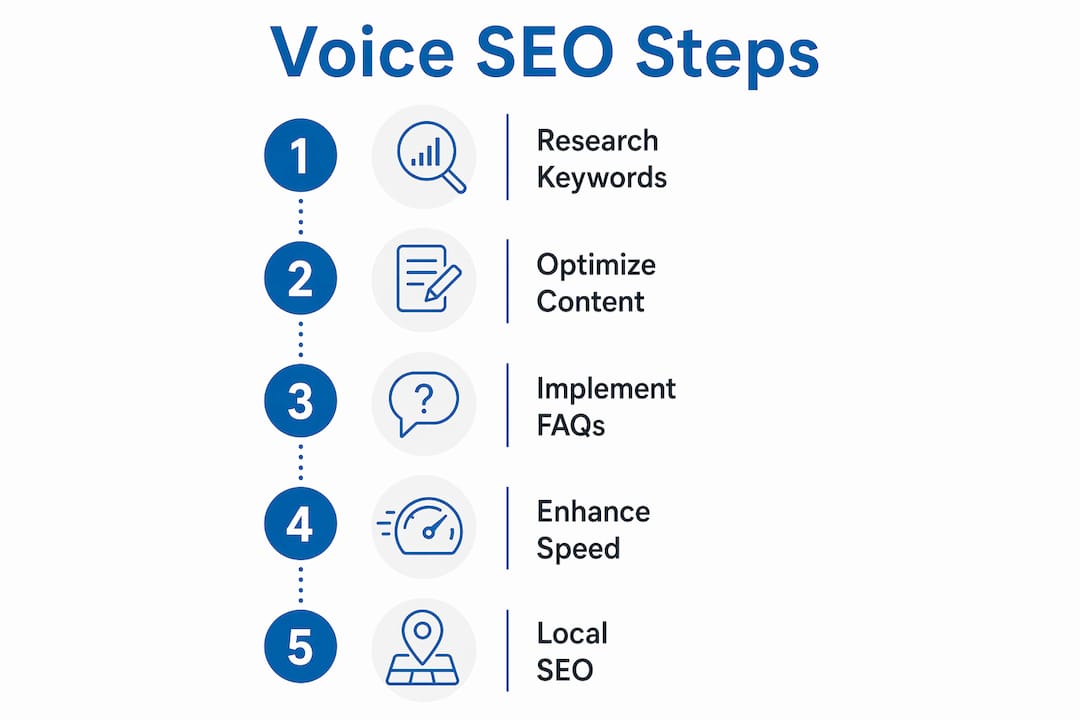
Using FAQ sections and structured data
FAQ sections are one of the most reliable voice SEO techniques available. They mirror the question-and-answer format that voice assistants prefer. Pair your FAQ content with FAQ schema markup so Google can parse the structure programmatically. For voice-specific content, Speakable schema markup tells Google which sections of your page are best suited for text-to-speech delivery. One critical caveat: Speakable schema only works if the underlying content is genuinely concise and answer-ready. Marking up a 200-word paragraph as speakable wastes the effort.
Technical requirements: speed and mobile performance
Here is a comparison of technical benchmarks for standard SEO versus voice SEO:
| Factor | Standard SEO target | Voice SEO target |
|---|---|---|
| Page load speed | Under 3 seconds | 4.6 seconds or faster (52% faster than average) |
| Mobile friendliness | Recommended | Required |
| Structured data | Helpful | Critical |
| Featured snippet ownership | Beneficial | Primary ranking signal |
| Content answer length | Varies | 23 to 41 words per answer |
Pro Tip: Run your site through Google PageSpeed Insights and target a mobile score above 90. Voice search queries come predominantly from mobile devices, and a slow mobile experience disqualifies you before the content even matters.
The numbered steps for a technical voice SEO audit are straightforward:
- Test mobile page speed using Google PageSpeed Insights.
- Confirm your site uses HTTPS across all pages.
- Implement FAQ schema and Speakable schema where content qualifies.
- Audit your featured snippet positions in Google Search Console.
- Check that your core pages load in under 4.6 seconds on a 4G connection.
Why local SEO is the anchor of voice search strategy
Local intent drives a significant share of voice queries. When someone asks “where is the nearest hardware store?” or “what time does the pharmacy close?” they expect an immediate, location-specific answer. Local SEO is critical for voice searches, and Google Business Profile is the single most important asset you can optimize for this channel.
Your Google Business Profile should include:
- NAP consistency: Name, address, and phone number must match exactly across every directory and citation.
- Business hours: Keep them current, including holiday hours, because voice assistants read this data directly.
- Products and services: List every offering with keyword-rich descriptions.
- Reviews: Actively collect and respond to reviews. Google factors review quantity and recency into local pack rankings.
- Photos and posts: Regular updates signal an active, credible business.
Local business schema markup reinforces what your Google Business Profile communicates. It tells search engines your business type, location, hours, and service area in a format machines can read without ambiguity. Pair this with local landing pages that target city-specific or neighborhood-specific queries, and you create multiple entry points for voice-driven local traffic.
| Local voice SEO tactic | Primary benefit |
|---|---|
| Google Business Profile optimization | Appears in “near me” voice results |
| Local business schema markup | Improves machine readability of location data |
| City-specific landing pages | Captures long-tail local voice queries |
| NAP citation consistency | Builds trust signals for local ranking |
The businesses that win local voice searches are not necessarily the biggest. They are the most precisely optimized. A New Jersey plumber with a fully built-out Google Business Profile and local schema will outrank a regional chain that has neglected its local SEO fundamentals.
How AI and mobile-first indexing are reshaping voice SEO
The technical environment around voice search is shifting fast. Three forces are converging: mobile-first indexing, AI language models, and passage indexing. Understanding how they interact helps you build a strategy that holds up as search continues to evolve.
Mobile-first indexing means Google primarily uses the mobile version of your site to determine rankings. Since most voice queries originate on mobile devices, a poor mobile experience directly suppresses your voice search visibility. This is not a future concern. It is the current reality. Bigfinseo covers the specifics of mobile performance in depth for teams that need a technical roadmap.
AI language models now influence which passages get selected for voice and generative search answers. AI and LLMs shape voice results by favoring content that is clear, conversational, and logically structured. This means writing in plain sentences, using descriptive subheadings, and avoiding dense blocks of text. The same content qualities that help you rank in AI-generated answers also help you rank in voice results. That convergence is not a coincidence.
Consider these emerging factors shaping voice SEO in 2026:
- Passage indexing: Google can rank individual passages from a page, not just the page as a whole. Well-structured content with clear H2 and H3 headings gives every section a chance to surface independently.
- Generative AI answers: Platforms like Google’s AI Overviews pull from authoritative, well-formatted content. The same optimization principles apply as for voice.
- Multimodal search: Voice, text, and image search are converging. Content optimized for one channel increasingly benefits the others.
- Zero-click results: Voice search is the ultimate zero-click experience. Your goal is to be the answer, not just rank on the page.
Pro Tip: Think of your content as a series of self-contained answers rather than one long narrative. Each section should be able to stand alone as a response to a specific question. This structure serves voice assistants, AI models, and human readers equally well.
The future of search is one where voice, typed queries, and AI-generated results feed from the same pool of well-structured, authoritative content. Optimizing for voice SEO today is not a separate track. It is preparation for where all search is heading.
Key takeaways
Voice search optimization succeeds when you combine natural language content, technical performance, local SEO precision, and structured data into a single, unified strategy.
| Point | Details |
|---|---|
| Voice queries are conversational | Write content that answers full questions, not keyword fragments, to match spoken search patterns. |
| Featured snippets drive voice results | Own position zero by structuring content with a direct 30 to 40 word answer under each question heading. |
| Local SEO is non-negotiable | Optimize your Google Business Profile and add local schema to capture “near me” voice traffic. |
| Technical speed matters | Pages must load in 4.6 seconds or faster on mobile to compete for voice search rankings. |
| AI and voice share the same signals | Clear, structured, conversational content ranks in both voice results and AI-generated search answers. |
Voice SEO is not a side project. It’s the main event.
I’ve worked with enough digital marketers and business owners to know the common mistake: treating voice search as a checkbox rather than a channel. Teams add a few FAQ sections, call it done, and wonder why their voice visibility doesn’t move. The problem is almost always that the underlying content was written for a search engine, not for a person speaking out loud.
The most effective voice SEO work I’ve seen starts with a simple exercise. Read your content aloud. If it sounds stiff, robotic, or like a keyword list dressed up as a sentence, it will not perform in voice search. Voice assistants are essentially reading your content to a human being. That human needs to hear a clear, confident answer, not a paragraph that was written to hit a keyword density target.
The other thing I’d push back on is the idea that voice SEO is technically complex. The fundamentals, which are page speed, mobile performance, structured data, and natural language content, are the same fundamentals that make any page rank well. Voice SEO is not a separate discipline. It is modern SEO best practices applied with a spoken-word lens. If you are already doing solid SEO work, you are closer to voice readiness than you think. The gap is usually in content tone and schema implementation, not in some mysterious technical layer.
The businesses that will lead in voice search over the next few years are the ones treating it as an extension of their broader digital strategy, not a one-time project. Stay curious, keep testing, and write for the person asking the question.
— Big
Ready to chart your course in voice search?
Voice search is one of the fastest-moving channels in digital marketing, and getting the fundamentals right now puts you well ahead of competitors still writing for 2018 search behavior. Bigfinseo helps businesses across New Jersey and beyond build SEO strategies that account for voice, AI, and every shift on the horizon.

Whether you are starting from scratch or refining an existing strategy, our SEO for beginners resource gives you a clear, practical foundation. From technical audits and schema implementation to local SEO and content strategy, Bigfinseo brings the expertise to help your business get found, whether someone types their query or speaks it. Let’s build something that lasts.
FAQ
What is voice search optimization in simple terms?
Voice search optimization is the process of structuring your website content and technical setup so voice assistants like Google Assistant, Siri, and Alexa can find and deliver your content as a spoken answer. It focuses on natural language, fast page speed, and featured snippet positioning.
How do I optimize for voice search?
Target long-tail, question-based keywords, write concise answers of 23 to 41 words under each question heading, implement FAQ and Speakable schema markup, and optimize your site for mobile. Local businesses should also fully build out their Google Business Profile.
Why does local SEO matter for voice search?
A large share of voice queries carry local intent, such as “near me” searches for restaurants, services, or store hours. Google pulls these answers directly from Google Business Profiles and local schema data, making local SEO the most direct path to voice visibility for brick-and-mortar businesses.
How do I measure voice search performance?
Direct voice search traffic data is not available in most analytics platforms. The best approach is to use proxy metrics like featured snippets, local pack rankings, and Q&A position tracking to gauge how well your content is performing in voice-driven results.
Does AI affect voice search rankings?
AI language models now play a direct role in selecting which content gets surfaced in voice and generative search answers. AI models favor structured, conversational content, which means the same writing practices that improve voice SEO also improve your visibility in AI-generated search results.

Michael Fleischner is the founder of Big Fin SEO, a New Jersey-based local SEO agency helping service-area and multi-location businesses increase visibility, generate qualified leads, and drive measurable revenue from search.
He is a TEDx speaker, Amazon-published author of The 7 Figure Freelancer, and a frequent speaker on SEO, AI-driven marketing, and personal branding.



 Corine R.
 Laura A.