

TL;DR:
- Tracking SEO metrics in 2026 helps connect marketing efforts to actual business outcomes and revenue. Modern measurement layers include health, traffic, ranking, and AI visibility indicators to capture the full performance picture. Regular audits and updated tools enable businesses to respond quickly and optimize their SEO strategies effectively.
Tracking SEO metrics is the practice of analyzing specific performance indicators to measure how well your SEO efforts contribute to traffic, visibility, and revenue. Organic search drives 53% of all website traffic and assists in up to 40% of customer conversions. That scale makes SEO one of the most powerful channels in your marketing mix. Yet most business owners and marketing professionals still rely on outdated measurements that no longer reflect how search actually works. Tools like Google Analytics 4, Google Search Console, and AI visibility dashboards now give you a far more complete picture. The challenge is knowing which numbers to trust and which ones to retire.

Why track SEO metrics in 2026?
The core reason to track SEO metrics is simple: you cannot improve what you do not measure. SEO performance analytics, the formal term for this practice, connects your content and technical efforts directly to business outcomes like leads, sales, and revenue. Without consistent measurement, you are sailing without a compass.
AI-generated answers now handle a growing share of queries, making traditional ranking metrics insufficient on their own. A page that ranks number three on Google may receive far fewer clicks than it did two years ago because an AI Overview answers the question before users scroll. If you only watch your average keyword position, you will miss that shift entirely.
The biggest SEO performance gap is the measurement system, not the effort expended. Businesses that track the right indicators catch problems early, respond faster, and allocate budget where it actually produces results. That is the real importance of SEO metrics: they turn guesswork into a repeatable, data-driven process.
What are the most important SEO metrics to track?
Modern SEO measurement requires a layered approach. An effective SEO metrics dashboard in 2026 involves multiple layers: health indicators, traffic, ranking signals, and AI visibility indicators. Each layer answers a different question about your performance.
The four measurement layers are:
- Health metrics: Core Web Vitals, crawl errors, index coverage, and site speed. These tell you whether Google can access and understand your site.
- Traffic metrics: Organic sessions segmented by search intent (informational, navigational, transactional). Raw session counts alone are misleading.
- Ranking metrics: Topic cluster rankings and SERP real estate ownership, meaning how many featured snippets, People Also Ask boxes, and image packs you control.
- AI visibility metrics: How often your brand or content appears in AI Overviews, ChatGPT responses, and Perplexity answers. This is the newest and most critical layer for 2026.
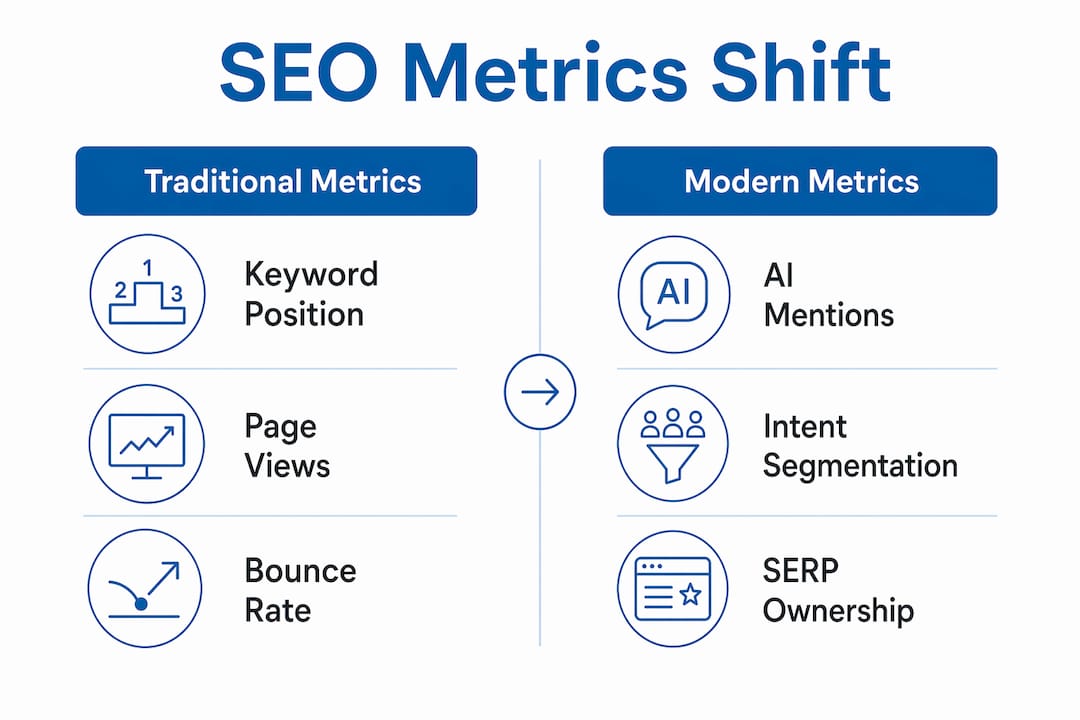
The table below shows how traditional metrics compare to modern alternatives:
| Traditional Metric | Modern Replacement | Why the Switch Matters |
|---|---|---|
| Average keyword position | Topic cluster rankings | Cluster rankings reflect authority, not just one query |
| Bounce rate | Engagement rate + scroll depth | GA4 replaced bounce rate with engagement rate in 2022 |
| Domain Authority | Conversion-weighted visibility | Revenue impact matters more than a third-party score |
| Raw organic traffic | Intent-segmented organic traffic | Traffic quality determines conversion potential |
| Page impressions | AI platform mention frequency | AI answers now intercept millions of queries before clicks |
Pro Tip: Connect Google Search Console to Google Analytics 4 so you can see which queries drive not just clicks but actual goal completions. That connection turns ranking data into revenue data.
Intent-segmented data and tracking SERP real estate ownership plus AI platform mentions are the metrics that separate forward-thinking teams from those still chasing outdated numbers. If you want to understand how AI changes what you measure, the shift is already underway.
Why is tracking SEO metrics crucial for business growth?
SEO metric tracking is a direct driver of business growth because it connects marketing activity to revenue outcomes. Here are the five most concrete benefits:
- Improved ROI clarity. Metrics aligned to revenue and topic authority justify SEO budget far more effectively than vanity numbers. When you can show that organic search contributed to 40% of closed deals, the investment becomes defensible.
- Early warning system. Consistent tracking reveals drops in impressions, CTR, or rankings early, enabling a timely response before a small dip becomes a revenue problem.
- Smarter content decisions. Tracking which topic clusters drive conversions tells your content team exactly where to focus next. You stop producing content by instinct and start producing it by evidence.
- Faster issue detection. Technical errors like broken internal links, slow page loads, or crawl blocks show up in health metrics before they tank your rankings.
- Competitive positioning. Monitoring SERP real estate and AI visibility tells you when a competitor is gaining ground in the spaces that matter most.
“Organic search has a low last-click conversion rate of roughly 2%, but an assisted conversion rate of around 40%. Measuring only last-click attribution means you are crediting SEO for 2% of its actual work.” — SEO Analytics, Emilytics
That assisted conversion reality is the single most important reason to modernize your analytics setup. Tracking SEO performance enables understanding which tactics produce results and helps you allocate resources with confidence rather than assumption.
Common pitfalls in SEO metric tracking
The most common mistake in SEO measurement is treating vanity metrics as proof of success. Metrics like Domain Authority and raw traffic numbers can mislead and should be replaced with intent-segmented data and AI visibility measurements. A site can double its organic traffic while conversions stay flat, which means the new traffic is the wrong traffic.
Watch out for these specific traps:
- Standalone traffic growth. Raw traffic growth is just a diagnostic indicator. CTR and visibility context are needed to interpret it properly. Traffic without intent context tells you almost nothing useful.
- Average keyword position. In a world of AI Overviews and zero-click searches, traditional metrics like average keyword position are outdated. A position-two ranking for a query that triggers an AI Overview may deliver zero clicks.
- Last-click attribution only. Relying solely on last-click data causes you to undervalue SEO’s contribution to the customer journey. GA4’s assisted conversion reports fix this blind spot.
- Ignoring AI visibility. If your content does not appear in AI-generated answers on platforms like ChatGPT or Perplexity, you are invisible to a growing segment of searchers. This is not a future problem. It is a current one.
Pro Tip: Set a quarterly metric audit. Review your KPI list and ask: “Does this number connect to a business outcome?” If the answer is no, retire it. Replace it with a metric that ties to leads, revenue, or customer acquisition.
SEO monitoring exposes growth opportunities and supports sustainable rankings, but only when the metrics you monitor are the right ones. Garbage in, garbage out applies to analytics just as much as it does to content.
How to effectively track SEO performance
Building a reliable SEO analytics system requires three things: the right tools, a clear measurement stack, and a consistent review cadence. Here is how to set it up.
Step 1: Install and connect your core tools.
- Google Analytics 4 for traffic, engagement, and conversion data
- Google Search Console for impressions, CTR, and query-level performance
- A rank tracker like Semrush or Ahrefs for topic cluster monitoring
- An AI visibility tool or manual audit process to track brand mentions in ChatGPT, Perplexity, and Google AI Overviews
Step 2: Build your three-layer measurement stack.
| Layer | What You Measure | Tool |
|---|---|---|
| Visibility | Impressions, AI mentions, SERP features | Search Console, AI audits |
| Engagement | Organic sessions by intent, scroll depth, time on page | Google Analytics 4 |
| Business results | Assisted conversions, revenue attribution, lead quality | GA4 + CRM integration |
Step 3: Set up conversion tracking and CRM integration. Connect GA4 goals to your CRM so you can see which organic queries produce actual customers, not just form fills. This is where SEO metrics for growth become real.
Step 4: Build a dashboard that combines all three layers. Looker Studio connects GA4 and Search Console data into a single view. Add a manual column for AI visibility scores and you have a complete picture.
Step 5: Review on a set schedule. Weekly checks for technical health, monthly reviews for traffic and ranking trends, and quarterly audits for AI visibility and conversion attribution. This cadence keeps you ahead of problems rather than reacting to them.
For a deeper look at AI search optimization metrics, the measurement approach is evolving fast. The new rules of SEO following AI updates require you to expand your measurement stack beyond what Google Search Console alone can show.
Key takeaways
Tracking SEO metrics is not optional in 2026. It is the foundation that connects every SEO activity to measurable business outcomes, from organic visibility to assisted revenue.
| Point | Details |
|---|---|
| Organic search impact | Organic search assists in up to 40% of conversions, far beyond what last-click data shows. |
| Modern metric layers | Track health, traffic, ranking, and AI visibility together for a complete performance picture. |
| Vanity metrics risk | Domain Authority and raw traffic numbers mislead. Replace them with intent-segmented and revenue-tied KPIs. |
| AI visibility is now | Track brand mentions in ChatGPT, Perplexity, and AI Overviews or risk missing a growing share of search traffic. |
| Consistent review cadence | Weekly, monthly, and quarterly reviews catch issues early and keep your SEO strategy on course. |
What i have learned after years of watching businesses measure the wrong things
The pattern I see most often is this: a business owner checks their organic traffic every month, sees it going up, and assumes SEO is working. Then six months later, leads are flat and no one can explain why. The traffic was real. The intent was wrong.
The shift that changes everything is moving from measuring activity to measuring outcomes. When we started integrating assisted conversion data for clients at Bigfinseo, the reaction was almost always surprise. SEO was contributing to 35–45% of closed deals that had been credited entirely to paid search or direct traffic. That is not a small rounding error. That is a strategic misread that was costing those businesses real budget.
The AI visibility piece is where I see the next blind spot forming. Most teams are not tracking whether their content appears in AI-generated answers at all. They are still optimizing for a version of Google that no longer exists. The AI-driven SEO changes happening right now require a measurement update, not just a content update.
My honest recommendation: spend one hour this week auditing your current KPI list. Remove anything that does not connect to a business outcome. Add AI visibility as a tracked indicator. Then set a monthly review date and stick to it. The businesses that win in search over the next two years will not be the ones with the biggest budgets. They will be the ones with the clearest picture of what is actually working.
— Big
Ready to track what actually moves the needle?
At Bigfinseo, we work with business owners and marketing professionals who are done guessing and ready to build a measurement system that connects SEO directly to growth. Whether you are just getting started or looking to modernize an existing analytics setup, we have the tools and experience to help you chart a clear course.

If you are new to SEO measurement, our SEO for beginners guide is the right place to start. It walks you through the foundations without the jargon. For businesses ready to track AI visibility and stay ahead of generative search changes, our AI optimization services are built exactly for that challenge. The shoreline is shifting. Let’s make sure your analytics are pointed in the right direction.
FAQ
Why track SEO metrics at all?
Tracking SEO metrics shows you which efforts drive traffic, conversions, and revenue. Without measurement, you cannot identify what is working or fix what is not.
What are the key SEO performance indicators in 2026?
The most important indicators are intent-segmented organic traffic, assisted conversions, topic cluster rankings, SERP feature ownership, and AI platform visibility. Traditional metrics like average position and bounce rate are no longer sufficient on their own.
How does organic search assist in conversions?
Organic search acts as an assisting channel in up to 40% of conversions, meaning it touches the customer journey even when another channel gets the last click. GA4 attribution reports reveal this contribution.
What tools do i need to track SEO performance?
Google Analytics 4 and Google Search Console cover the core of traffic and ranking data. Add a rank tracker like Semrush or Ahrefs for topic cluster monitoring, and conduct regular manual audits for AI visibility across platforms like ChatGPT and Perplexity.
How often should i review my SEO metrics?
Review technical health weekly, traffic and ranking trends monthly, and full conversion attribution quarterly. This cadence keeps you ahead of algorithm changes and content decay before they affect revenue.

Michael Fleischner is the founder of Big Fin SEO, a New Jersey-based local SEO agency helping service-area and multi-location businesses increase visibility, generate qualified leads, and drive measurable revenue from search.
He is a TEDx speaker, Amazon-published author of The 7 Figure Freelancer, and a frequent speaker on SEO, AI-driven marketing, and personal branding.


 Corine R.
 Laura A.