

TL;DR:
- Website development goes beyond design, encompassing coding, server setup, and ongoing maintenance to support business growth. A well-maintained, technically optimized site improves search rankings, user experience, and lead conversion in competitive markets. Continuous updates and improvements are essential to ensure the website remains a strategic asset that drives long-term success.
Your website is not just a digital brochure. It’s the engine behind your lead generation, your brand credibility, and your search rankings. Many business owners and marketing managers in New Jersey treat website development as a one-time design project, then wonder why their site fails to convert visitors or rank on Google. This guide cuts through that misconception and shows you exactly what website development covers, why it matters for your bottom line, and how to put it to work for your business in a competitive market.
Key Takeaways
| Point | Details |
|---|---|
| Development goes beyond design | A successful website requires both technical foundations and a user-centered interface. |
| Front-end and back-end matter | Both visible and behind-the-scenes components affect site performance and results. |
| SEO relies on development | Optimized development directly impacts search ranking and user engagement. |
| Business goals drive strategy | Smart development aligns the website with lead generation and marketing outcomes. |
| Continuous improvement is key | Regular website updates ensure your business stays competitive and relevant. |
Defining website development: More than design
When most people hear “website development,” they picture color palettes, fonts, and logo placement. That’s design, and while design matters, it’s only the surface layer. True website development is a much broader discipline.
Website development covers every layer of how a site is built, maintained, and improved over time. According to the MDN Learn Web Development curriculum, website development is the process of creating and maintaining websites and related web applications, including the work needed for both the site’s user-facing experience and the code, server, and database that make it function.
Think of it like a ship. The paint job and deck furniture are what passengers see. But the hull, the engine room, and the navigation systems are what actually keep the vessel moving. Both matter. Neither works without the other.
Here’s what website development actually includes:
- Front-end development: The visual interface users interact with, including layout, buttons, forms, and animations
- Back-end development: Server-side logic, databases, APIs, and the code that powers dynamic content
- Performance optimization: Page speed, caching, and code efficiency that keep the site fast
- Security: SSL certificates, firewalls, and data protection protocols
- Ongoing maintenance: Updates, bug fixes, and feature additions that keep the site current
“A website is never truly finished. The most successful businesses treat their site as a living asset, not a completed project.”
When your development is solid across all these areas, your site becomes a true business tool. It attracts the right visitors, guides them toward action, and supports every marketing channel you invest in.
The building blocks: Front-end vs. back-end development
With the basics covered, it helps to break website development into its main technical components so you know where your investment is going and why it matters.
Front-end development is everything a visitor sees and touches. It’s built with HTML (the structure of a page), CSS (the styling and layout), and JavaScript (the interactivity). The MDN Learn Web Development curriculum describes creating web pages using HTML and styling with CSS as the foundational front-end building blocks every developer starts with.

When a visitor clicks a button, fills out a contact form, or watches a product image zoom in, that’s front-end code doing its job. Poor front-end work leads to broken layouts on mobile devices, slow-loading pages, and confusing navigation. All of these issues drive visitors away before they ever become leads.
Back-end development is the engine room. It includes the server that hosts your site, the database that stores your content and customer data, and the application logic that connects everything together. When someone submits a contact form on your site, the back-end processes that request, stores the data, and sends you a notification. Without a solid back-end, none of that works reliably.
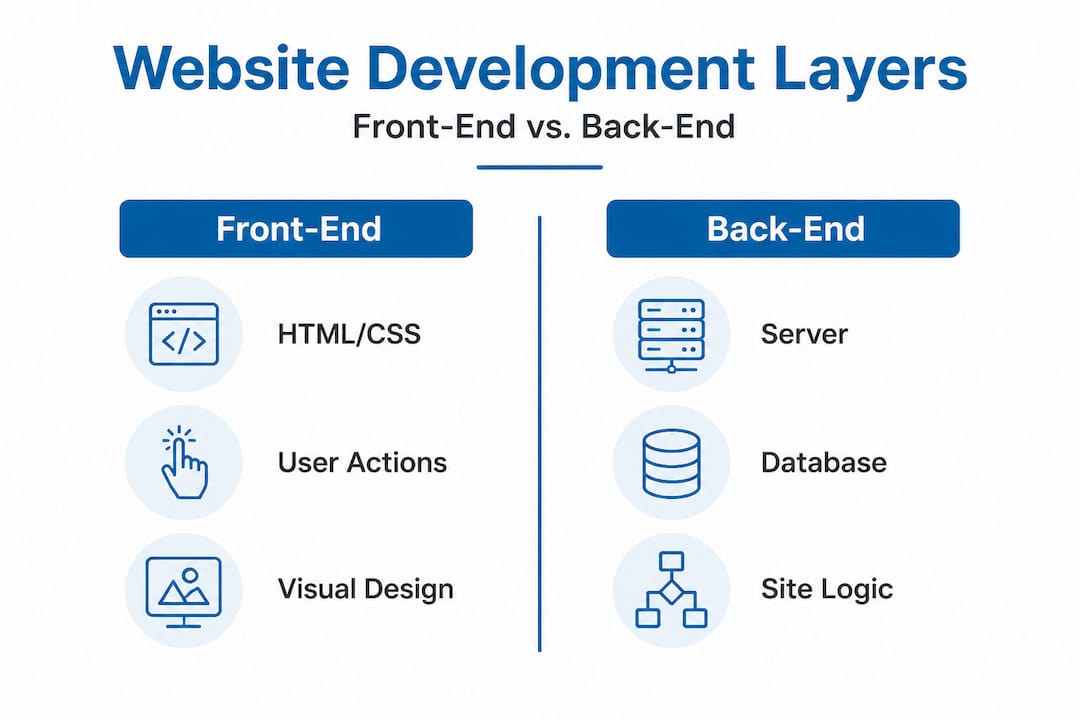
Here’s a quick comparison to show how each layer affects your business:
| Feature | Front-end impact | Back-end impact |
|---|---|---|
| Page load speed | Optimized images, lean CSS/JS | Server response time, caching |
| Mobile experience | Responsive design, touch-friendly UI | Fast API calls, efficient queries |
| Lead capture | Form design, CTA placement | Form processing, data storage |
| Security | HTTPS display, input validation | Server security, database protection |
| SEO performance | Structured content, meta tags | Site architecture, URL structure |
| Scalability | Flexible layouts | Database and server capacity |
Both layers work together. A beautifully designed front-end sitting on a slow, poorly configured server will still frustrate users and tank your rankings. Conversely, a lightning-fast back-end paired with a confusing interface won’t convert visitors into customers.
Pro Tip: When evaluating a web development partner, ask them specifically how they handle both front-end performance and back-end server configuration. If they only talk about design, that’s a red flag.
A well-developed site also creates a stronger lead funnel, guiding visitors from their first click through to a conversion. Every technical decision, from button placement to server response time, either supports or undermines that journey.
Why development matters for SEO and business growth
Understanding the technical elements, let’s see how they drive real results for New Jersey businesses competing for attention online.
Search engines like Google don’t just read your content. They evaluate how your site is built. The MDN Learn Web Development curriculum covers core concepts around how browsers render pages and how web standards affect site performance, which directly ties into how search engines crawl and index your content.
Here’s the reality: a poorly developed site can have outstanding content and still rank below competitors whose sites are technically superior. Google’s ranking systems reward fast, accessible, well-structured websites. That’s not a design question. That’s a development question.
Here are the key ways development directly drives business growth:
-
Page speed: Google uses Core Web Vitals as ranking signals. Sites that load in under 2.5 seconds consistently outperform slower competitors. This is a back-end and front-end optimization challenge, not a content one.
-
Mobile-first indexing: Google now indexes the mobile version of your site first. If your mobile experience is broken or slow, your rankings suffer regardless of how good your desktop site looks.
-
Crawlability: Search engines use bots to crawl and index your pages. A clean URL structure, proper use of sitemaps, and logical internal linking make it easier for bots to understand and rank your content. You can explore website optimization strategies that address these technical foundations.
-
Structured data: Schema markup is a form of code that tells search engines exactly what your content means. Adding it to your site can earn rich results in search, like star ratings and FAQ dropdowns, that increase click-through rates significantly.
-
Accessibility: Sites built with accessibility in mind, using proper heading hierarchies, alt text, and keyboard navigation, tend to perform better in search because these practices align with how search engines read content.
-
Security signals: HTTPS is a confirmed ranking factor. A site without an SSL certificate sends a warning to both visitors and search engines. Proper back-end security setup is non-negotiable.
Pro Tip: Run your site through Google’s PageSpeed Insights tool monthly. The report will flag specific development issues that are hurting your performance scores, giving you a clear action list for your developer.
Solid on-page SEO practices and strong development work together. One without the other leaves significant ranking potential on the table. And when your site ranks higher, your lead generation improves naturally because more qualified visitors find you before they find your competitors.
Making website development actionable for New Jersey businesses
Ready for actionable insights? Here’s how to put website development to work for your business right now.
New Jersey’s digital market is competitive. Whether you’re serving clients in Newark, Princeton, Cherry Hill, or along the Shore, your potential customers are searching online before they ever pick up the phone. A technically strong website is your first impression and often your most powerful sales tool.
Here are the development priorities every NJ business owner and marketing manager should focus on:
- Audit your current site speed using free tools like Google PageSpeed Insights or GTmetrix. If your scores are below 70 on mobile, that’s costing you rankings and leads.
- Confirm your site is mobile-responsive by viewing it on multiple devices. Check that forms work, buttons are tappable, and text is readable without zooming.
- Review your URL structure. Clean, descriptive URLs like "/services/web-design
perform better than/page?id=42`. This is a development fix, not a content one. - Check for broken links and 404 errors using tools like Screaming Frog or Google Search Console. These errors frustrate users and signal poor site quality to search engines.
- Implement SSL if you haven’t already. Your hosting provider can typically activate this within minutes, and it immediately removes the “Not Secure” warning from browsers.
- Set up Google Analytics and Search Console so you can track website engagement analytics and understand how visitors interact with your site.
Here’s a practical mapping of business objectives to the website components that support them:
| Business objective | Key website component | Development priority |
|---|---|---|
| Generate more leads | Contact forms, landing pages | Front-end UX, back-end form processing |
| Rank higher on Google | Site speed, structure, schema | Full-stack optimization |
| Build brand credibility | Professional design, fast load | Front-end performance |
| Serve local NJ customers | Local SEO, Google Business integration | On-page and technical SEO |
| Reduce bounce rate | Mobile experience, page speed | Front-end and server optimization |
| Scale content marketing | CMS flexibility, blog architecture | Back-end content management |
The MDN Learn Web Development curriculum emphasizes that understanding how browsers render pages and how web standards work is foundational to building sites that perform well across all devices and platforms. For business owners, that translates to one clear takeaway: the technical quality of your site determines how many people find it and how many stay.
Investing in website optimization techniques is not a luxury. For NJ businesses competing in crowded local markets, it’s the difference between being found and being invisible.
The truth most business owners miss about web development
Here’s the perspective most web development articles won’t give you, because it’s uncomfortable: the biggest mistake we see NJ businesses make is treating their website like a finished product.
They invest in a new site, celebrate the launch, and then leave it untouched for three or four years. Meanwhile, Google updates its algorithm dozens of times. Mobile usage patterns shift. Competitors rebuild their sites. New schema markup opportunities emerge. And that “finished” website quietly loses ground in the rankings month after month.
Web development is not a destination. It’s a voyage. The businesses that treat their site as an ongoing strategic asset, updating content, improving performance, testing new features, and adapting to algorithm changes, consistently outperform those that don’t. We’ve seen this pattern repeat itself across dozens of New Jersey clients.
The counterintuitive truth is that the businesses with the most outdated sites often think they’re saving money by not investing in development. What they’re actually doing is paying a hidden tax in the form of lost rankings, lower conversion rates, and missed leads. That cost is real, even if it doesn’t show up on an invoice.
Strategies that increase your online leverage always include a development component because your website is the foundation everything else is built on. Your SEO, your paid ads, your social media, all of it drives traffic back to your site. If the site is weak, every other marketing dollar you spend is less effective.
The businesses that win online are the ones that captain their web presence with intention, making regular improvements and staying ahead of the current rather than waiting for a crisis to force a rebuild.
Enhance your web presence with expert help
Knowing what website development involves is the first step. Putting it into practice is where the real growth happens.

At Big Fin SEO, we work with New Jersey businesses to build and optimize websites that are engineered for search performance and lead generation. Whether you’re starting from scratch or improving an existing site, our team handles both the technical development and the SEO strategy that makes your investment pay off. Explore our professional website development services to see how we approach each project, or start with our beginner SEO guide if you’re newer to the digital marketing landscape. You can also review our website optimization tips for quick wins you can act on today. Let’s chart a course toward a stronger, more competitive web presence together.
Frequently asked questions
What does website development include beyond design?
It covers coding, server setup, database integration, and ongoing maintenance in addition to creating the look and feel of the site. As the MDN curriculum notes, development encompasses everything from the user-facing experience to the code, server, and database that make a site function.
How does website development impact SEO?
Proper development ensures fast load times, accessible content, and clean site structure, which are essential signals for search engine rankings. The MDN web standards framework highlights how browser rendering and web standards directly influence how search engines evaluate and index your pages.
Why should New Jersey businesses invest in website development?
A well-developed website helps local businesses stand out in competitive NJ markets, attract qualified visitors, and convert more of them into leads. Strong development practices create user-friendly experiences and site functions that align directly with business growth goals.
Is website development a one-time project or an ongoing process?
It should be treated as an ongoing strategic investment to keep pace with algorithm updates, changing user behavior, and evolving technology. Businesses that update and optimize their sites continuously consistently outperform those that treat development as a one-time task.
Article generated by BabyLoveGrowth

Michael Fleischner is the founder of Big Fin SEO, a New Jersey-based local SEO agency helping service-area and multi-location businesses increase visibility, generate qualified leads, and drive measurable revenue from search.
He is a TEDx speaker, Amazon-published author of The 7 Figure Freelancer, and a frequent speaker on SEO, AI-driven marketing, and personal branding.



 Corine R.
 Laura A.