

TL;DR:
- Investing in SEO is crucial because it drives the majority of high-intent traffic, leading to measurable revenue growth. Early and sustained SEO efforts build long-term visibility, reduce customer acquisition costs, and adapt to AI search, providing a durable competitive advantage. Avoid common pitfalls by aligning SEO strategies with business outcomes and technical health to maximize return on investment.
Most business owners hear “SEO” and picture slow timelines, unpredictable results, and a bill that’s hard to justify. That skepticism is understandable. But if you’ve been treating SEO as optional, you’re leaving serious revenue on the table. Results typically take 3-6 months to materialize, yes, but the businesses that start early are the ones that dominate their markets while competitors are still paying for every click. This guide breaks down exactly why invest in SEO is one of the smartest decisions you can make for long-term business growth, and how to make that investment count.
Key takeaways
| Point | Details |
|---|---|
| SEO drives the majority of traffic | Organic search generates 53% of all online traffic, making it the single most important channel for web visibility. |
| Early investment compounds over time | SEO builds momentum, and businesses that start sooner gain a durable advantage that paid ads simply cannot replicate. |
| AI search still runs on SEO fundamentals | Google’s generative AI features rely on the same quality signals, meaning your SEO work protects you across both search formats. |
| Tie SEO to revenue, not just rankings | Aligning SEO goals with lead targets makes the investment measurable and keeps leadership bought in. |
| Avoid common pitfalls to protect ROI | Unrealistic timelines, neglected technical health, and siloed teams are the top reasons SEO investments underperform. |
Why invest in SEO: the foundation of online visibility
SEO is not a trick you play on Google. It is the practice of making your website genuinely useful, credible, and accessible to both search engines and real human beings. When you do that well, you show up. When you do not, your competitors do.
Here is what makes this especially relevant right now. Google’s SEO fundamentals remain essential for both classic search results and the new generative AI-powered answers increasingly appearing at the top of the page. This is not two separate channels requiring two separate strategies. It is one discipline that covers both.
“SEO now means optimizing for Google rankings and generative AI simultaneously, since they rely on the same core quality and ranking systems.” — Google Search Central, 2026
What that means practically is that your investment in technical health, content quality, and site credibility does double duty. It gets you into the traditional blue links and into the AI-generated summaries that users increasingly rely on. If you want to understand how Google’s AI affects your rankings, it is worth seeing how closely the two are intertwined.
For business owners, this removes a concern that many have raised: “Do I need a separate AI strategy?” The answer is no. Invest in the SEO fundamentals, and you are already charting a course for visibility across the entire modern search experience.
Core business benefits of SEO investment
Let’s get specific about what SEO actually does for your bottom line, because vague promises about “visibility” do not pay the bills.
Traffic quality matters more than traffic volume. Organic search drives 44% of revenue share for small businesses, and that is not by accident. People who find you through organic search are actively looking for what you sell. They typed in a question or a need, and your site answered it. That is a fundamentally different kind of visitor than someone who saw a banner ad while scrolling through a news article.
Here is a breakdown of the core benefits that make SEO such a strong investment for business growth:
- Qualified lead generation. Organic visitors arrive with intent. A person searching “HVAC repair near me” or “best accounting software for freelancers” is already in buying mode. SEO puts you in front of them at the exact right moment.
- Brand credibility through content authority. Ranking consistently in search results signals expertise and trustworthiness to potential customers. People trust Google. When Google ranks you, that trust transfers.
- User experience improvements. Good SEO requires fast load times, mobile optimization, clean site structure, and logical navigation. These improvements serve your visitors directly and reduce bounce rates that kill conversions.
- Compounding reach over time. A well-optimized piece of content can generate traffic for months or even years. That is not something a paid ad does the moment your budget runs out.
Pro Tip: Connect your SEO work to lead generation metrics from day one. Track which pages bring in the most conversions, not just the most clicks, and you will have a much clearer picture of real business impact.
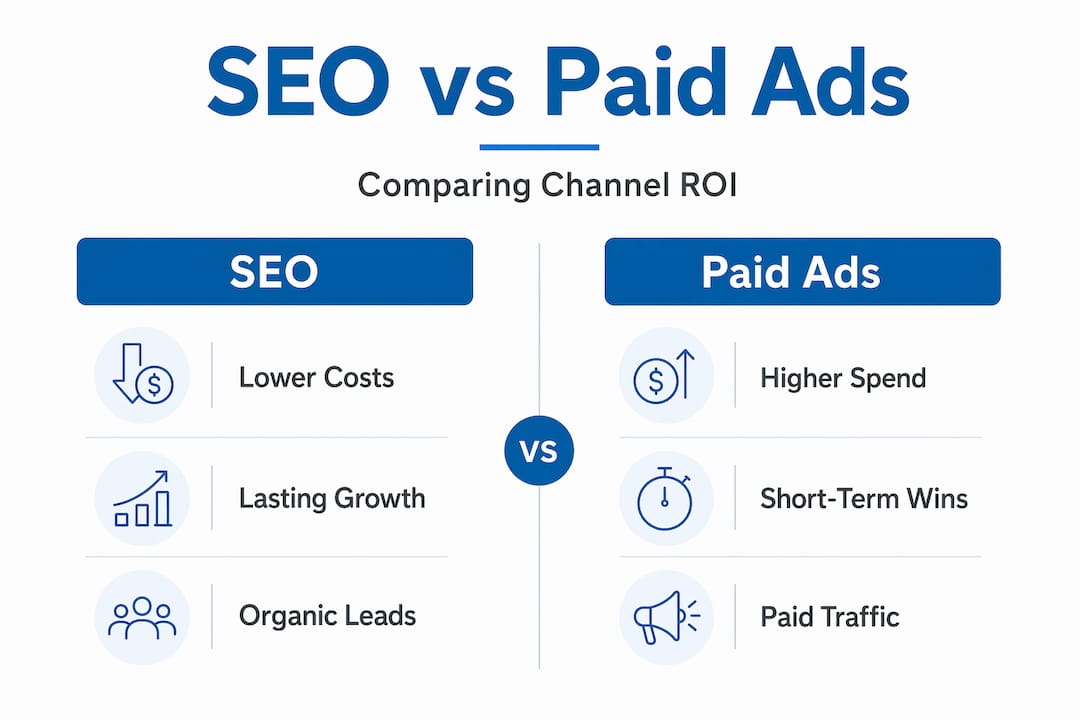
SEO ROI vs. paid channels
This is where most business owners get their eyes opened. Let’s put SEO and paid advertising side by side.

| Factor | SEO | Paid Ads (PPC) |
|---|---|---|
| Cost per click over time | Decreases as rankings improve | Stays the same or increases |
| Traffic when budget stops | Continues with maintenance | Stops immediately |
| Trust signal to users | High (organic results are trusted more) | Lower (labeled as ads) |
| Time to results | 3-6 months to gain traction | Immediate |
| Long-term value | Compounds and grows | Resets with each campaign |
Paid ads are not bad. At Bigfinseo, we run PPC campaigns for clients and we see the value in them, especially for fast launches or seasonal pushes. But SEO traffic compounds over time in a way that paid traffic fundamentally cannot. The longer you invest in SEO, the lower your effective cost per acquisition becomes. Paid ads, by contrast, keep charging you the same rate or more as competition drives up bid prices.
SEO reduces customer acquisition costs over time by replacing a portion of your paid traffic with sustainable organic growth. For a business spending $5,000 a month on Google Ads, even shifting 30% of that traffic to organic sources over 18 months represents significant savings, and those organic rankings do not disappear overnight.
Pro Tip: Calculate the “organic traffic value” of your SEO by multiplying your monthly organic visitors by your average cost-per-click in paid search. If you rank well for terms worth $8 per click and pull 2,000 visits per month, that is $16,000 in monthly equivalent ad spend your SEO is delivering for free.
Strategies for effective SEO planning
Knowing why to invest in SEO is one thing. Knowing how to do it well is another. Here is a practical framework for turning SEO investment into measurable business impact.
-
Start with your business outcome, not a keyword list. Modern SEO planning recommends reverse-engineering your goals from revenue and lead targets. If you need 50 new customers per month, work backward from conversion rates, traffic estimates, and close rates to determine the organic traffic volume you actually need. This gives your SEO a purpose that leadership can get behind.
-
Prioritize technical health first. Before you write a single piece of content, make sure your site loads fast, passes Core Web Vitals, is mobile-friendly, and has clean internal linking. A beautifully written article on a slow, broken site will never reach its ranking potential.
-
Build content authority around intent clusters. Group your content around the questions and problems your customers are already searching for. Do not chase individual keywords in isolation. Create topic clusters that signal to Google you are the authority on a subject, not just a one-page wonder.
-
Break down team silos. Structured SEO planning requires cross-team coordination between content writers, developers, and marketing managers. When these groups do not talk, you end up with fast pages that say nothing or brilliant content that Google cannot index properly.
-
Monitor the right metrics. Track organic sessions, keyword rankings, and backlinks, yes. But also track form submissions, phone calls, and revenue attributed to organic traffic. Tools like Google Search Console, GA4, and rank trackers give you the data you need to show stakeholders that SEO is earning its budget.
Pro Tip: Review your SEO roadmap quarterly, not annually. Search behavior shifts, competitor strategies evolve, and your own business priorities change. Quarterly reviews keep your strategy aligned with what actually matters right now.
Common SEO pitfalls to avoid
Even with the best intentions, many SEO investments underperform because of avoidable mistakes. These are the most common ones we see, and they are worth knowing before you get started.
- Expecting results in week three. SEO is not a light switch. Early indicators help demonstrate progress while the compounding effect builds, but anyone promising page-one rankings in 30 days is selling you something you do not want to buy.
- Measuring success by rankings alone. A position-one ranking for a term nobody searches is worth nothing. Tie your reporting to traffic, leads, and revenue from the start.
- Ignoring technical SEO. Slow load speeds, broken redirects, and duplicate content quietly sabotage every piece of content you produce. Technical debt compounds just like SEO value does, only in the wrong direction.
- Misaligning SEO execution with business leadership. Misalignment between SEO teams and leadership expectations is one of the most common failure points. If your CEO is expecting sales and your SEO team is reporting on domain authority, that gap will eventually kill the program’s budget.
- Neglecting local SEO for service businesses. For businesses that serve a specific geography, local SEO is not optional. It is the difference between being found by someone three miles away and being invisible to them.
My honest take on why SEO investment pays off
I’ve watched businesses in nearly every industry struggle with the same doubt: “Is this actually working?” The question usually comes around month two, right before things start to move.
Here is what I’ve learned from years of steering SEO strategies for businesses of all sizes. The companies that treat SEO as a long-term asset, the way they’d treat real estate or equipment, get results that genuinely transform their revenue mix. The ones that treat it as a short-term experiment cancel before the tide comes in.
What I’ve also found is that the most successful SEO programs are not the most technically sophisticated ones. They are the ones where the business owner understands what they are investing in and why. When leadership can connect organic traffic growth to actual pipeline, they stay the course. That patience is what separates the businesses riding high on the first page from the ones still paying full price for every click.
One more thing I feel strongly about: AI search is not the end of SEO. It is SEO’s expansion. The same fundamentals that made your site rank in 2020 are the ones that will get you cited in an AI-generated answer in 2026. That is a compelling reason to invest now rather than wait for the waters to settle. If you want to explore how AI shapes SEO strategy, the implications are worth understanding before your competitors do.
— Big
Ready to chart your SEO course?
At Bigfinseo, we work with business owners and marketing teams who are ready to stop wondering whether SEO is worth it and start seeing what it actually produces. Whether you are just getting oriented or looking to sharpen an existing strategy, we have the resources to get you moving.
Start with our SEO for beginners guide if you are early in the process. Or if you are ready to go deeper on technical optimization, our website SEO optimization tips walk you through five high-impact changes you can make right now. And for businesses that want to stay ahead of the AI-driven search shift, our AI optimization services are built specifically for where search is heading. Reach out and let’s plot a course for measurable, lasting growth together.
FAQ
Why invest in SEO instead of just running paid ads?
Paid ads stop the moment your budget does. SEO builds traffic that compounds over time, lowering your cost per acquisition the longer you invest in it. For sustainable growth, SEO and paid advertising work best together, with SEO carrying the long-term load.
How long does it take to see results from SEO?
Most businesses begin seeing meaningful results within 3-6 months of consistent SEO investment. Early indicators like crawl improvements and keyword indexing show progress sooner, but ranking gains and traffic growth build steadily over that window.
Does SEO still matter with AI-powered search?
Yes. Google’s generative AI search relies on traditional SEO best practices, meaning the same fundamentals that improve your Google rankings also increase your visibility in AI-generated answers. SEO is more relevant now, not less.
What is the most important factor in SEO success?
No single factor wins alone, but aligning your SEO strategy with specific business outcomes like lead volume and revenue is what separates high-performing programs from ones that get cut. Reverse-engineering SEO from business targets keeps the work grounded in real results.
How does SEO impact sales for small businesses?
Organic search contributes to 44% of revenue share for small businesses by driving high-intent visitors who are actively searching for what you sell. That intent-driven traffic converts at significantly higher rates than display or social advertising.

Michael Fleischner is the founder of Big Fin SEO, a New Jersey-based local SEO agency helping service-area and multi-location businesses increase visibility, generate qualified leads, and drive measurable revenue from search.
He is a TEDx speaker, Amazon-published author of The 7 Figure Freelancer, and a frequent speaker on SEO, AI-driven marketing, and personal branding.


 Corine R.
 Laura A.