

TL;DR:
- Social signals do not influence Google’s rankings directly, as Google cannot reliably read engagement data from social platforms.
- However, social media supports SEO indirectly through backlink opportunities, branded search growth, and referral traffic that positively impact search performance.
Most digital marketers assume a viral post boosts their Google rankings. It’s an intuitive leap. More engagement must mean more authority, right? The role of social media in SEO is far more nuanced than that, and understanding the actual mechanics separates professionals who get results from those who spin their wheels chasing likes. This guide cuts through the noise, addresses the biggest misconceptions head-on, and gives you a clear, evidence-based framework for making social media work for your SEO rather than as a distraction from it.
Key takeaways
| Point | Details |
|---|---|
| Social signals aren’t ranking factors | Google does not use likes, shares, or followers to rank pages in search results. |
| Indirect effects are real and measurable | Social media drives backlink opportunities, branded search volume, and referral traffic that do influence SEO. |
| Measurement tools have improved | Google Search Console now integrates social channel data, giving marketers better attribution for organic performance. |
| Quality beats quantity on every platform | Engagement depth and content quality matter more than follower counts for any SEO-linked social activity. |
| Integration requires a deliberate strategy | Combining social distribution with SEO-optimized content produces compounding results that neither channel achieves alone. |
The role of social media in SEO: what Google actually says
Here is where most strategies go sideways. Marketers see a correlation between high social engagement and strong search rankings and conclude one causes the other. Google has addressed this directly, and the answer is clear. Social signals are not direct ranking factors in Google’s algorithm. Spokespeople including John Mueller and Matt Cutts have confirmed this on multiple occasions.
Why can’t Google reliably use social data? Several practical reasons make it technically problematic:
- Social platforms actively restrict crawler access to protect user privacy, so Google cannot consistently read engagement data at scale.
- Metrics like likes and follower counts are trivially manipulated, making them unreliable quality signals.
- Data from social platforms changes rapidly, creating crawl freshness problems that search indexes aren’t built to handle.
- Google’s Feedfetcher crawler only processes RSS and Atom feeds after an explicit human request. It doesn’t actively seek out social engagement cues.
This distinction matters enormously for how you allocate your time and budget.
“We don’t use social signals in our ranking algorithm. The fact that a page has a lot of Facebook likes doesn’t help it rank higher in Google.” — Google’s position, consistently held across multiple spokespeople and years.
Google does crawl social media profile pages. It treats a Twitter/X profile or a Facebook business page the same way it treats any other public webpage. That means your profiles can rank in search results for branded queries, but the engagement those posts receive carries no algorithmic weight for ranking your main site. Understanding this distinction will save you from building a strategy on a foundation that doesn’t hold.
How social media indirectly supports SEO
Dismissing social media entirely would be a mistake. The indirect impact of social media on SEO is real, measurable, and worth building into your strategy. The key word is indirect. Think of social media as the wind in your sails rather than the engine itself.
Here are the primary mechanisms that matter:
-
Backlink acquisition through content amplification. When you publish a strong piece of content and distribute it through social channels, it gets in front of journalists, bloggers, and content creators who would otherwise never find it. Social amplification earns backlinks by exposing your work to linkers. Backlinks remain one of Google’s top confirmed ranking signals.
-
Branded search volume growth. As your social media presence grows, more people search for your brand name directly in Google. Branded search volume correlates strongly with higher organic rankings and qualified traffic. Google reads consistent branded search demand as a trust signal.
-
Referral traffic and engagement signals. Social channels drive visitors to your site. When those visitors spend time engaging with your content, Google notices. Lower bounce rates and longer session durations from socially referred traffic send positive behavioral signals that can influence rankings over time.
-
Faster content indexing. Sharing new content on social platforms encourages other sites to link to it and discuss it quickly. That activity generates the crawl triggers Google needs to index and evaluate the content faster than it would through passive discovery.
-
Platform-specific SEO value. Twitter/X and LinkedIn consistently outperform other platforms for earning SEO-relevant backlinks because they attract the journalists and content creators who actively link to original sources.
Pro Tip: Focus your social content distribution efforts on LinkedIn and Twitter/X before Instagram or TikTok if your primary goal is SEO lift. The audiences on those platforms are the ones most likely to link back to your content.
Measuring the social-SEO connection

Knowing that the connection exists is only useful if you can measure it. For years, attribution between social activity and SEO results was murky. That picture is getting clearer.
Google has introduced a meaningful update here. Search Console now includes social channel data, showing site owners the total reach of their associated social profiles and the search queries that lead users to those profiles. This lets you track how your organic search visibility spills over into social discovery and vice versa.
Here is a practical framework for measuring the social-SEO relationship:
| Tool | What to measure | Why it matters |
|---|---|---|
| Google Search Console | Social profile impressions and clicks from search | Tracks branded search spill into social discovery |
| Google Analytics 4 | Referral traffic from social channels | Identifies which platforms send engaged visitors |
| SEMrush or Ahrefs | Branded keyword volume over time | Correlates social campaigns with organic search lift |
| Social listening tools | Brand mention volume and sentiment | Early signals of earned media and link potential |
Tracking branded keyword performance over time is particularly telling. Run a significant social campaign, then track what happens to branded search volume in the following weeks. That connection is often stronger than most marketers expect.
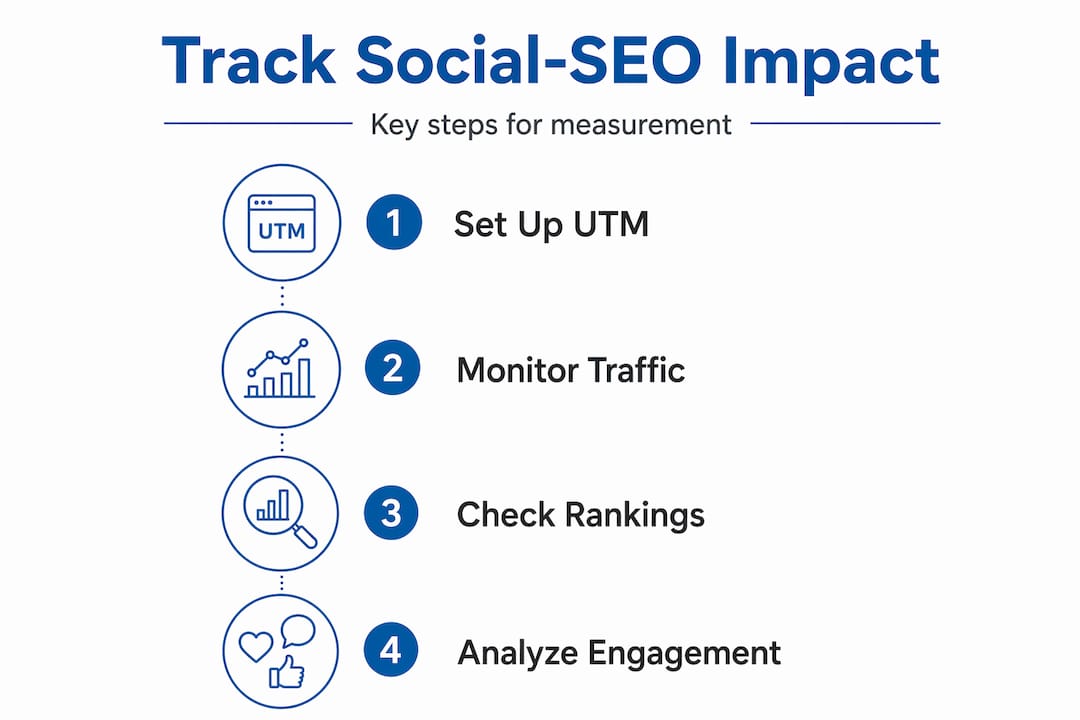
Pro Tip: Set up UTM parameters for every link you share on social platforms. This gives you clean data in Google Analytics to track which social posts actually drive traffic that converts or engages, rather than relying on platform-native analytics.
One critical warning: avoid the correlation trap. High social activity and strong rankings often appear together because both reflect good content, not because one causes the other. Use attribution modeling to identify actual causal paths, not just coincidences.
Myths vs. facts: what actually works
The social-SEO space attracts more bad advice than almost any other area of digital marketing. Before you commit resources, it helps to know what to discard.
Myths to stop believing:
- Buying social signals improves rankings. Google doesn’t trust manipulated social data, and paid engagement creates zero SEO value. It wastes budget and can damage your brand credibility.
- More followers means better SEO. Follower count is a vanity metric. A smaller audience that actively shares your content and generates backlinks outperforms a large passive one every time.
- Ignoring social media won’t hurt your SEO. While it isn’t a direct factor, abandoning social means abandoning a distribution channel that feeds backlinks, traffic, and branded search growth.
What actually works:
- Publish high-quality, link-worthy content and use social platforms primarily as distribution infrastructure.
- Build relationships with content creators and journalists in your niche on LinkedIn and Twitter/X. Those relationships generate the backlinks that do move rankings.
- Optimize your social profiles for branded search. A well-optimized LinkedIn company page or Twitter/X profile can rank on page one for your brand name, giving you more real estate in the search results.
- Use social listening to identify trending topics in your space and create SEO content around them before the competition catches on.
The core principle is simple: authoritative backlinks and quality content remain the primary verified ranking factors Google rewards. Social media supports the acquisition of both when used deliberately.
Building an integrated social and SEO strategy
Knowing the theory is one thing. Executing a system that makes both channels work together is where most marketing teams fall short. Here is a practical framework for getting it right.
-
Optimize your social profiles for search discovery. Use your primary keywords in your bio, description, and content headlines. Google crawls public social profiles, and optimized profiles rank for branded and category queries. Check out Bigfinseo’s guide on SEO fundamentals to align your profile optimization with your broader strategy.
-
Promote your best SEO-optimized content through social channels. Don’t share everything. Pick your highest-quality, most link-worthy pieces and give them sustained promotion across multiple platforms over several weeks rather than a single post.
-
Use social for link outreach. Before sending a cold email asking for a backlink, engage with the journalist or blogger on Twitter/X or LinkedIn. Warm outreach converts at significantly higher rates, and the relationship you build has compounding value.
-
Implement UTM parameters on every social link. Clean data lets you see exactly which platforms, posts, and campaigns drive SEO-relevant behaviors like backlinks and branded search.
-
Track and iterate monthly. Review your branded keyword volume, referral traffic from social, and new backlink acquisition together. Look for patterns and double down on the content types and platforms that show consistent correlation with organic performance improvements.
This kind of integrated approach to social media marketing treats social not as a standalone channel but as a distribution and relationship-building engine that fuels your SEO results over time.
My take on social media and SEO after years in the field
I’ve watched countless marketing teams burn budget on social media campaigns they expected to lift their Google rankings, only to find no connection in the data. The frustration is real. And I get why the misconception persists. When a brand has strong social presence and strong rankings, it looks like one drives the other.
Here is what I’ve actually learned: the brands that win in both channels don’t think of them separately at all. They create genuinely useful content, they get it in front of the right people through social distribution, and they measure what happens to their backlink profile and branded search volume over the following months. The results show up. They just don’t show up the way most people expect.
The mistake I see most often isn’t ignoring social media or overinvesting in it. It’s using social metrics as SEO KPIs. Likes and shares feel like progress. They can be completely disconnected from any SEO outcome. Anchor your strategy to metrics that actually track toward ranking improvements: backlinks earned, branded search volume, organic traffic from new referring domains. Social activity is upstream. Those outcomes are downstream. Keep your eyes on the downstream data.
If you feel like your social and SEO efforts aren’t talking to each other, that’s usually a sign you need a clearer content strategy, not more posts.
— Big
Ready to chart a stronger SEO course?
If this article clarified the relationship between social media and SEO but left you wondering where to start with your own strategy, Bigfinseo is built exactly for this kind of challenge. We work with digital marketers, business owners, and agencies across New Jersey and beyond to align their SEO fundamentals with their broader digital presence.
Start with our SEO for beginners guide to anchor your foundational strategy, or explore 5 ways to optimize your website to apply what you’ve learned today. Whether you need a full SEO strategy or want to sharpen a specific piece of your marketing engine, Bigfinseo has the expertise to help you move forward with confidence. The shoreline is closer than you think.
FAQ
Does social media directly affect Google rankings?
No. Google does not use social signals like likes, shares, or follower counts as direct ranking factors. This has been confirmed by multiple Google spokespeople including John Mueller and Matt Cutts.
How does social media help SEO indirectly?
Social media helps SEO by amplifying content to audiences that include journalists and bloggers who earn you backlinks, by driving referral traffic that improves engagement metrics, and by growing branded search volume that signals authority to Google.
What social platforms are best for SEO impact?
Twitter/X and LinkedIn are the most effective platforms for SEO-linked social activity because their audiences include the content creators and journalists most likely to link to original sources.
Can I track the impact of social media on my SEO?
Yes. Google Search Console now integrates social channel data, and tools like Google Analytics 4, SEMrush, and Ahrefs let you track branded keyword volume and referral traffic tied to your social activity.
Is buying social signals worth it for SEO?
No. Buying social signals provides zero SEO value because Google cannot trust manipulated engagement data and does not factor it into rankings. The budget is better invested in content quality and genuine link outreach.

Michael Fleischner is the founder of Big Fin SEO, a New Jersey-based local SEO agency helping service-area and multi-location businesses increase visibility, generate qualified leads, and drive measurable revenue from search.
He is a TEDx speaker, Amazon-published author of The 7 Figure Freelancer, and a frequent speaker on SEO, AI-driven marketing, and personal branding.



 Corine R.
 Laura A.