

TL;DR:
- Effective lead generation attracts and qualifies potential buyers, driving revenue through structured workflows.
- Most leads do not convert without proper nurturing, follow-up, and shared definitions between sales and marketing.
The lead generation process is the structured method businesses use to attract potential buyers, qualify them, and move them toward a purchase. Most marketers call this “demand generation” at the top of the funnel and “lead generation” once a prospect takes a trackable action. Both terms describe the same revenue engine. 83% of the B2B buyer’s journey is complete before a prospect ever contacts a vendor. That single fact reshapes every decision you make about content, channels, and timing. Without a structured workflow, 80% of new leads never convert into sales. A repeatable process fixes that.
What does an effective lead generation process require before you start?
Building a lead generation workflow without preparation is like setting sail without charts. You need three things locked in before you activate any channel: a clear picture of who you are targeting, shared definitions between sales and marketing, and the right tools to track everything.
Define your ideal customer profile and lead stages
Your ideal customer profile (ICP) describes the company type, industry, size, and role most likely to buy from you. Without it, every campaign targets the wrong audience. Alongside the ICP, sales and marketing must agree on two definitions. A Marketing Qualified Lead (MQL) is a prospect who meets ICP criteria and has shown enough engagement to warrant marketing attention. A Sales Qualified Lead (SQL) is an MQL that sales has reviewed and accepted as ready for direct outreach. Clear shared MQL and SQL definitions eliminate budget waste and prevent leads from falling through the cracks between teams.
Tools and infrastructure you need
The table below maps each process stage to the tool category that supports it.
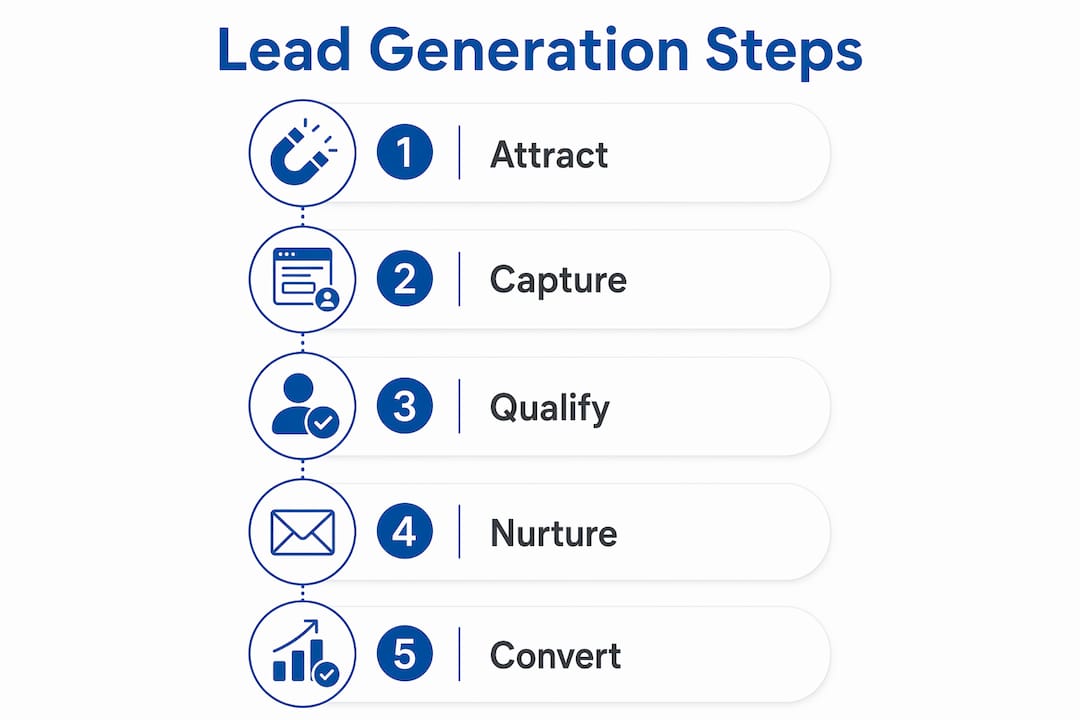
| Stage | Tool category | Primary job |
|---|---|---|
| Attract | SEO and paid media platforms | Drive targeted traffic to content and offers |
| Capture | Landing page and form builders | Convert visitors into identified leads |
| Qualify | CRM with lead scoring | Score and route leads by ICP fit and behavior |
| Nurture | Marketing automation | Run email sequences and retargeting campaigns |
| Measure | Analytics and attribution tools | Connect leads to revenue by channel |
Key infrastructure requirements before launch:
- CRM: Stores every lead record and tracks activity history across the funnel.
- Marketing automation: Triggers email sequences and follow-up tasks based on prospect behavior.
- Attribution tool: Links each lead back to the channel and campaign that created it.
- Analytics platform: Measures traffic, form completions, and conversion rates at each stage.
Setting up funnel design with explicit exit criteria at each stage is equally critical. Demand-state exit criteria based on behavioral signals and lead scores keep your pipeline accurate and prevent ambiguous lead movement. A full process, from funnel design through activation to reporting, typically takes 60 to 90 days to establish. Plan for that timeline before you promise pipeline numbers to leadership.
How do you design and activate an inbound lead generation workflow?
Inbound lead generation attracts buyers who are already researching solutions. Your job is to be visible, credible, and easy to engage with at every stage of that research. The steps below build a repeatable inbound engine.
-
Map content to buyer research stages. Early-stage buyers want education. Mid-stage buyers compare options. Late-stage buyers need proof. Create at least one content asset for each stage: a blog post or guide for awareness, a case study or webinar for consideration, and a demo or pricing page for decision.
-
Promote through the right channels. SEO drives long-term organic traffic from buyers actively searching for solutions. Paid search and social ads accelerate visibility for high-intent keywords. Organic social builds trust and keeps your brand visible between purchase cycles. Most successful lead generation strategies combine inbound engines for long-term leverage with outbound tactics for immediate pipeline needs.
-
Build capture mechanisms that convert. Every piece of content should point to a landing page with a single, clear offer. Keep forms short. Minimal form fields, typically name and email, maximize completion rates while feeding your nurture workflow with enough data to personalize follow-up.
-
Engage early with anonymous visitors. Web visitor identification tools let you see which companies are reading your content before they fill out a form. That data lets you prioritize outbound follow-up toward prospects already showing intent.
-
Optimize your conversion path. Test one variable at a time: headline, CTA button text, form length, or page layout. Small improvements compound quickly across high-traffic pages.
Pro Tip: Focus your lead generation tips on 3 to 4 tactics from 2 to 3 channels and run them consistently for a full quarter before changing anything. Scattered efforts produce noise. Focused execution produces data.
Common mistakes to avoid at this stage:
- Sending traffic to your homepage instead of a dedicated landing page.
- Using long forms that ask for budget, company size, and phone number before the prospect trusts you.
- Publishing content without a clear next step or offer attached.
- Ignoring mobile optimization when most research happens on phones.
How do you qualify, nurture, and convert leads after capture?
Capturing a lead is the beginning, not the finish line. Marketing qualified leads need a structured path from first touch to sales conversation. Without that path, most leads go cold.

Lead scoring and qualification
Lead scoring assigns points based on ICP fit (job title, company size, industry) and engagement behavior (pages visited, emails opened, content downloaded). A prospect who matches your ICP and has visited your pricing page three times scores higher than someone who downloaded one blog post six months ago. Set a score threshold that triggers MQL status, then have sales review each MQL within a defined window, typically 24 hours, to accept or reject it as an SQL.
Multi-touch nurture tactics
Not every lead is ready to buy when they first engage. Nurture sequences keep your brand present and build trust over time. Effective tactics include:
- Behavioral email sequences: Triggered by specific actions, such as downloading a guide or visiting a product page, these emails deliver relevant content at the right moment.
- Retargeting ads: Keep your brand visible to prospects who visited your site but did not convert. Social proof in retargeting accelerates the sales cycle by reducing buyer hesitation.
- Personalized content recommendations: Send case studies or testimonials that match the prospect’s industry or pain point.
- Direct outreach triggers: When a lead hits SQL score, alert the sales rep immediately. Timely follow-up is the single biggest driver of conversion after qualification.
Pro Tip: Build trigger-based sequences that adapt to behavior. If a prospect opens three emails but never clicks, switch the channel. Try a LinkedIn message or a direct call instead of another email.
Avoid chasing vanity metrics like total leads generated or email open rates. Those numbers feel good but do not predict revenue. Track pipeline created, SQL-to-close rate, and cost per acquired customer instead. Conversion-focused metrics drive more reliable pipeline growth than dashboard numbers that look impressive but lack revenue connection.
How do you measure and continuously improve your lead generation results?
A lead generation workflow without measurement is guesswork. You need a small set of metrics tracked consistently across every funnel stage to know what is working and what needs fixing.
Key metrics to track
| Funnel stage | Metric | What it tells you |
|---|---|---|
| Attract | Organic sessions, ad impressions | Channel reach and traffic quality |
| Capture | Form completion rate, cost per lead | Offer and landing page effectiveness |
| Qualify | MQL-to-SQL rate | Lead quality and scoring accuracy |
| Nurture | Email click-through rate, retargeting CTR | Content relevance and timing |
| Convert | SQL-to-close rate, pipeline value | Sales efficiency and deal quality |
Attribution and troubleshooting
Attribution models connect each lead to the channel and campaign that influenced it. First-touch attribution credits the channel that brought the prospect in. Last-touch credits the channel that drove conversion. Multi-touch attribution distributes credit across every interaction. Multi-touch gives the most accurate picture for complex B2B sales cycles.
Pro Tip: Review your funnel metrics monthly, not quarterly. A monthly cadence catches problems early, before a bad month becomes a bad quarter. Look for the stage where the biggest drop-off occurs and fix that first.
Common pipeline problems and their fixes:
- Low lead volume: Your content is not ranking or your offer is not compelling. Audit your SEO and test a new lead magnet.
- High lead volume but low MQL rate: Your ICP definition is too broad. Tighten your targeting criteria and adjust your scoring model.
- High MQL rate but low SQL rate: Sales and marketing disagree on what a qualified lead looks like. Revisit your shared definitions.
- High SQL rate but low close rate: The problem is in sales, not marketing. Review the handoff process and sales conversation quality.
Disciplined execution of a focused set of tactics, sustained for a full quarter, gives you the data clarity needed to make confident decisions. Broad, scattered efforts produce results that are impossible to interpret.
Key Takeaways
A structured lead generation process built on shared definitions, focused tactics, and conversion metrics consistently outperforms ad-hoc campaigns.
| Point | Details |
|---|---|
| Define ICP and lead stages first | Shared MQL and SQL definitions align sales and marketing and prevent wasted budget. |
| Keep capture forms minimal | Name and email fields maximize form completions and feed effective nurture workflows. |
| Focus on 3 to 4 tactics per quarter | Consistent execution of a small set of tactics produces clearer data and better ROI. |
| Track conversion metrics, not vanity metrics | SQL-to-close rate and pipeline value predict revenue; open rates and total leads do not. |
| Plan for a 60 to 90 day setup timeline | Full funnel design, activation, and reporting takes time. Set realistic expectations early. |
What I have learned from charting lead generation courses
Most businesses I work with want to fix their lead generation by adding more tactics. They add a new social channel, launch a podcast, or run a webinar series. Then they wonder why results do not improve. The real problem is almost never a shortage of tactics. It is a shortage of discipline.
The businesses that generate the most predictable pipeline do fewer things better. They pick two or three channels, build clean capture paths, and run consistent nurture sequences. They review their numbers monthly and make one change at a time. That approach feels slow at first. After 90 days, it produces data you can actually trust.
The other thing I see consistently is misalignment between sales and marketing. Marketing sends over leads. Sales ignores them. Marketing blames sales for not following up. Sales blames marketing for sending bad leads. The fix is not a new tool. It is a shared definition of what a good lead looks like, written down and agreed upon by both teams before any campaign launches.
If you are generating leads online and not seeing pipeline growth, audit your definitions before you audit your channels. The answer is usually there.
— Big
How Bigfinseo helps you build a lead generation engine
Building a lead generation process that actually fills your pipeline takes the right mix of organic visibility, paid traffic, and a website built to convert.
Bigfinseo is a New Jersey-based digital marketing agency that helps business owners and marketers build exactly that. Our SEO for beginners service gets your content ranking for the searches your buyers are already making, so inbound leads arrive without paid spend on every click. We also run pay-per-click campaigns for clients who need pipeline now, not in six months. And our website optimization work turns traffic into form completions. Contact Bigfinseo to map out a lead generation plan built for your goals.
FAQ
What is a lead generation process?
The lead generation process is the structured series of steps a business uses to attract potential buyers, qualify them, and move them toward a sale. It typically includes attraction, capture, qualification, nurturing, and conversion stages.
How long does it take to build a lead generation workflow?
A full lead generation workflow, covering funnel design, channel activation, and attribution reporting, typically takes 60 to 90 days to establish. Plan for that timeline before committing to pipeline targets.
What is the difference between an MQL and an SQL?
An MQL is a prospect who meets your ideal customer profile and has shown enough engagement to warrant marketing attention. An SQL is an MQL that sales has reviewed and accepted as ready for direct outreach.
Why do most leads fail to convert into sales?
80% of new leads never convert because they lack a structured nurture path after initial capture. Without follow-up sequences and timely sales handoffs, leads go cold before they are ready to buy.
How many lead generation tactics should I run at once?
Run 3 to 4 tactics from 2 to 3 channels and execute them consistently for at least one full quarter. Focused execution produces cleaner data and better results than spreading effort across too many tactics at once.

Michael Fleischner is the founder of Big Fin SEO, a New Jersey-based local SEO agency helping service-area and multi-location businesses increase visibility, generate qualified leads, and drive measurable revenue from search.
He is a TEDx speaker, Amazon-published author of The 7 Figure Freelancer, and a frequent speaker on SEO, AI-driven marketing, and personal branding.


 Corine R.
 Laura A.