

TL;DR:
- Backlinks serve as editorial endorsements that influence a website’s authority and search ranking. Relevance, domain diversity, and editorial placement are key factors in evaluating backlink quality in 2026. Building high-quality, relevant links through content and partnerships remains the most effective and ethical strategy.
Backlinks are defined as hyperlinks from external websites pointing to your pages, and they function as votes of confidence that directly shape your site’s authority and ranking on Google. The role of backlinks in SEO has remained central for over 25 years because Google treats them as editorial endorsements that are genuinely difficult for spammers to fake. An analysis of 14 billion web pages found that 95% of indexed pages have zero backlinks. That single statistic tells you everything about how rare and valuable a quality backlink truly is. If you want to rank, earning links from other sites is not optional.
How do backlinks influence search engine ranking algorithms?
Backlinks power Google’s PageRank system, which measures a page’s authority by counting and weighing the links pointing to it. Every link passes what SEOs call “link equity,” a share of the linking page’s authority that flows to your site. Not all links carry equal weight, and understanding that difference is where most SEO professionals gain their edge.

Unique referring domains carry far more ranking influence than multiple links from the same domain. One hundred backlinks from 100 different sites outperform 100 links from a single source. Google reads domain diversity as a signal that many independent sources find your content credible.
The authority of the linking page also matters. A link from a high-traffic, well-ranked page passes more equity than one from a dormant site with no visitors. The impact of backlinks on search engines compounds when the linking page itself earns links, creating a chain of authority that flows downstream to your site.
The data on this is striking. Top-ranking Google pages hold on average 3.8 times more backlinks than pages ranked 2 through 10. That gap does not close by accident. It reflects sustained link building for SEO over months and years.
| Link attribute | SEO impact |
|---|---|
| Unique referring domains | High: each new domain adds independent authority signal |
| Followed (dofollow) links | High: passes full link equity to your page |
| Nofollowed links | Moderate: treated as hints, can still influence rankings |
| Sidebar or footer links | Low: editorial context is weak, equity transfer is minimal |
| Links from high-traffic pages | High: authority and traffic signals combine |
Pro Tip: When auditing your backlink profile, sort by referring domains first, not total link count. A site with 500 links from 10 domains is far weaker than one with 200 links from 180 domains.
Why does link quality now outweigh quantity in 2026?
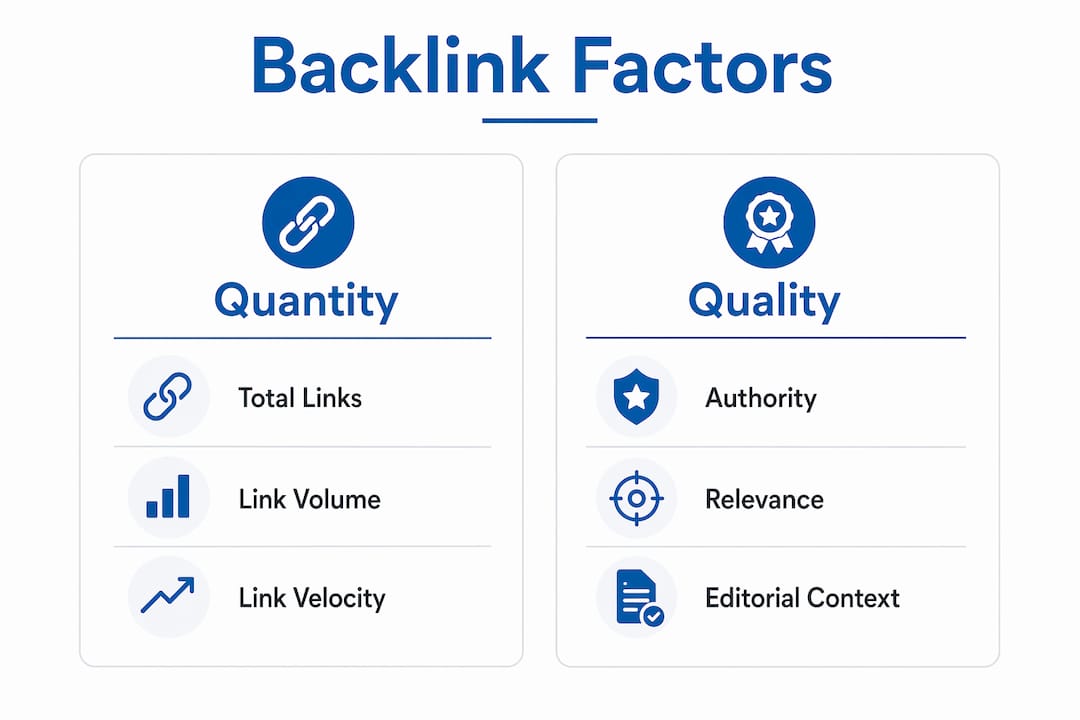
Google’s algorithm has shifted decisively toward relevance and editorial context as the primary filters for link value. Raw link counts still matter, but they matter far less than they did five years ago. The 2026 algorithm rewards precision over volume.
The clearest proof of this shift is in the numbers. A domain rating 30 link from your exact niche is approximately 4 times more valuable than a DR 70 link from an unrelated site. A fitness blog linking to your personal training service carries more weight than a high-authority finance site doing the same. Topical relevance is now a core part of how Google measures link quality.
Anchor text and editorial placement reinforce this. Links embedded naturally in relevant editorial content with descriptive anchor text pass significantly more equity than sidebar or footer links. Google reads the surrounding content to judge whether the link makes sense in context. A link buried in a list of unrelated resources signals far less than one woven into a paragraph that discusses your topic directly.
Here is what separates strong link building from weak link building in 2026:
- Topical alignment: The linking site covers the same subject area as your page.
- Editorial placement: The link appears within body content, not in a footer, widget, or navigation bar.
- Descriptive anchor text: The anchor describes what the linked page is about, not just “click here.”
- Natural link velocity: Links accumulate at a pace consistent with organic content discovery.
- Diverse domain sources: New referring domains come from varied industries and site types.
Google’s SpamBrain 3.0 algorithm actively detects unnatural link patterns such as sudden velocity spikes and domain clustering. Sites that buy links in bulk or participate in link schemes face ranking penalties that can take months to recover from. The risk is simply not worth it when ethical methods produce more durable results.
Pro Tip: Before pursuing a link from any site, check whether its content is topically related to yours. A relevant DR 30 link will do more for your rankings than a generic DR 70 link from a site that covers everything.
What are the best ethical strategies for acquiring backlinks?
Sustainable link building for SEO starts with creating content that earns links without you having to ask for every single one. Original research, detailed guides, and proprietary data attract citations from journalists, bloggers, and industry publications. When you publish something genuinely new, other sites reference it because it serves their readers. That is the foundation of a healthy backlink profile.
Beyond content creation, these are the methods that consistently produce high-quality links in 2026:
- Publish original research. Studies, surveys, and data analyses attract natural citations. When your data is unique, other sites have no choice but to link to you as the source.
- Write guest posts for niche-relevant publications. Pitch articles to sites that cover your exact topic. The link you earn carries topical relevance by default.
- Use digital PR and media outreach. Pitch story angles to journalists covering your industry. A single editorial mention in a major publication can generate dozens of secondary links.
- Reclaim unlinked brand mentions. Search for sites that mention your brand without linking to you. A short outreach email asking them to add the link converts at a high rate because the content already exists.
- Build industry partnerships. Co-author content, sponsor events, or collaborate on resources with complementary businesses. These relationships produce links that feel natural because they are.
- Audit and fix broken links. Find broken links on relevant sites and offer your content as a replacement. You solve their problem and earn a link in return.
Measuring the effectiveness of your backlink strategies for SEO is as important as executing them. Track referring domain growth month over month, not just total link count. Watch for changes in your domain authority score after major link acquisitions. If a new batch of links does not move your rankings within 60 to 90 days, reassess the quality and relevance of those sources.
You can find a deeper breakdown of how these methods fit into the broader search engine ranking factors picture at Bigfinseo’s 2026 guide for marketers.
What are the biggest backlink myths in 2026?
Several persistent myths about backlinks lead SEO professionals to waste time or, worse, trigger penalties. Clearing these up protects your strategy and your rankings.
- Myth: Backlinks are the only ranking factor. Backlinks are among the strongest signals, but Google also weighs content quality, page experience, and topical authority. A page with great links but thin content will not hold its rankings.
- Myth: More backlinks always mean better rankings. Quality and domain diversity outweigh raw volume. Ten links from ten relevant, authoritative domains beat 100 links from low-quality directories.
- Myth: Nofollow links have zero SEO value. Google updated its treatment of nofollow links in 2019. Nofollowed links now act as hints and can still influence rankings under certain conditions. A nofollow link from a high-authority site is not worthless.
- Myth: Link building is dead because of AI search. AI-based search platforms still rely on foundational search indices, and backlinks remain critical signals for domain authority used in AI-generated answers. Visibility in tools like ChatGPT and Perplexity still traces back to the authority your backlinks build.
- Myth: Multiple links from the same domain compound in value. The first link from a referring domain carries the most weight. Each additional link from that same domain returns diminishing value. Diversifying your sources is always the better move.
Understanding what authority means in SEO helps you see why these myths persist. Authority is not a single number. It is a composite signal built from link diversity, topical relevance, and consistent editorial endorsement over time.
Key Takeaways
Backlinks remain the single most durable trust signal in Google’s algorithm, and their value in 2026 is determined by relevance, editorial context, and domain diversity far more than raw count.
| Point | Details |
|---|---|
| Backlinks signal authority | Google has treated editorial links as its top trust signal for over 25 years. |
| Domain diversity beats volume | 100 links from 100 domains outperform 100 links from one domain every time. |
| Relevance multiplies link value | A niche-relevant DR 30 link is roughly 4 times more valuable than an off-topic DR 70 link. |
| Nofollow links still matter | Google treats nofollow as a hint, not a hard block, so high-authority nofollow links retain some value. |
| AI search still needs backlinks | Domain authority built through backlinks directly influences visibility in AI-generated search answers. |
Backlinks in 2026: what I’ve learned after years at the helm
The most common mistake I see is treating link building as a numbers game. Teams chase volume, hit their monthly link targets, and then wonder why rankings barely move. The answer is almost always the same: the links lack topical relevance, and Google can tell.
What actually works is thinking about backlinks the way a journalist thinks about sources. You want citations from people who genuinely know your subject. A link from a respected industry publication in your niche carries more weight than ten links from general-purpose blogs that cover everything from recipes to real estate. Precision beats volume every time.
The snowball effect is real, and it is the most underappreciated dynamic in SEO. Once a page earns enough authority to rank well, it attracts more natural links, which push it higher, which attracts even more links. Getting that flywheel spinning requires patience and consistent effort early on. But once it moves, it compounds in ways that paid traffic simply cannot replicate.
My practical advice: audit your existing backlink profile before you build a single new link. Find your strongest referring domains, understand why they linked to you, and build more content in that same vein. Protect what you have, then expand from a position of strength. That approach keeps you well clear of SpamBrain 3.0’s radar and builds authority that lasts.
— Big
Bigfinseo’s resources for building a stronger backlink foundation
Understanding backlinks is one thing. Putting that knowledge to work on your own site is where most SEO professionals want a reliable guide.
Bigfinseo’s SEO for beginners resource is built for exactly that. It covers the fundamentals of link building, on-page optimization, and authority building in plain language, without the jargon overload that makes most SEO guides hard to act on. Whether you are just getting started or filling gaps in your current strategy, the guide gives you a clear course to follow. You can also explore Bigfinseo’s link building strategies page for a deeper look at how to earn the kind of backlinks that actually move rankings.
FAQ
What is the role of backlinks in SEO?
Backlinks are external links pointing to your site that signal authority and trust to Google. They have been Google’s top ranking factor for over 25 years because they represent genuine editorial endorsements from other websites.
Do backlinks still improve rankings in 2026?
Yes. Top-ranking pages hold on average 3.8 times more backlinks than pages ranked 2 through 10. Backlinks remain one of the strongest signals in Google’s algorithm.
How many backlinks do I need to rank on page one?
There is no fixed number. Unique referring domains matter more than total link count, and a smaller set of highly relevant, authoritative links outperforms a large set of low-quality ones.
Are nofollow backlinks worth pursuing?
Nofollow links act as hints rather than hard blocks since Google’s 2019 update. A nofollow link from a high-authority, relevant site can still contribute to your overall authority and visibility.
How do backlinks affect AI search visibility?
AI-based search platforms use foundational search indices where domain authority, built largely through backlinks, determines which sources appear in AI-generated answers. Strong backlink profiles directly support visibility in tools like ChatGPT and Perplexity.

Michael Fleischner is the Founder and CEO of Big Fin SEO, a New Jersey-based digital marketing and SEO agency helping service-area and multi-location businesses increase visibility, generate qualified leads, and drive measurable revenue from search.
He is a TEDx speaker (“The Freelance Journey”), and the author of multiple marketing and SEO books, including SEO Made Simple and The 7 Figure Freelancer. He served as President of the American Marketing Association’s Professional Chapters Council (2022–2023), founded CapitalQuest AI, and has over 20 years of experience in marketing and search.



 Corine Rigby
 Laura Ayres
 Michael Fleischner