
TL;DR:
- Google’s search algorithms use automated systems to crawl, index, and rank pages based on user intent and content relevance. To improve rankings, focus on technical accessibility, authoritative content with clear E-E-A-T signals, and backlinks from relevant sites. Continuous monitoring and adaptation to algorithm updates are essential for maintaining search performance.
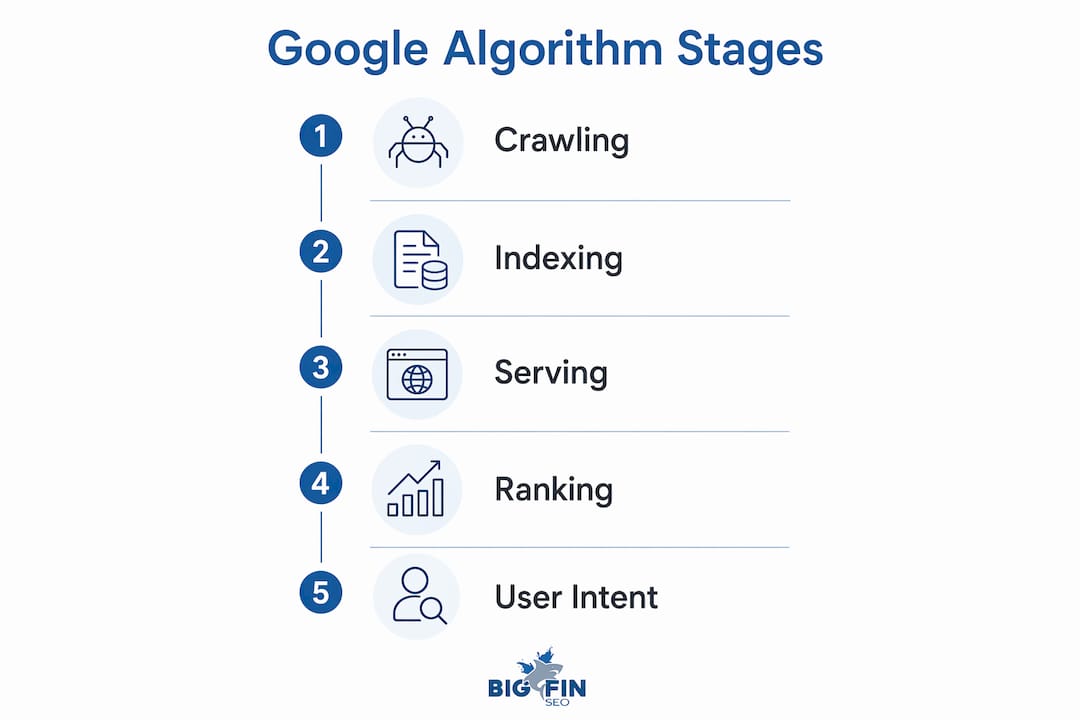
Google’s search algorithms are a suite of automated ranking systems that crawl, index, and rank pages to match user intent. Every time someone types a query, these systems work through three stages: crawling (discovering pages), indexing (processing and storing content), and serving (selecting and ranking results). For SEOs and agency strategists, understanding search algorithms isn’t academic — it’s the operational foundation for every content, technical, and link decision you make.
Your three highest-leverage priorities, right now:
- Content relevance and intent alignment — match the page to the specific query intent, not just the keyword.
- Technical access and crawlability — if Googlebot can’t reach and render your pages, nothing else matters.
- Credibility signals (E-E-A-T and backlinks) — authority is earned through demonstrated expertise, trustworthy sourcing, and quality links.
Named systems you need to know as you chart a course through this guide:
- PageRank — the original link-authority signal, still active in evolved form
- RankBrain — Google’s first major machine-learning ranking component
- BERT — natural language understanding for query and content context
- MUM — multimodal AI for complex, multi-step queries
- Core Updates — broad, periodic ranking changes announced by Google
How Google Search actually works: crawling, indexing, and serving
How search works breaks into three distinct stages, and each one has its own failure modes. Treating them as a single process is one of the most common diagnostic mistakes SEOs make.
Crawling
Googlebot discovers URLs through sitemaps, internal links, and external backlinks. It prioritizes pages based on crawl budget, which is influenced by page authority, server response speed, and how frequently content changes. One detail that trips up many teams: Googlebot renders pages using a recent version of Chrome, so JavaScript-heavy sites must be fully renderable for their content to be discovered and indexed. A page that looks complete in a browser may be invisible to Googlebot if its content loads client-side without proper server-side rendering or prerendering.
Crawl diagnostic checklist:
- Confirm Googlebot access in
robots.txt(no accidental disallow rules) - Check crawl stats in Google Search Console for drops or anomalies
- Run URL Inspection to see the rendered HTML, not just the raw source
- Review server logs for crawl frequency and blocked requests
- Submit an updated XML sitemap after major content changes
Indexing
Once Googlebot crawls a page, Google processes it: extracting text, images, and structured data, then determining the canonical version when duplicates exist. Pages can be excluded from the index for several reasons: thin content, canonicalization conflicts, noindex tags, or soft 404s. Canonicalization is particularly tricky on large sites where URL parameters, session IDs, or pagination create near-duplicate clusters.
Indexing diagnostic checklist:
- Check the Coverage report in Search Console for “Excluded” pages
- Verify canonical tags point to the correct URL
- Use URL Inspection to confirm “URL is on Google” status
- Audit for accidental noindex tags in staging environments pushed to production
- Review duplicate content clusters with a site: search or crawl tool
Serving (search results)
Serving is where Google selects which indexed page to show for a given query, on a given device, in a given location. Ranking systems operate at the page level using a mix of signals, but site-wide signals also contribute to overall trust. Google applies diversity limits so one domain doesn’t dominate a results page, and it personalizes results based on location, device, and search history.
Serving diagnostic checklist:
- Compare rankings on mobile vs. desktop using Search Console’s device filter
- Check impressions by country to spot localization issues
- Review which pages Google selects as canonical for key queries
- Monitor click-through rate (CTR) by query to catch serving-level drops
Pro Tip: When diagnosing a traffic drop, work backward through the three stages. First confirm the page is still indexed (URL Inspection). Then check crawl stats for access issues. Only after ruling out crawl and index problems should you investigate ranking signals. Skipping this sequence wastes days chasing the wrong fix.
The core ranking factors that matter today
Google’s ranking systems use page-level signals, site-level signals, and specialized classifiers working together. No single factor guarantees a top position, but some carry more weight than others in most competitive contexts. Here’s how to prioritize your work.
Primary ranking factors and action steps
-
Relevance and on-page signals — Google matches query terms to page content, title tags, headers, and semantic context. Action: Align your title tag, H1, and first paragraph to the specific intent behind the target query, not just the keyword string.
-
Content quality and E-E-A-T — Experience, Expertise, Authoritativeness, and Trustworthiness are the framework Google’s Search Quality Rater Guidelines use to evaluate page quality. Action: Add named authors with credentials, cite authoritative sources, and include original evidence (data, case studies, first-hand experience).
-
Backlinks and authority — PageRank, in its evolved form, remains part of core ranking systems. Links from authoritative, topically relevant sites carry the most weight. Action: Prioritize earning links from industry publications and partner sites rather than volume-based link schemes.
-
Core Web Vitals and technical performance — Largest Contentful Paint (LCP), Interaction to Next Paint (INP), and Cumulative Layout Shift (CLS) are measured signals. Action: Run PageSpeed Insights monthly and fix the highest-impact CWV issues first, starting with LCP on mobile.
-
Mobile-first indexing — Google primarily uses the mobile version of a page for indexing and ranking. Action: Confirm your mobile page contains the same content, structured data, and internal links as the desktop version.
-
Structured data and schema markup — Schema helps Google understand entity relationships and can earn rich results (FAQ, How-To, Review snippets). Action: Implement schema for your primary content type and validate with Google’s Rich Results Test.
-
Spam signals and manual actions — Google’s SpamBrain system detects manipulative behaviors including link schemes, cloaking, and thin affiliate content. Action: Audit your backlink profile quarterly and disavow toxic links before they trigger a manual action.
| Ranking Factor | How Google Measures It | Priority Action |
|---|---|---|
| Relevance | Query-to-content match, semantic signals | Align title, H1, and intro to query intent |
| E-E-A-T | Author credentials, sourcing, reputation | Add bylines, cite sources, build author pages |
| Backlinks | PageRank signals, link quality and relevance | Earn links from topically relevant authority sites |
| Core Web Vitals | LCP, INP, CLS via field data | Fix LCP on mobile first using PageSpeed Insights |
| Mobile-first | Mobile page content parity | Audit mobile vs. desktop content match |
| Structured data | Schema markup, rich result eligibility | Implement and validate schema for primary content type |
| Spam signals | SpamBrain automated detection | Quarterly backlink audit, disavow toxic links |
Search engine ranking factors shift in weight over time, but these seven have remained consistently influential across multiple core update cycles.
A timeline of major Google algorithm updates
Google’s algorithm isn’t a single system — it’s a fleet of specialized ranking components, updated continuously. Here’s the chronological map of the updates that changed how SEOs work.
-
1998 — PageRank: Larry Page and Sergey Brin’s original link-authority model. Treated backlinks as votes; more links from authoritative pages meant higher rankings. Takeaway: Link building became the dominant SEO tactic.
-
2003 — Florida Update: Targeted keyword stuffing and manipulative on-page tactics. Takeaway: Exact-match keyword density stopped being a reliable shortcut.
-
2011 — Panda: Targeted thin content, duplicate content, and low-quality content farms. Sites with large volumes of poor pages saw site-wide ranking drops. Takeaway: Content quality became a site-wide signal, not just a page-level one.
-
2012 — Penguin: Targeted manipulative link schemes, paid links, and over-optimized anchor text. Takeaway: Link quality overtook link quantity as the primary backlink metric.
-
2013 — Hummingbird: Rewrote the core query-processing engine to understand conversational queries and semantic meaning, not just individual keywords. Takeaway: Topic and intent coverage became more important than keyword repetition.
-
2014 — Pigeon: Improved local search results by tying local rankings more closely to traditional web ranking signals and distance. Takeaway: Local SEO required the same quality signals as organic SEO.
-
2015 — Mobile-Friendly Update (“Mobilegeddon”): Made mobile-friendliness a ranking signal for mobile searches. Takeaway: Responsive design became non-negotiable.
-
2015 — RankBrain: Google’s first machine-learning ranking component, used to interpret unfamiliar queries by mapping them to related concepts. Takeaway: Optimizing for user satisfaction signals (CTR, dwell time) became a measurable priority.
-
2019 — BERT: Applied transformer-based natural language processing to better understand how word combinations express meaning in queries and content. Takeaway: Writing for humans, not keyword patterns, became the clearest path to relevance.
-
2021 — MUM (Multitask Unified Model): A multimodal AI capable of processing text, images, and video across languages. Applied to select tasks rather than general ranking. Takeaway: Content depth, multi-format coverage, and cross-lingual relevance gained strategic importance.
-
2022 — Helpful Content System: Introduced a site-wide classifier targeting content written primarily for search engines rather than people. Takeaway: Demonstrating genuine, first-hand value in content became a survival requirement.
-
2023–2026 — Ongoing Core Updates: Google issues several broad core updates per year, each aiming to improve how systems surface relevant, satisfying content. The May 2026 core update is a recent example, with a rollout window of approximately two weeks affecting content globally.
The pattern across every major update is consistent: Google moves toward rewarding content that genuinely serves users and penalizing tactics that game signals without delivering real value. Every update that punished a shortcut was preceded by SEOs over-relying on it.
On cadence: between public core updates, Google makes frequent, often unannounced refinements to its systems. Significant visibility shifts can and do happen outside announced update windows, which is why continuous monitoring matters more than update-reactive responses.
How Google uses AI and machine learning to understand your content
Three AI systems sit at the center of how Google interprets queries and content today. They don’t replace traditional ranking signals — they sit on top of them, reshaping how relevance is determined.

RankBrain was Google’s first machine-learning ranking component, introduced in 2015. It maps unfamiliar queries to related concepts by learning from patterns in search behavior. Where older systems failed on novel queries, RankBrain finds the closest semantic match. The practical implication: pages that satisfy user intent broadly tend to rank better than pages optimized for a single exact-match phrase.
BERT (Bidirectional Encoder Representations from Transformers) processes the full context of a query, not just individual words. BERT helps Google understand how combinations of words express meaning — the difference between “can you get medicine for someone” and “can someone get medicine for you” matters, and BERT catches it. For content creators, this means writing that answers the specific question in natural, complete sentences outperforms content that repeats keyword phrases.
MUM (Multitask Unified Model) goes further: it can process text, images, and video across multiple languages simultaneously. MUM is applied to select tasks rather than general ranking, but its influence on how Google handles complex, multi-step queries is growing. Multi-format content and comprehensive topic coverage are the strategic response.
Neural matching and passage ranking round out the picture. Neural matching connects queries to conceptually related pages even when exact terms don’t appear. Passage ranking lets Google index and rank individual passages within a long page, meaning a well-written section can rank even if the overall page isn’t the strongest on the topic.
Content strategy implications:
- Write to answer a specific user intent completely, not to hit a keyword density target
- Structure long-form content with clear, self-contained sections (passage ranking rewards this)
- Build topical authority by covering related subtopics on the same site, not just the head term
- Use entities (named people, places, concepts) to give Google clear semantic anchors
- Consider multi-format content (video, images with alt text, structured data) for complex topics
Pro Tip: When briefing writers, lead with the user’s specific question and the answer in the first paragraph — not the keyword. AI-driven systems reward intent completion. A brief that starts with “the user wants to know X because they’re trying to do Y” produces better-ranking content than one that starts with a keyword list.
The role of AI in content strategy continues to grow as BERT-style models become more central to how search engines evaluate relevance. Agencies that build editorial workflows around intent modeling rather than keyword matching are better positioned for every update that follows.
How to diagnose ranking drops and respond after an update
A traffic drop is a signal, not a verdict. The goal is to isolate the cause before committing to a fix. Here’s the playbook.
Step 1: Confirm whether an update is involved
- Check Google Search Central’s announcements and the May 2026 core update timeline for any recent activity.
- Cross-reference the traffic drop date in GA4 with the update rollout window.
- Check industry trackers for broad volatility signals across multiple sites.
- If the drop aligns with an update window, treat it as update-related until proven otherwise.
Step 2: Isolate affected pages and queries
- Pull Search Console performance data segmented by page and query for the affected period.
- Identify whether the drop is concentrated in specific content types, topic clusters, or site sections.
- Check the Manual Actions report in Search Console for any penalties.
- Review the Coverage report for new indexing exclusions that coincide with the drop.
- Analyze server logs for changes in Googlebot crawl frequency on affected pages.
Step 3: Form and test hypotheses
- Compare your affected pages against the top-ranking competing pages for the same queries. Where do they differ in depth, format, author credentials, or sourcing?
- Review E-E-A-T signals: are authors named and credentialed? Are claims sourced? Is there original evidence?
- Audit Core Web Vitals for affected pages using PageSpeed Insights and Lighthouse.
- Check for rendering issues with URL Inspection’s “View Rendered Page” feature.
- Review your backlink profile for any new toxic links or lost high-authority links.
Step 4: Prioritize and implement fixes
Focus on site-wide quality improvements first. Google recommends self-assessment and sustainable, user-focused improvements rather than quick fixes after a core update. Technical issues (crawl errors, CWV failures, rendering problems) tend to show impact faster than content quality improvements. Content rewrites and E-E-A-T enhancements often take one to several months to translate into recovered rankings, particularly after a broad core update.

Pro Tip: Don’t try to fix everything at once. Prioritize the highest-traffic affected pages and the issues with the clearest evidence. Making too many simultaneous changes makes it impossible to know what worked. Fix, wait for recrawl, measure, then move to the next priority.
Powerful optimization techniques for technical health can accelerate the recrawl and reindexing cycle, which shortens the feedback loop on your fixes.
Tools and metrics to monitor algorithm-driven performance
Continuous monitoring is what separates agencies that react to updates from those that anticipate them. These are the tools and metrics that matter.
Core monitoring tools:
- Google Search Console — impressions, clicks, average position, CTR, coverage, Core Web Vitals, manual actions
- GA4 — organic traffic trends, engagement rate, landing page performance
- PageSpeed Insights / Lighthouse — field and lab CWV data, performance scores
- Log-file analysis (Screaming Frog Log File Analyser, Splunk, or similar) — actual Googlebot crawl behavior
- Industry trackers — broad volatility signals across the web
| Tool | Primary Metrics | Monitoring Cadence |
|---|---|---|
| Google Search Console | Impressions, clicks, CTR, average position, coverage, CWV | Weekly |
| GA4 | Organic sessions, engagement rate, landing page performance | Weekly |
| PageSpeed Insights | LCP, INP, CLS (field data), performance score | Monthly |
| Lighthouse | Lab-based CWV, accessibility, best practices | Monthly or after deploys |
| Log-file analysis | Googlebot crawl frequency, crawl errors, blocked URLs | Monthly |
| Industry trackers | Algorithm volatility signals | Daily during update windows |
Key metrics to watch:
- Impressions and clicks by query (Search Console) — early warning for ranking shifts
- Average position trends by page cluster — identifies which content types are affected
- CTR by query — a sustained CTR drop without a position change can signal a SERP feature change
- Coverage exclusions — a spike in “Excluded” pages often precedes a traffic drop
- Core Web Vitals field data — LCP and INP failures correlate with ranking disadvantages on mobile
Escalation triggers (act immediately when you see these):
- Organic impressions drop more than 20% week-over-week with no site changes
- A new manual action appears in Search Console
- Coverage exclusions spike significantly without a known technical change
- LCP or INP scores move from “Good” to “Needs Improvement” in field data
- Googlebot crawl frequency drops sharply in log-file data
The best AI search optimization tools add another monitoring layer for agencies tracking visibility in AI-generated answer surfaces, which operate on different signals than traditional SERP rankings.
How agencies should operationalize E-E-A-T, GEO, and AI search
Understanding Google algorithms is one thing. Building agency processes around them is another. Here’s how to translate the theory into repeatable client deliverables.
Operationalizing E-E-A-T
E-E-A-T is not a checklist — it’s context-dependent evidence of expertise, experience, authoritativeness, and trustworthiness. Agencies must document proof, not just assert it.
- Author credentials: Every content piece should carry a named author with a bio page linking to their professional credentials, publications, or relevant experience.
- Sourcing: Claims should cite primary sources (government data, peer-reviewed research, official documentation). Thin sourcing is a quality signal Google’s raters notice.
- Reputation building: Online reputation management activities — earning mentions in industry publications, managing reviews, and building a consistent brand presence — contribute to the site-level trust signals that support E-E-A-T.
- Case study evidence: Original data, client results (with permission), and documented outcomes are the strongest form of experience signals.
GEO and AI search optimization
Generative Engine Optimization (GEO) is the practice of structuring content and schema so it surfaces in AI-driven answer environments like ChatGPT, Perplexity, and Google’s AI Overviews. The rise of GEO as a discipline reflects a real shift: a growing share of search interactions now happen inside AI-generated responses rather than traditional blue-link results.
For agencies, the practical steps are:
- Implement structured data (FAQ, HowTo, Article, Organization schema) to give AI systems clear entity signals.
- Write content with direct, citable answers in the first paragraph of each section.
- Build topical authority clusters so AI systems recognize your client as a reliable source on a given subject.
- Monitor AI citation patterns using tools designed for AI search optimization.
Pro Tip: Package your E-E-A-T and GEO work into a monthly “Authority Report” for clients. Show author credential additions, new citations earned, schema implementations, and AI citation appearances. Clients who can see algorithmic risk and opportunity in a single report are far more likely to approve the budget for sustained work.
Agency process flow for algorithmic readiness
- Onboarding audit: Crawl the site, check indexing coverage, run CWV, review E-E-A-T signals, and identify manual actions or spam risks.
- Priority matrix: Score issues by impact (traffic at risk) and effort (hours to fix). Address technical blockers first.
- Content workflow: Assign named authors, add sourcing requirements to briefs, and build a content calendar around topical authority clusters.
- Schema implementation: Deploy structured data for primary content types and validate monthly.
- Monitoring cadence: Weekly Search Console review, monthly CWV and log-file analysis, immediate response protocol for manual actions or major update announcements.
- Reporting: Deliver a monthly authority and performance report that maps algorithmic signals to business outcomes.
Agency readiness checklist:
- Named authors with credential pages on all key content
- Primary sources cited in every factual claim
- Schema markup validated and live for primary content types
- Core Web Vitals in “Good” range for top-traffic pages
- Search Console monitored weekly with escalation triggers defined
- GEO content structure (direct answers, entity-rich copy) in place
- AI citation monitoring active for key clients
SEO for marketing managers offers a step-by-step process framework that agencies can adapt for client onboarding and ongoing delivery.
Key Takeaways
Google’s algorithms reward pages that are technically accessible, genuinely authoritative, and precisely matched to user intent — and no single tactic substitutes for all three working together.
| Point | Details |
|---|---|
| Three-stage model | Every SEO diagnosis starts with crawl → index → serve; fix access before chasing rankings. |
| E-E-A-T is evidence, not assertion | Add named authors, cite primary sources, and document original experience on every key page. |
| Core updates require patience | Site-wide quality improvements after a core update often take one to several months to show ranking recovery. |
| AI systems reward intent completion | Write to answer the specific user question fully; BERT and RankBrain favor intent-complete pages over keyword-dense ones. |
| Bigfinseo for agency execution | Bigfinseo delivers white-label SEO, GEO, and AI search optimization for agencies needing repeatable, algorithm-ready fulfillment. |
What recent algorithm trends actually mean for your strategy
The conversation about Google algorithms tends to focus on individual updates as if each one is a discrete event to survive. That framing misses the larger pattern. What Google has been doing consistently for the past several years is reducing the gap between “what ranks” and “what genuinely serves users.” Every major system — BERT, the Helpful Content classifier, E-E-A-T operationalization, GEO — is a different instrument playing the same note.
For agencies, this has a concrete staffing implication. The skills that matter most now are editorial judgment, subject-matter credibility, and technical execution — not keyword research volume or link velocity. Agencies that built their model around high-volume, low-quality content production are facing structural pressure, not just a bad update cycle. The ones charting a course toward authority-first content and technical precision are gaining ground with each core update rather than losing it.
What this means for client conversations in 2026: stop framing SEO as a set of tactics and start framing it as a credibility infrastructure project. Clients who understand that their rankings reflect how much Google trusts their site — not just how well their pages are optimized — make better long-term investment decisions. They approve the author credential work, the schema implementation, the content depth improvements. They don’t ask for quick fixes after a core update because they understand why quick fixes don’t work.
The 2026 digital marketing roadmap reflects this shift: the agencies winning right now are the ones that treat algorithmic readiness as a continuous operational discipline, not a reactive project.
White-label SEO and GEO services built for agencies that need results
Agencies that want to deliver algorithm-ready SEO and GEO work without building an in-house team have a clear alternative. Bigfinseo provides white-label SEO for agencies that covers the full stack: technical audits, E-E-A-T content workflows, schema implementation, link building, GEO optimization, and AI search visibility — all delivered under your brand in as few as five business days.
The concrete advantage: you get a fulfillment team that stays current with every core update, every AI system shift, and every GEO development, without the overhead of hiring, training, or retaining that expertise in-house. Bigfinseo’s model is built for agencies that need to scale client delivery quickly and profitably. If you’re evaluating whether to keep SEO and GEO work in-house or partner with a white-label provider, the decision usually comes down to four factors: your team’s current capability gap, the margin you need to hit, your SLA commitments to clients, and the reporting depth your clients expect.
Bigfinseo addresses all four. To see how the partnership works and what’s included, visit the white-label SEO service overview or reach out directly to discuss your agency’s current client load and growth targets.
FAQ
How do Google algorithms work?
Google’s algorithms work in three stages: crawling (discovering pages via Googlebot), indexing (processing and storing content), and serving (selecting and ranking results for a given query). Ranking decisions use a mix of page-level signals, site-level trust signals, and AI systems like BERT and RankBrain to match results to user intent.
What are the different Google algorithms?
Google operates a suite of specialized ranking systems rather than a single algorithm. Major named systems include PageRank (link authority), Panda (content quality), Penguin (link spam), Hummingbird (semantic query processing), RankBrain (machine-learning intent matching), BERT (natural language understanding), MUM (multimodal AI), the Helpful Content system, and SpamBrain (anti-spam detection), alongside periodic broad core updates.
How do I know if a Google core update affected my site?
Cross-reference your organic traffic drop date in GA4 with Google’s announced update rollout window, then check Search Console for changes in impressions, average position, and coverage exclusions. If the timing aligns and the drop is broad across multiple pages or content types, a core update is the likely cause.
What is E-E-A-T and why does it matter for SEO?
E-E-A-T stands for Experience, Expertise, Authoritativeness, and Trustworthiness — the framework Google’s Search Quality Rater Guidelines use to evaluate page quality. It matters because Google’s systems are designed to surface content from credible, demonstrably expert sources, and sites that lack visible E-E-A-T signals are more vulnerable to core update ranking drops.
How long does it take to recover from a Google algorithm update?
Recovery from a broad core update typically requires sustained, site-wide quality improvements and often takes one to several months to translate into regained rankings. Technical fixes (crawl errors, Core Web Vitals) tend to show impact faster than content quality improvements, which require recrawling, reindexing, and re-evaluation by Google’s systems.
Useful sources and official references
These are the primary sources worth bookmarking. Use them in the order listed — official Google documentation first, then supplementary industry reporting.
- How Google Search Works — Google Search Central’s official explanation of crawling, indexing, and serving. Check this first when diagnosing any stage of the pipeline.
- Google Search Ranking Systems Guide — The authoritative reference for named ranking systems (PageRank, BERT, MUM, SpamBrain, neural matching, passage ranking). Use it to verify which systems are active and how they’re described officially.
- Core Updates — Google Search Central — Official guidance on what core updates are, how to self-assess after one, and what Google recommends for recovery. Monitor this page after any significant traffic shift.
- Search Quality Rater Guidelines (PDF) — The full human-rater framework Google uses to evaluate search quality, including detailed E-E-A-T criteria and Needs Met ratings. Essential reading for anyone building content strategy around quality signals.
- May 2026 Core Update — Search Engine Roundtable — Industry reporting on the most recent broad core update, including rollout timeline and observed volatility. Useful for calibrating your monitoring response to current update patterns.
- Google Algorithms Explained — industry commentary — Supplementary industry perspective connecting algorithm changes to traffic outcomes. Useful context, but treat it as commentary rather than authoritative documentation.
| Source | Type | Best Used For | Monitoring Frequency |
|---|---|---|---|
| Google Search Central (how search works) | Official documentation | Crawl/index/serve diagnostics | As needed |
| Ranking Systems Guide | Official documentation | Verifying active ranking systems | Quarterly review |
| Core Updates page | Official documentation | Post-update self-assessment | After each announced update |
| Search Quality Rater Guidelines | Official framework | E-E-A-T and content quality planning | Annual review |
| Search Engine Roundtable | Industry reporting | Real-time update tracking | Daily during volatility |
A note on source hierarchy: Google Search Central documentation is the only authoritative source for how Google’s systems actually work. Industry blogs — including high-quality ones — report observations and interpretations, not confirmed mechanisms. When a blog post contradicts official documentation, the documentation wins. Use industry sources to track volatility and gather practitioner signals; use official docs to build your strategy.

Michael Fleischner is a marketing strategist, entrepreneur, author, and TEDx speaker with more than 20 years of experience helping businesses grow. As Founder and CEO of Big Fin SEO, he advises small and midsize businesses on marketing strategy, SEO, paid advertising, customer acquisition, and Generative Engine Optimization (GEO).
Michael works directly with business owners and leadership teams through half-day marketing strategy intensives, full-day workshops, and ongoing strategic advisory engagements, including fractional CMO support.
He is the author of SEO Made Simple and The 7 Figure Freelancer, and has served in national leadership roles with the American Marketing Association.
Learn more about Michael at https://michaelfleischnermedia.com or explore his marketing strategy services at https://bigfinseo.com/marketing-strategy/.



 Corine Rigby
 Laura Ayres
 Michael Fleischner