
TL;DR:
- Search visibility measures how prominently a website appears across organic search results and predicts potential exposure. It is crucial for business growth because it directly influences revenue, reduces customer acquisition costs, and enhances brand authority. AI-driven search in 2026 emphasizes off-site brand mentions and content breadth, requiring strategies beyond traditional keyword ranking focus.
Search visibility is the percentage score that reflects how prominently your website appears across organic search results for tracked keywords, serving as the clearest single indicator of your brand’s online presence. Unlike click-through rates or session counts, this metric captures potential exposure before a single user ever clicks. Business owners and marketing professionals who understand search visibility gain a measurable edge: they can chart a course toward growth instead of guessing why traffic stalls. Industry standards categorize scores from 1–5% as low, 6–15% as moderate, 16–30% as good, and 30%+ as very good in competitive industries.
What is search visibility and how is it calculated?
Search visibility is a modeled percentage score, weighted by keyword search volume and estimated click-through rate, that aggregates your site’s ranking positions across every tracked query. It does not measure actual clicks. It measures the share of potential impressions your site could capture if users searched those terms right now.

The core formula works like this: for each tracked keyword, a tool assigns a CTR value based on your ranking position, then multiplies that by the keyword’s monthly search volume. It sums those weighted values across all tracked keywords and divides by the total possible impressions. The result is your visibility score.
Different SEO platforms calculate this score with slight variations in their CTR curves and keyword sets, so scores are not always comparable across tools. The number that matters is the trend within a single platform over time.
| Keyword | Monthly Volume | Rank | Est. CTR | Weighted Score |
|---|---|---|---|---|
| “project management software” | 40,500 | 3 | 10% | 4,050 |
| “task tracking tool” | 8,100 | 7 | 4% | 324 |
| “team collaboration app” | 12,000 | 15 | 1.5% | 180 |
| Total | 60,600 | 4,554 |
In this example, the site captures roughly 7.5% of total possible impressions. That puts it in the moderate range. Improving even one high-volume ranking from position 7 to position 3 can shift the score meaningfully.
A critical distinction separates search visibility from keyword rankings. Rankings focus on one page and one keyword; visibility aggregates presence across thousands of queries, reflecting your brand’s true share of voice. Top businesses track total visibility, not just individual keyword positions.
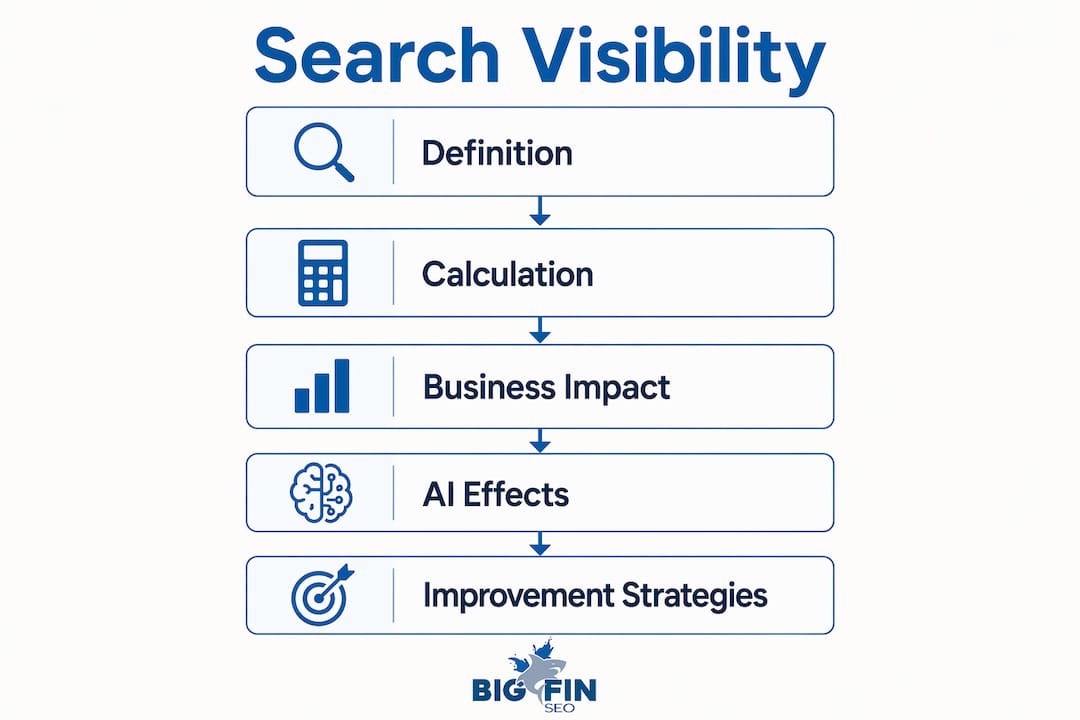
Why does search visibility matter for business growth?
Search visibility is a leading indicator of revenue, not a vanity metric. Organic search drives over 40% of company revenue on average, with a conversion rate of 14.6%, outperforming both paid and outbound channels. That conversion advantage compounds when visibility grows because more qualified prospects find you before they find a competitor.
“Visibility should be treated as infrastructure with compounding returns. A 1% increase in search visibility can disproportionately grow revenue because it shifts your brand into consideration sets earlier in the buyer journey.” — The Drum
The cost argument is equally strong. Implementing SEO to raise visibility can reduce customer acquisition costs by 40–60% after one year compared to paid acquisition. That means every dollar you invest in improving your organic presence pays back at a higher rate over time.
Visibility also anchors your multi-channel marketing. When prospects see your brand in organic results, in AI-generated answers, and in third-party content, recognition builds faster. That recognition shortens sales cycles and increases the likelihood that paid ads convert when prospects finally see them.
Key business reasons to prioritize search visibility:
- Revenue correlation: Higher visibility means more organic sessions, which directly feeds pipeline.
- Lower acquisition costs: Organic leads cost significantly less than paid leads after the first year.
- Brand authority: Consistent presence across search results signals credibility to buyers.
- AI discovery: Visibility now extends to AI-generated answers, not just blue links.
How has AI-driven search reshaped visibility in 2026?
The definition of search visibility has expanded. Ranking on page one of Google still matters, but it no longer tells the full story of your brand’s discoverability. AI-powered search tools now synthesize answers from sources across the web, and those sources are often not the top-ranked pages.
Nearly two-thirds of AI search citations come from pages outside the traditional top 10 rankings. That single data point rewrites the rules. A brand can rank number one on Google and still be invisible in the AI-generated answers that buyers read first. Meanwhile, 85% of AI visibility is driven by third-party domains, meaning your own website is not the primary vehicle for AI discovery.
Early buyer research now happens off-site. AI assistants pull from user-generated content, reviews, forums, and third-party editorial sources to form their answers. If your brand is not mentioned in those places, you are absent from the conversation at the moment a buyer is forming their shortlist.
This shift demands a new approach called Generative Engine Optimization, or GEO. Branded web mentions correlate approximately 3x more strongly with AI Overview visibility than backlinks do. Top brands average 169 AI mentions versus just 14 for others. That gap is not accidental. It reflects deliberate investment in off-site brand presence.
Here is how to think about the new visibility model:
- Traditional SEO visibility measures your ranking share across tracked keywords in standard search results.
- AI citation visibility measures how often AI tools reference your brand when answering relevant queries.
- Off-site brand visibility measures your presence in third-party content, reviews, and community discussions.
- Omnichannel visibility combines all three into a single picture of how discoverable your brand truly is.
Understanding how AI search changes your brand’s discoverability is the first step toward charting a course that accounts for all four layers.
Pro Tip: Monitor your brand’s share of mentions in AI outputs directly. Current analytics platforms often misclassify AI-driven traffic, making standard dashboards unreliable for measuring true AI visibility.
What strategies can businesses use to improve search visibility?
Improving search visibility requires work on two fronts: your own site and the broader web ecosystem where your brand lives. Neither alone is sufficient in 2026.
Technical foundations come first
Search bots and AI crawlers prioritize technically accessible, error-free content with structured schema markup. Without these foundations, even authoritative content gets skipped. Run a full technical audit to confirm your pages load correctly, return clean status codes, and carry structured data that describes your content to both search engines and AI models.
Schema markup is particularly important. When you mark up articles, products, FAQs, and reviews with structured data, you give AI systems the context they need to cite you accurately. Skipping schema is the single fastest way to become invisible to AI-generated answers.
Build brand mentions, not just backlinks
The old playbook centered on link acquisition. The new playbook centers on brand mentions. Off-site brand signals now carry more weight in AI visibility than traditional backlinks. Digital PR, podcast appearances, industry roundups, and community participation all generate the kind of third-party mentions that AI systems use as trust signals.
Reputation management is part of this work. Positive reviews on Google, industry directories, and niche forums feed directly into the third-party content pool that AI tools draw from. Bigfinseo’s reputation management services address this layer specifically, helping brands build the off-site presence that drives AI citation.
Use topic clusters to multiply coverage
Fan-out ranking across topic clusters multiplies AI citation potential by covering multiple related queries with a network of interconnected content. Only 38% of AI citations come from top 10 Google rankings. The remaining 62% come from pages that rank lower but cover adjacent subtopics comprehensively. A single pillar page supported by ten cluster articles covers far more ground than ten isolated posts.
Strategies that move the needle on search engine visibility:
- Technical SEO audit: Fix crawl errors, improve page speed, and implement schema markup across key page types.
- Topic cluster architecture: Build pillar pages with supporting cluster content to capture a wider range of related queries.
- Digital PR and brand mentions: Pitch stories, contribute expert quotes, and earn coverage on third-party sites your audience trusts.
- Structured data implementation: Use Article, FAQ, Product, and Review schema to help AI systems understand and cite your content.
- Off-site reputation management: Actively cultivate reviews and community presence to feed the third-party content pool AI tools reference.
Pro Tip: Pair your organic traffic strategy with a brand mention tracking tool. Visibility gains often appear in AI citation data before they show up in standard organic traffic reports.
Search visibility is the metric that tells the real story
Most marketing professionals I work with arrive focused on keyword rankings. They want to know if they rank number one for their target term. That is understandable. Rankings are concrete and easy to report. But after years of watching businesses optimize for individual positions while their overall market share erodes, I am convinced that ranking fixation is one of the most expensive blind spots in digital marketing.
Search visibility, measured as a share of total potential impressions across all tracked queries, tells you something rankings cannot. It tells you whether your brand is present in the conversations your buyers are having, across the full range of topics that matter to them. A business that ranks number one for three keywords but has 2% overall visibility is far more exposed than it looks on a standard ranking report.
The shift to AI-driven search makes this even more urgent. Businesses that track overall organic visibility including AI discovery are the ones winning in 2026. The ones still reporting a handful of keyword positions are sailing without a full map. They do not know what they cannot see.
My advice is to treat visibility as infrastructure, not a campaign. You do not run a campaign to build a foundation. You build it once, maintain it continuously, and let it compound. That means technical health, consistent content production, active brand mention cultivation, and regular measurement of your AI citation share alongside traditional visibility scores. The brands that anchor their strategy to total visibility, rather than chasing individual rankings, are the ones that build durable, compounding growth. That is the course worth charting.
— Michael Fleischner
How Bigfinseo helps you build lasting search visibility
Bigfinseo specializes in the full spectrum of visibility work that 2026 demands, from technical SEO foundations to AI optimization services that get your brand cited by ChatGPT, Perplexity, and Google’s AI Overviews. For agencies, the white-label SEO program delivers these services under your brand in as few as five business days, with no need to build an in-house team.
Whether your clients need traditional ranking improvements or a full Generative Engine Optimization strategy, Bigfinseo has the expertise to move the needle on visibility metrics that actually connect to revenue. The sea of search is changing fast. We help you stay ahead of the current and reach the right shoreline.
FAQ
What is a good search visibility score?
Industry benchmarks place scores of 16–30% in the “good” range and 30%+ as very good for competitive industries. Scores below 5% indicate minimal organic presence.
How is search visibility different from keyword rankings?
Rankings measure one page against one keyword. Search visibility aggregates your presence across thousands of queries, giving you a true picture of brand share of voice in organic search.
What affects search visibility the most?
Technical accessibility, keyword ranking positions, content breadth across topic clusters, and off-site brand mentions all affect visibility. In AI-driven search, branded mentions now outweigh backlinks as a visibility driver.
How does AI search affect visibility scores?
Traditional visibility scores do not capture AI citation share. Since 85% of AI visibility comes from third-party domains, brands must track off-site mentions separately to measure their true discoverability.
How long does it take to improve search visibility?
Technical fixes can show results within weeks. Content and brand mention strategies typically take three to six months to produce measurable visibility gains, with compounding returns building over the following year.
Key Takeaways
Search visibility is the most complete measure of organic presence available, and improving it requires both on-site technical work and active off-site brand building.
| Point | Details |
|---|---|
| Visibility is a percentage score | It weights keyword rankings by search volume and CTR to reflect total potential impressions. |
| AI has expanded the definition | 85% of AI visibility comes from third-party domains, making off-site presence critical. |
| Brand mentions outperform backlinks | Branded mentions correlate 3x more strongly with AI citation visibility than links do. |
| Technical SEO is non-negotiable | Error-free, schema-structured content is a prerequisite for both traditional and AI search visibility. |
| Visibility compounds like infrastructure | A 1% gain in visibility can disproportionately grow revenue when sustained over time. |

Michael Fleischner is the Founder and CEO of Big Fin SEO, a New Jersey-based digital marketing and SEO agency helping service-area and multi-location businesses increase visibility, generate qualified leads, and drive measurable revenue from search.
He is a TEDx speaker (“The Freelance Journey”), and the author of multiple marketing and SEO books, including SEO Made Simple and The 7 Figure Freelancer. He served as President of the American Marketing Association’s Professional Chapters Council (2022–2023), founded CapitalQuest AI, and has over 20 years of experience in marketing and search.


 Corine Rigby
 Laura Ayres
 Michael Fleischner