
TL;DR:
- Semantic search uses AI to interpret user intent and meaning, shifting focus from exact keywords to content relevance. Marketers should build topic clusters, use schema markup, and prioritize clear sentences to improve rankings in this model. Combining semantic understanding with traditional keyword tactics offers the best SEO results.
Semantic search is defined as the process of interpreting the meaning and intent behind user queries using natural language processing and AI, rather than matching exact keywords. Google’s AI models, including BERT, RankBrain, and MUM, power this approach by analyzing context, entities, and relationships within a query. For digital marketers and business owners, understanding what is semantic search means understanding how Google actually reads your content. The shift from keyword matching to intent recognition changes everything about how you build and structure pages for visibility.
What is semantic search and how does it work technically?
Semantic search works through a multi-stage query processing pipeline that runs before any ranking occurs. Google first tokenizes the query, breaking it into meaningful units, then applies named-entity recognition to identify people, places, and concepts. After that, synonym expansion broadens the query so that “book a holiday” matches results for “book a vacation” or “plan a trip.”

Three AI models do the heavy lifting inside this pipeline. BERT (Bidirectional Encoder Representations from Transformers) reads queries in both directions simultaneously, which means it correctly interprets prepositions and qualifiers that older systems missed entirely. RankBrain handles queries Google has never seen before, using machine learning to infer intent from patterns. MUM (Multitask Unified Model) goes further by processing text, images, and multiple languages at once to answer complex, multi-part questions.
At the core of the system are vector embeddings. Each word, phrase, and document gets converted into a numerical vector that represents its meaning. Google then measures the distance between the query vector and document vectors to find the closest semantic match. This is fundamentally different from counting keyword occurrences.
| Feature | Keyword search | Semantic search |
|---|---|---|
| Matching method | Exact string match | Meaning and intent match |
| Query handling | Known terms only | New and ambiguous queries |
| Context awareness | None | Full sentence and entity context |
| Synonym recognition | Manual or limited | Automatic via synonym expansion |
| AI models used | None | BERT, RankBrain, MUM |
Pro Tip: Write content as complete sentences with clear subjects and objects. BERT reads bidirectionally, so sentence structure directly affects how accurately Google interprets your page’s meaning.
Approximately 15% of daily Google queries are entirely new, meaning no historical data exists for them. That statistic shows why rule-based keyword systems alone cannot serve modern search. Semantic algorithms fill that gap by inferring intent from context rather than relying on exact matches.
What are the benefits of semantic search for SEO and marketing?
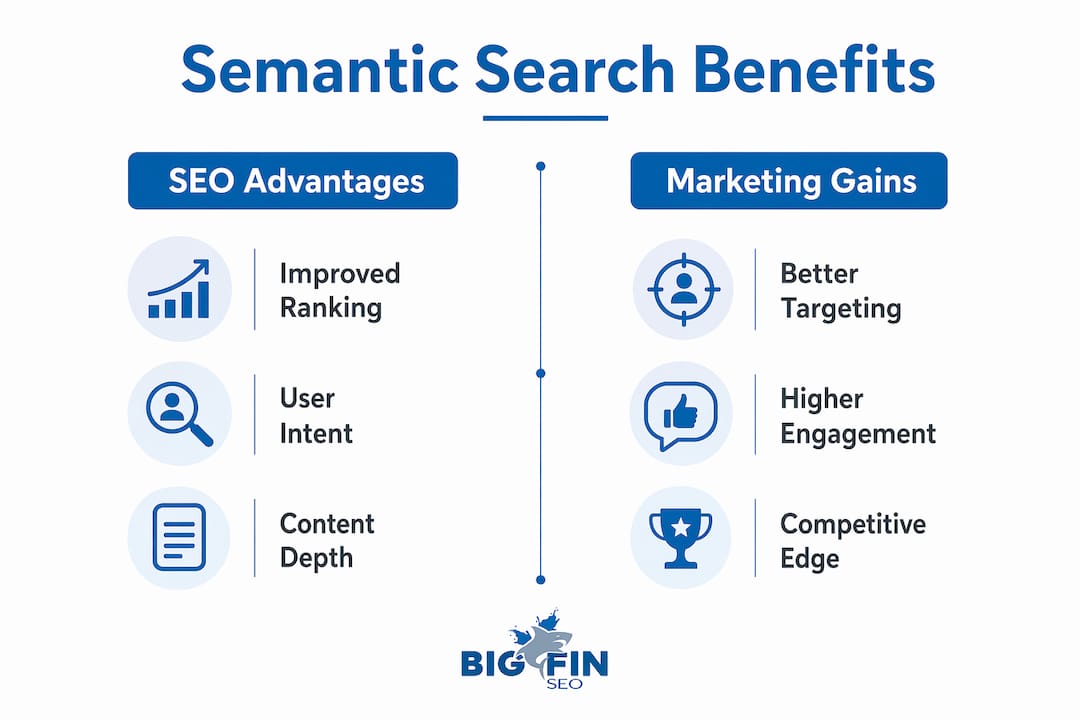
Semantic search improves search accuracy and contextual relevance in ways that directly reward well-structured, intent-driven content. Content that matches user intent surpasses keyword-stuffed pages in rankings, which means the old practice of forcing exact phrases into every paragraph now actively works against you.
The practical benefits for marketers are significant:
- Broader query coverage. Topic-cluster SEO strategies rank for dozens of related queries simultaneously because Google recognizes the shared intent behind them. One well-built pillar page can capture traffic from queries you never explicitly targeted.
- Better performance on conversational queries. Voice search and AI chat interfaces generate long, natural-language questions. Semantic systems handle these far better than keyword systems, which means your content reaches users who phrase queries the way they actually speak.
- Reduced keyword cannibalization. When Google understands topic relationships, multiple pages on related subtopics support each other rather than compete. This makes site architecture a ranking factor in itself.
- Sustainable rankings. Content aligned with intent holds its position longer. Keyword-stuffed pages tend to fluctuate because they satisfy the algorithm temporarily but not the user permanently.
- Alignment with AI-generated answers. Platforms like ChatGPT and Perplexity pull from semantically coherent content. Pages that clearly address a topic’s full context are more likely to be cited.
Understanding search intent alignment is the foundation of this shift. Marketers who still plan content around keyword lists alone are charting a course with an outdated map.
Pro Tip: Before writing any page, identify the primary user intent (informational, navigational, commercial, or transactional) and build the entire content structure around satisfying that intent first. Keywords come second.
How does semantic search differ from traditional keyword search?
The core difference is retrieval method. Keyword search finds documents that contain the exact string a user typed. Semantic search finds documents that address the concept the user meant, even when the wording differs entirely.
Keyword search excels with exact identifiers, such as product codes, legal citations, or proper names where precision matters more than interpretation. Semantic search excels with natural language, ambiguous queries, and questions where the user’s phrasing may vary widely from the document’s language.
Neither approach is universally superior. The right fit depends on the corpus and the query type. A parts catalog database benefits from exact keyword matching. A consumer-facing website benefits from semantic retrieval. Most modern SEO strategies need both working together.
Here is how the two approaches compare in practical scenarios:
- Query: “best running shoes for flat feet” — Keyword search returns pages containing all those exact words. Semantic search returns pages about overpronation support, arch correction, and motion control, even if they never use the phrase “flat feet.”
- Query: “invoice #INV-2024-0091” — Keyword search retrieves the exact document instantly. Semantic search may return related billing records, which is not what the user needs.
- Query: “why does my back hurt after sitting” — Keyword search struggles with the causal structure. Semantic search identifies the intent as a health question about posture and returns ergonomic and medical content.
- Query: “Python 3.12 release notes” — Both approaches work equally well here because the query is specific and the document language is predictable.
The practical takeaway for marketers is to combine both approaches rather than abandon one for the other. Use structured data and exact terms for product identifiers, and use intent-driven content for informational and commercial pages.
How to optimize your SEO strategy for semantic search
Effective semantic SEO starts with entity clarity. Google’s NLP pipeline applies named-entity recognition and salience scoring to every page it crawls. Entities with higher salience scores dominate ranking relevance, which means your primary topic must be the most prominent concept on the page, not buried beneath tangential information.
The key practices that move the needle:
- Build topic clusters, not isolated keyword pages. A pillar page covering a broad topic, supported by cluster pages on related subtopics, signals topical authority to Google. This content cluster architecture is the structural backbone of semantic SEO.
- Use schema markup. Schema explicitly links your content to knowledge bases, improving entity resolution and semantic clarity. Without it, Google must infer relationships. With it, you state them directly.
- Write clear, unambiguous sentences. Ambiguous sentence structure reduces AI’s ability to correctly parse meaning and link entities. Short, subject-verb-object sentences give BERT the clearest possible signal.
- Align content format with query intent. How-to queries need step-by-step formats. Comparison queries need tables or structured lists. Matching format to intent tells Google your page satisfies the user’s goal.
- Prioritize entity salience. Your main topic must appear prominently in the title, first paragraph, and subheadings. Primary topic salience is the single strongest signal for semantic ranking relevance.
Understanding Google’s AI updates and how they affect content requirements is no longer optional for marketers who want to stay competitive.
Pro Tip: Run your draft through Google’s Natural Language API demo before publishing. It shows you exactly which entities Google detects and their salience scores. If your primary topic does not score highest, rewrite the opening section until it does.
Key Takeaways
Semantic search rewards content that clearly addresses user intent, not content that repeats keywords, making entity clarity and topic structure the two most critical factors in modern SEO.
| Point | Details |
|---|---|
| Semantic search definition | It interprets query meaning and intent using AI, not just exact keyword matches. |
| Core AI models | BERT, RankBrain, and MUM each handle different aspects of query understanding. |
| SEO strategy shift | Build topic clusters and intent-driven pages instead of isolated keyword pages. |
| Schema markup matters | Schema links content to knowledge bases, improving entity resolution and ranking clarity. |
| Hybrid approach wins | Combine semantic and keyword strategies, as each suits different query types and content formats. |
Why most marketers are still thinking about this the wrong way
After working on semantic SEO across dozens of client projects, the pattern I see most often is marketers treating semantic search as a more advanced version of keyword optimization. It is not. It is a fundamentally different model of how search engines read content.
The misconception goes like this: “If I cover more related keywords, I will rank for more queries.” That logic made sense in 2012. Today, Google does not count keywords. It identifies entities, measures their salience, and evaluates whether your content resolves the user’s actual question. A page that uses the phrase “best project management software” forty times will lose to a page that clearly explains what project management software does, who it is for, and what problems it solves, even if that second page uses the phrase only twice.
The other thing I have learned is that sentence structure is a ranking factor most marketers ignore completely. Ambiguous phrasing, passive constructions, and buried subjects all reduce the confidence score Google’s NLP assigns to your entities. Clean, direct sentences are not just good writing. They are a technical SEO requirement under semantic models.
The marketers who adapt fastest are the ones who stop asking “what keywords should I target?” and start asking “what question am I answering, and am I answering it better than anyone else?” That reframe, more than any technical tactic, is what separates strong semantic SEO from weak keyword stuffing dressed up in new language.
For agencies, the opportunity is real. Clients who have not updated their content strategy since 2020 are sitting on pages that actively underperform because they were built for a search model that no longer exists. Helping them rebuild around intent-driven content is one of the highest-value services you can offer right now.
— Michael Fleischner
Semantic SEO services that keep your agency ahead
Semantic search has raised the bar for what good SEO looks like, and most agencies do not have the in-house capacity to rebuild client content strategies at scale. That is where Bigfinseo comes in.
Bigfinseo specializes in white-label SEO for agencies, delivering semantic SEO, topic cluster architecture, and AI optimization under your brand in as few as five business days. You get proven results for your clients without building an internal team. Our AI optimization services are built specifically for the semantic search era, covering entity-focused content, schema implementation, and intent alignment across your clients’ full site portfolios. If your agency is ready to offer modern SEO that actually works in 2026, Bigfinseo has the crew to make it happen.
FAQ
What is the semantic search definition in simple terms?
Semantic search is a method search engines use to understand the meaning and intent behind a query, not just the words typed. It uses AI models like BERT and RankBrain to match queries with content based on context and concept.
How does semantic search work differently from keyword search?
Keyword search matches exact strings of text, while semantic search interprets the concept behind the query and finds relevant content even when the wording differs. Google’s pipeline includes tokenization, entity recognition, and synonym expansion before any ranking occurs.
What are the main benefits of semantic search for SEO?
Semantic search allows content to rank for multiple related queries simultaneously and rewards pages that fully address user intent over pages that repeat keywords. It also improves performance for conversational and long-tail queries.
What is semantic technology and how does it relate to SEO?
Semantic technology refers to AI systems that understand meaning, relationships, and context in language, including tools like knowledge graphs, NLP models, and vector embeddings. In SEO, it powers how Google evaluates entity salience and content relevance.
How do I optimize content for semantic search?
Write clear, entity-focused content with strong salience for your primary topic, use schema markup to link entities to knowledge bases, and build topic clusters instead of isolated keyword pages. Sentence clarity directly affects how accurately Google’s NLP parses your content.

Michael Fleischner is the Founder and CEO of Big Fin SEO, a New Jersey-based digital marketing and SEO agency helping service-area and multi-location businesses increase visibility, generate qualified leads, and drive measurable revenue from search.
He is a TEDx speaker (“The Freelance Journey”), and the author of multiple marketing and SEO books, including SEO Made Simple and The 7 Figure Freelancer. He served as President of the American Marketing Association’s Professional Chapters Council (2022–2023), founded CapitalQuest AI, and has over 20 years of experience in marketing and search.


 Corine Rigby
 Laura Ayres
 Michael Fleischner