
TL;DR:
- Google optimization improves website content, technical health, and authority to boost higher rankings and AI citation. It builds long-term brand authority, drives qualified traffic, and influences both traditional search and AI-generated answers. Focusing on foundational SEO signals and answer placement helps businesses succeed in the evolving search landscape.
Google optimization is the practice of improving your website’s content, technical health, and authority so it ranks higher in Google Search results and gets cited by AI-powered answers. With Google processing more than 8.5 billion searches per day, no other channel delivers comparable reach for businesses seeking qualified traffic. Search engine optimization (SEO) is the formal discipline behind this work, and understanding why optimize for Google matters is the first step toward building a presence that compounds over time. This guide covers the core reasons, the tactics that work in 2026, and the pitfalls that waste your budget.
Why optimize for Google: the core business case
Google controls the dominant share of global search traffic. When a potential customer searches for your product or service, Google decides whether your business appears on page one or page five. That placement directly affects revenue.

SEO ROI compounds over 12–36 months, delivering ongoing value without recurring ad costs. Paid advertising stops the moment you stop paying. Organic rankings, built through consistent SEO work, continue generating traffic long after the initial investment.
The importance of Google optimization extends beyond raw traffic. Nearly 49% of Google searches resulted in zero clicks, a figure that has grown as AI-generated answers deliver direct responses inside the search results page. That means your brand name, your expertise, and your content appear in front of searchers even when they never visit your site. That is brand authority at scale, earned without a single ad dollar.
Ranking #1 on Google influences which sources AI models cite, linking traditional search rankings directly to AI visibility. The two channels are not separate races. They share the same finish line.
How foundational SEO practices improve Google search visibility
Google evaluates combined signals from content quality, site authority, technical health, and user experience to rank pages. No single factor dominates. The algorithm rewards pages that satisfy users across all dimensions simultaneously.
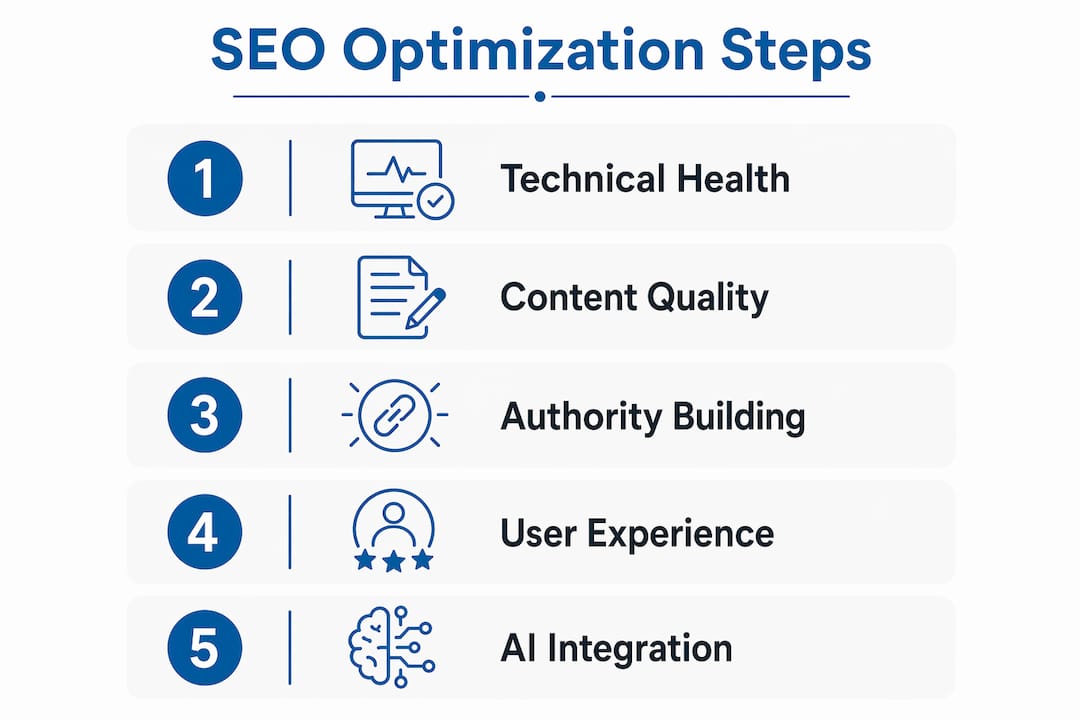
The core ranking factors fall into four categories:
- Technical health. Your site must load fast, be crawlable by Google’s bots, and perform well on mobile devices. Core Web Vitals directly impact rankings and user experience, influencing both traditional and AI search visibility. A page that loads in under 2.5 seconds scores well on Largest Contentful Paint, one of Google’s primary Core Web Vitals metrics.
- Content relevance. Pages must match the actual intent behind a search query. A business owner searching “how to optimize for Google” wants a practical guide, not a glossary definition. Google’s algorithm detects the mismatch and ranks intent-matched pages higher.
- Authority signals. Backlinks from authoritative sites are a strong signal for both Google rankings and AI model trust, outweighing sheer quantity of links. Ten links from respected industry publications outperform 500 links from low-quality directories.
- User experience. Engagement metrics such as time on page, scroll depth, and bounce rate tell Google whether visitors found what they needed. Pages that hold attention rank better over time.
Search engines assess SEO signals as a synergistic set, not in isolation. A technically perfect site with thin content will not rank. A content-rich site that loads in eight seconds will not rank either. Both must work together.
Pro Tip: Run Google Search Central’s PageSpeed Insights tool on your top five pages before making any other changes. Fix the technical issues it flags first. Speed and crawlability are the foundation everything else rests on.
Why Google optimization now includes AI-powered search results
82% of consumers find AI-powered search results more helpful, but these results rely on the same Google indexing systems as traditional search. Optimizing for Google’s traditional results and optimizing for AI answers are the same job.
Here is how the connection works in practice:
- Google crawls and indexes your page using the same signals it has always used: content quality, authority, technical health.
- Google’s AI Overview feature pulls answers from pages already ranking in the top positions.
- AI retrieval systems process only the top portion of a page and favor clear, factual, self-contained answers positioned high on the page.
- Your brand gets cited in the AI answer, which builds recognition even when the user does not click through.
“SEO is not replaced by AI visibility but expanded by it; synchronizing both maximizes overall brand presence and traffic.” — Why Ranking #1 on Google Still Matters in 2026
The zero-click trend reinforces this point. When AI answers a question directly, the brand cited in that answer earns credibility with the searcher. That credibility influences future purchase decisions even without a website visit. Businesses that understand the impact of AI on SEO are already charting a course for this dual-channel reality.
AI-powered search systems prioritize top-of-page, explicit claims with standalone context for citations and snippets. Burying your key answer in paragraph seven of a 3,000-word article is a structural mistake that costs you AI visibility.
Common misconceptions and pitfalls in Google optimization
Several outdated beliefs still circulate among business owners and marketers. Acting on them wastes time and can actively harm your rankings.
- Keyword stuffing still works. It does not. Google’s 2026 guidance states that being relentlessly helpful and showcasing unique expertise outperforms bot-focused tactics like keyword stuffing. Repeating a phrase 40 times on a page signals low quality, not relevance.
- Domain authority masks thin content. A high domain authority score does not protect weak pages from ranking drops. Google evaluates each page on its own merits. A trusted domain with a shallow article still loses to a newer site with a genuinely useful, detailed answer.
- More backlinks always mean better rankings. Quantity without quality is noise. A single link from an industry publication like Search Engine Land carries more weight than hundreds of links from unrelated blogs.
- Artificial snippet chunking improves AI visibility. Breaking content into disconnected bullet fragments to “trick” AI retrieval systems backfires. AI systems favor coherent, self-contained answers, not fragmented lists stripped of context.
- SEO is a one-time project. Google’s algorithm updates continuously. Content that ranked well in 2024 may need refreshing in 2026 to stay competitive.
Pro Tip: Audit your five highest-traffic pages for answer placement. If your core claim appears below the fold, move it to the first paragraph. That single structural change improves both featured snippet eligibility and AI citation rates.
Practical steps to optimize for Google starting today
The benefits of optimizing for search engines are clearest when you follow a structured process. These five steps give business owners and marketers a clear starting point.
- Conduct a content audit focused on answer placement. Review your top pages and confirm that the primary answer to the page’s target question appears in the first 100 words. Use Google Search Console to identify pages with high impressions but low click-through rates. Those pages have a visibility problem, not a traffic problem.
- Optimize your Google Business Profile. Google Business Profile optimization integrates local SEO results with overall search authority, critical for maximizing brand presence across Google platforms. Complete every field, add photos, collect reviews, and post updates weekly.
- Implement structured data markup. Schema markup helps Google understand your content type, whether it is a product, an article, a FAQ, or a local business. Pages with structured data earn rich results, which increase click-through rates.
- Update content regularly. Google favors freshness for topics where recency matters. Revisit your core service pages and blog posts every six months. Add new data, update examples, and remove outdated references.
- Monitor AI visibility alongside traditional rankings. Track whether your brand appears in Google AI Overviews for your target queries. Tools like Google Search Console show impression data for AI-generated results. Pair this with traditional rank tracking to get a complete picture.
The table below shows how traditional SEO tactics map to AI search benefits:
| Traditional SEO tactic | AI search benefit |
|---|---|
| Fast page load speed | Improves crawl frequency and indexing depth |
| Clear, factual opening paragraphs | Increases AI citation and snippet selection |
| Authoritative backlinks | Raises trust score used by AI retrieval systems |
| Structured data markup | Enables rich results and AI answer formatting |
| Google Business Profile updates | Boosts local AI answer inclusion |
For a deeper look at how to put these tactics into practice, the SEO content creation guide from Bigfinseo covers current content strategies in detail.
Key Takeaways
Google optimization is the single highest-ROI investment a business can make in its online presence, because it builds compounding authority across both traditional search and AI-powered results simultaneously.
| Point | Details |
|---|---|
| Google dominates search traffic | Ranking on page one drives qualified visitors without recurring ad spend. |
| AI answers rely on SEO rankings | Pages that rank well in Google are the same pages AI cites in generated answers. |
| Foundational signals work together | Content quality, technical health, authority, and user experience must all perform well. |
| Answer placement is critical | Place your core claim in the first 100 words to improve both snippet and AI citation rates. |
| SEO compounds over time | Organic authority built over 12–36 months delivers ongoing value that paid ads cannot replicate. |
Why I think most businesses are still underestimating Google in 2026
After years of working with business owners across industries, I keep seeing the same pattern. A company invests heavily in paid ads, gets solid short-term results, and then treats SEO as a secondary project. The moment the ad budget tightens, the traffic disappears. There is no anchor holding the ship in place.
What I have found is that the best formula for Google success remains foundational SEO focused on people, not bots, emphasizing authentic content and excellent user experiences. That is not a new idea. What is new is that AI search has made it more urgent. When Google’s AI Overview cites a competitor instead of you, it is not because they spent more on ads. It is because their content answered the question more clearly and more credibly.
The businesses winning in 2026 are the ones treating their website as a long-term asset, not a short-term campaign. They are publishing content that reflects genuine expertise, fixing technical issues before they become ranking problems, and building authority through real relationships and real backlinks. If you want to understand how AI and traditional SEO compare in practice, the gap is closing fast. The businesses that sail ahead are the ones who started building that foundation before the tide shifted.
— Big
How Bigfinseo helps you rank on Google and get cited by AI
At Bigfinseo, we work with business owners and marketing professionals who want measurable results from their Google presence, not just traffic reports.
Our team covers the full range of optimization work: technical site audits, content strategy, authority building, and AI optimization services designed to get your brand cited across both Google Search and AI-powered platforms. Whether you are starting from scratch or looking to improve an existing site, our SEO for beginners resource is a practical first step. We also offer 5 proven ways to optimize your website for business owners ready to move from strategy to execution. If you want a partner to help you chart a course through the evolving search environment, we are ready to crew up with you.
FAQ
Why does Google optimization matter more than social media?
Google captures users with active purchase intent, while social media reaches passive audiences. A searcher typing “best CRM for small business” is ready to buy. A social media user scrolling a feed is not.
How long does it take to see results from Google SEO?
Most businesses see meaningful ranking improvements within 3–6 months of consistent optimization work. Full authority and compounding traffic gains typically develop over 12–36 months.
Does Google SEO still matter if AI answers replace search results?
Yes. AI-powered search results rely on the same Google indexing systems as traditional search. Pages that rank well in Google are the pages AI cites in generated answers.
What is the single most important Google ranking factor?
Google evaluates content quality, technical health, authority, and user experience as a combined set. No single factor dominates, but content that directly answers user intent with clear, factual language consistently performs best.
How does Google Business Profile affect search rankings?
Google Business Profile optimization integrates local SEO signals with overall search authority. A complete, regularly updated profile improves your visibility in local search results and Google Maps, which feeds into broader brand authority on Google platforms.

Michael Fleischner is a marketing strategist, entrepreneur, author, and TEDx speaker with more than 20 years of experience helping businesses grow. As Founder and CEO of Big Fin SEO, he advises small and midsize businesses on marketing strategy, SEO, paid advertising, customer acquisition, and Generative Engine Optimization (GEO).
Michael works directly with business owners and leadership teams through half-day marketing strategy intensives, full-day workshops, and ongoing strategic advisory engagements, including fractional CMO support.
He is the author of SEO Made Simple and The 7 Figure Freelancer, and has served in national leadership roles with the American Marketing Association.
Learn more about Michael at https://michaelfleischnermedia.com or explore his marketing strategy services at https://bigfinseo.com/marketing-strategy/.


 Corine Rigby
 Laura Ayres
 Michael Fleischner