

TL;DR:
- Optimizing your Google Business Profile, reviews, citations, and on-page SEO improves your chances of appearing in the top three local search results.
- Consistent effort in managing reviews, fixing profile data, and building localized content is essential for sustainable rankings over several months.
Local pack optimization is the practice of improving your local business’s presence in Google’s prominent three-listing Local Pack results to attract more nearby customers. Also called Google Local Pack optimization, this process combines Google Business Profile (GBP) management, review acquisition, on-page SEO, and citation consistency to influence how Google ranks local businesses. GBP signals alone account for about 32% of Local Pack rankings, making your profile the single most powerful lever you control. Get this right, and your business appears at the top of local search before any organic results. Get it wrong, and you hand those customers to the business next door.
What is local pack optimization and why does it matter?
The Google Local Pack is the map-based block of three business listings that appears at the top of search results for queries like “plumber near me” or “best Italian restaurant downtown.” It sits above organic results, which means it captures the majority of clicks for local intent searches. Appearing there is not accidental. Google selects businesses based on three core principles: relevance, distance, and prominence.

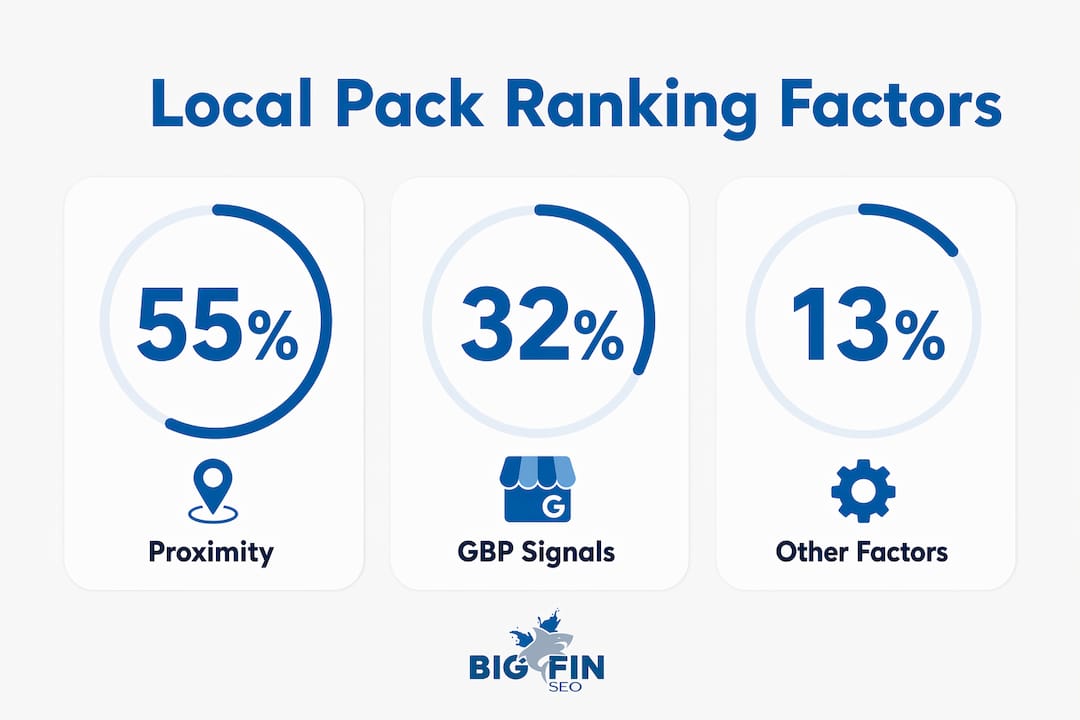
GBP signals contribute about 32% to Local Pack rankings as of Q2 2026. That makes them the most influential factor a business owner can actually control. Review signals, on-page SEO, link signals, behavioral signals, and citation signals fill out the remaining weight.
One factor you cannot control is proximity. Proximity accounts for about 55% of local pack ranking, because it is dictated entirely by where the searcher is standing. That number sounds discouraging, but it clarifies your mission. You focus your energy on the 45% you can influence: category selection, NAP consistency, review volume, and profile completeness.
AI is reshaping this picture further. AI Overviews extract business data directly from fully optimized Google Business Profiles to answer search queries. A thin or incomplete profile now costs you visibility in both traditional Local Pack results and AI-generated answers.
What are the primary ranking factors driving Local Pack results?
Understanding which signals carry the most weight helps you prioritize your time. The major ranking categories break down across GBP signals, review signals, on-page SEO, link signals, behavioral signals, and citation signals.
- GBP signals (~32%): Business category accuracy, profile completeness, photo freshness, and post frequency all feed this bucket. Your primary category is the single most critical field in your entire profile.
- Review signals: Volume, average star rating, review velocity, and your response rate all count. A 4.0+ average star rating is the threshold where Google views a business as credible enough for Local Pack consideration.
- On-page SEO: Localized landing pages, LocalBusiness schema, and geo-targeted metadata send relevance signals that reinforce your GBP data.
- Link signals: Backlinks from local news sites, chambers of commerce, and industry directories build domain authority that supports Local Pack prominence.
- Citation signals: Consistent Name, Address, and Phone (NAP) data across directories like Yelp, Apple Maps, and data aggregators confirms your business identity to Google.
- Behavioral signals: Click-through rate, direction requests, and phone calls from your listing tell Google that real people find your business relevant.
Pro Tip: Pick your primary GBP category before anything else. Changing it later can temporarily drop your ranking, so research competitors in your area and choose the most specific category that accurately describes your core service.
The rising use of AI in local search means a well-structured, data-rich profile is now the authoritative source Google and AI systems pull from first. Treat every field in your GBP as a data point that feeds both algorithms and AI-generated answers.
How to fully optimize your Google Business Profile for Local Pack success
A complete, active GBP is the foundation of any local search strategy. Follow these steps to build a profile that performs.
- Claim and verify your listing. An unverified profile cannot rank. Complete the verification process through Google’s postcard, phone, or video options before making any other changes.
- Select the right primary category. Choose the most specific category that matches your main service. Add secondary categories for supporting services, but never add categories that do not reflect what you actually do.
- Fill every profile section. Complete your business description, hours, website URL, phone number, and service areas. Google truncates descriptions after 250 characters, so lead with your most relevant sentence to maximize CTR and keyword relevance.
- Add photos consistently. Upload high-quality photos of your storefront, interior, team, and products. Fresh photos signal an active business. Aim to add new images at least twice a month.
- Build a review acquisition system. Ask satisfied customers for reviews through email follow-ups, SMS, or in-person requests. Responding to reviews within 24–48 hours signals operational status to Google and builds trust with prospective customers.
- Publish Google Posts regularly. Posts about offers, events, or updates keep your profile active. Treat them like short social media updates tied to your local keywords.
- Manage the Q&A section. Seed it with common questions and answer them yourself. Left unmanaged, anyone can answer your Q&A, including competitors.
- Audit your profile every 90 days. Ranking improvements require ongoing audits and correction of unauthorized edits. Google allows users to suggest changes to your profile, and those changes can go live without your approval.
Pro Tip: Set a calendar reminder every 90 days to review your GBP for unauthorized edits, outdated hours, and missing photos. One uncorrected change to your address or phone number can tank your Local Pack ranking within weeks.
For a detailed walkthrough of each profile field, Bigfinseo’s guide on GBP optimization techniques covers every section with current 2026 standards.
How do on-page SEO and local citations complement Local Pack optimization?
Your GBP does not operate in isolation. Google cross-references your profile data against your website and third-party directories to confirm your business is legitimate and relevant. Strong on-page SEO and clean citations amplify every signal your GBP sends.
Localized landing pages are the most direct on-page tool. Localized landing pages with clear URLs, NAP info, geographic references, and LocalBusiness schema boost on-page relevance and support Local Pack visibility. Each page should include unique service descriptions, readable NAP data, geo-coordinates embedded in LocalBusiness schema, and references to nearby landmarks or neighborhoods. Copying the same content across multiple location pages triggers duplicate content penalties and dilutes your relevance signals.
Citation consistency is equally critical. Citations across major data aggregators and niche directories build prominence that positively influences Local Pack rankings. NAP discrepancies, even minor ones like “St.” versus “Street,” reduce Google’s confidence in your business data and lower your ranking potential.
The table below compares the impact of on-page and citation tactics across key ranking dimensions:
| Tactic | Primary ranking signal strengthened |
|---|---|
| Localized landing pages with schema | Relevance and on-page SEO signals |
| Consistent NAP across directories | Citation signals and prominence |
| Internal linking with local keywords | On-page SEO and behavioral signals |
| LocalBusiness schema with geo-coordinates | Relevance and AI data extraction |
| Backlinks from local organizations | Link signals and domain authority |
Internal linking also matters. Link your service pages to your location pages using anchor text that includes your city and service type. This structure helps Google understand your geographic footprint and reinforces the relevance signals your GBP sends. For a deeper look at website-level tactics, Bigfinseo’s resource on on-page SEO for local businesses covers the technical side in full.
How long does local pack optimization typically take?
Setting realistic expectations prevents the most common mistake in local SEO: abandoning a strategy before it has time to work.
- Weeks 1–2: Foundation changes show the fastest results. Completing your GBP, correcting your primary category, fixing NAP inconsistencies, and adding photos can produce measurable movement in impressions within two weeks.
- Days 60–90: Review signals take longer to accumulate. Review improvements typically take 60–90 days to impact rankings because Google needs to observe a consistent velocity, not just a one-time spike.
- Months 3–6: Full compounding effects appear over 3–6 months as citation cleanup, on-page SEO, and review accumulation work together. This is when businesses typically see sustained top-three placement.
Track your progress with GBP Insights, which shows impressions, clicks, calls, and direction requests directly from your dashboard. For rank tracking across a service area, tools like Local Falcon and BrightLocal provide grid-based reports that show exactly where you rank at different geographic points around your location.
Quarterly audits keep your gains from eroding. Rankings fluctuate as competitors update their profiles and Google refreshes its local index. Treat your Local Pack position as something you maintain, not something you win once.
Pro Tip: Prioritize review velocity over review volume. Ten new reviews spread across a month outperform fifty reviews posted in a single week. Google’s algorithm reads steady accumulation as a sign of genuine customer engagement, not a manipulation attempt.
Understanding how to measure SEO performance over time helps you connect your GBP activity to real business outcomes like calls and direction requests.
Common pitfalls that kill Local Pack rankings
Most local businesses lose their Local Pack position not from a single mistake but from a pattern of small, avoidable errors.
- Keyword stuffing in your business name. Adding “Best Plumber NYC” to your business name violates Google’s guidelines and triggers spam filters. Use your legal business name only.
- Ignoring unauthorized profile edits. Google lets users suggest changes to your listing. Check your profile monthly for edits you did not make, especially to your address, phone number, or hours.
- Inconsistent NAP across platforms. A different suite number on Yelp versus your website creates a data conflict Google resolves by lowering your confidence score.
- Duplicate listings. Multiple GBP profiles for the same location split your ranking signals and confuse Google’s algorithm. Merge or remove duplicates immediately.
- Neglecting review responses. Leaving reviews unanswered, especially negative ones, signals low engagement. Natural, conversational responses improve both ranking and customer trust.
- Posting and then going silent. A burst of activity followed by weeks of inactivity signals an abandoned profile. Consistent posting, even once a week, outperforms sporadic bursts.
Pro Tip: Set up Google Alerts for your business name and address. You will catch unauthorized profile edits, new reviews, and mentions across the web without checking manually every day.
The comprehensive local SEO strategies that produce lasting results share one trait: they treat GBP maintenance as an ongoing operation, not a one-time project.
Key Takeaways
Local pack optimization requires consistent GBP maintenance, clean citations, steady review acquisition, and localized on-page SEO working together to produce sustained Local Pack rankings.
| Point | Details |
|---|---|
| GBP signals lead all factors | GBP signals account for about 32% of Local Pack rankings, making profile completeness your top priority. |
| Proximity is fixed; focus on what you control | Proximity drives about 55% of ranking but cannot be changed; invest in categories, NAP, and reviews. |
| Reviews need velocity, not just volume | Steady review accumulation over 60–90 days signals genuine engagement and moves rankings more reliably than spikes. |
| On-page SEO and citations reinforce GBP | Localized landing pages with LocalBusiness schema and consistent NAP across directories amplify every GBP signal. |
| Audit every 90 days | Unauthorized profile edits and stale data erode rankings steadily; quarterly audits protect your position. |
What I’ve learned after years of watching local businesses win and lose the Local Pack
The businesses I see dominate the Local Pack year after year share one habit: they treat their GBP like a living storefront, not a form they filled out once. The ones who struggle almost always made the same mistake. They optimized their profile at launch, saw some early movement, and then stopped. Six months later, a competitor who kept posting, kept collecting reviews, and kept fixing their citations had quietly taken their spot.
The AI shift makes this even more urgent. AI Overviews now pull directly from GBP data to answer local queries. A profile with thin descriptions, outdated hours, or missing service details gets skipped entirely. The businesses that invested in structured, complete profile data are the ones showing up in both the traditional Local Pack and AI-generated answers. That is a compounding advantage that grows wider every month.
I also want to push back on the obsession with proximity. Yes, it dominates the algorithm. But I have watched businesses in competitive markets outrank closer competitors consistently because their review velocity was stronger and their on-page signals were tighter. Proximity sets the playing field. What you do with your profile determines where you finish on it.
The most underused tactic I see? The Q&A section. Most businesses leave it empty or let random users fill it with inaccurate answers. Seed it with the ten questions your customers ask most often, answer them clearly, and you have created a relevance signal that almost no competitor bothers to build.
— Michael Fleischner
How Bigfinseo helps you chart a course to Local Pack visibility
Local pack optimization works best when every signal, your GBP, citations, reviews, and on-page SEO, pulls in the same direction. That takes consistent effort and a clear system.
Bigfinseo specializes in white-label local SEO services built for agencies that want to deliver real Local Pack results to their clients without building an in-house team. From GBP audits and citation cleanup to review management and localized landing page creation, Bigfinseo handles the full optimization cycle under your brand. Services launch in as few as five business days, and monthly reporting keeps you and your clients anchored to measurable progress. If you are ready to scale your agency’s local SEO offering, Bigfinseo is the crew you want on deck.
FAQ
What is local pack optimization in simple terms?
Local pack optimization is the process of improving your Google Business Profile, reviews, citations, and website signals so your business appears in Google’s top three local search results. It combines profile completeness, review management, and on-page SEO into one coordinated strategy.
How long does it take to rank in the Google Local Pack?
Foundation changes like completing your GBP and fixing NAP inconsistencies can show results within one to two weeks. Full ranking improvements, including review-based signals, typically compound over three to six months.
What is the most important factor for Local Pack rankings?
GBP signals account for about 32% of Local Pack rankings, making your Google Business Profile the single most controllable and impactful factor. Primary category selection and profile completeness carry the most weight within that bucket.
Does my website affect my Local Pack ranking?
Yes. Localized landing pages with LocalBusiness schema, consistent NAP data, and geo-targeted content reinforce your GBP signals and improve your relevance score. On-page SEO and GBP optimization work best when they align.
How do reviews affect Local Pack visibility?
Reviews influence Local Pack rankings through volume, average star rating, and velocity. A 4.0+ average star rating is the credibility threshold Google uses for Local Pack consideration, and responding to reviews within 24–48 hours signals active engagement to the algorithm.

Michael Fleischner is a marketing strategist, entrepreneur, author, and TEDx speaker with more than 20 years of experience helping businesses grow. As Founder and CEO of Big Fin SEO, he advises small and midsize businesses on marketing strategy, SEO, paid advertising, customer acquisition, and Generative Engine Optimization (GEO).
Michael works directly with business owners and leadership teams through half-day marketing strategy intensives, full-day workshops, and ongoing strategic advisory engagements, including fractional CMO support.
He is the author of SEO Made Simple and The 7 Figure Freelancer, and has served in national leadership roles with the American Marketing Association.
Learn more about Michael at https://michaelfleischnermedia.com or explore his marketing strategy services at https://bigfinseo.com/marketing-strategy/.


 Corine Rigby
 Laura Ayres
 Michael Fleischner