

TL;DR:
- Multi-channel marketing engages customers across multiple platforms to increase reach and conversions. It significantly improves purchase rates, engagement, and retention compared to single-channel strategies. Building two or three coordinated channels first provides a strong foundation for future omnichannel integration.
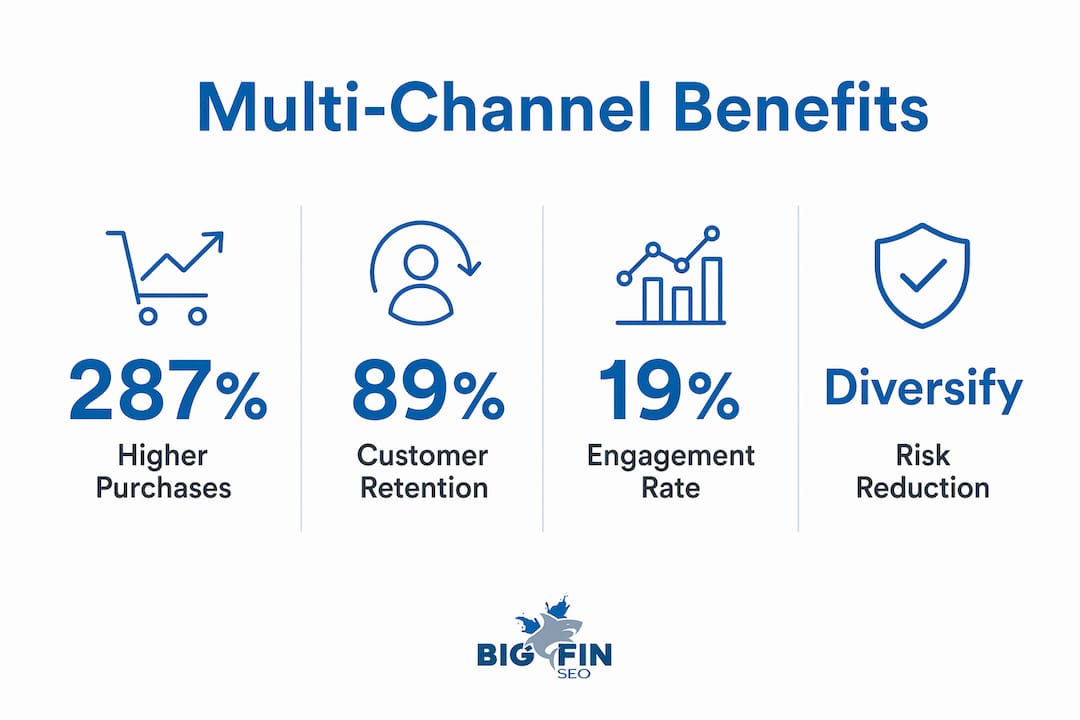
Multi-channel marketing is the practice of engaging customers across multiple, independent platforms simultaneously to maximize reach and conversion. Businesses that ask why use multi-channel marketing are really asking how to stop depending on a single channel that can disappear overnight. The data answers that question clearly: businesses using three or more channels achieve a 287% higher purchase rate than single-channel competitors. That gap widens to 412% for brands active on five or more channels. Pair those numbers with the fragmented, device-hopping behavior of modern buyers, and the case for spreading your presence across platforms becomes impossible to ignore.
What are the key benefits of multi-channel marketing?
The benefits of multi-channel marketing go well beyond simple reach. Each advantage compounds the others, creating a flywheel effect that single-channel programs cannot replicate.
1. Broader customer reach
Your audience does not live on one platform. Some buyers discover brands through organic search, others through social media, and others through email newsletters. Running independent channels in parallel means you meet each segment where they already spend time, rather than waiting for them to find you in one place.

2. Higher engagement rates
Multi-channel campaigns generate an 18.96% engagement rate, compared to 5.48% for single-channel efforts. That is more than three times the engagement from the same audience. Repeated exposure across different contexts reinforces brand recall and moves buyers through the funnel faster.
3. Risk reduction through diversification
Algorithm updates are the silent killer of single-channel strategies. A platform policy change or a search engine update can wipe out traffic overnight. Diversifying across channels acts as insurance. When one channel underperforms, others carry the load while you adapt.
4. Richer data and campaign insight
Each channel produces its own behavioral data. Email open rates, social engagement patterns, and paid search click-through rates each reveal something different about your audience. Running multiple channels gives you a fuller picture of what messaging works, what timing converts, and where budget is best spent.
5. Stronger customer retention
Mature multi-channel programs report an average customer retention rate of 89%. Single-channel engagement retains only about 33% of customers. That 56-point gap represents real revenue. Retained customers spend more, refer others, and cost far less to maintain than new acquisitions.
Pro Tip: Start with the two or three channels where your audience is most active before adding more. Spreading budget too thin across six channels too early dilutes impact and makes attribution harder to read.
Brands with strong multi-channel and omnichannel strategies also report a 9.5% annual revenue increase versus 3.4% for weaker approaches. The financial lift is not theoretical. It shows up in quarterly results.
How does multi-channel differ from omnichannel marketing?
Marketers often use these terms interchangeably, but they describe fundamentally different operating models. Understanding the distinction helps you choose the right approach for your current resources and goals.
Multi-channel marketing runs independent channels in parallel. Each channel has its own messaging, budget, and performance metrics. Channels operate without shared data or unified customer profiles. A customer who clicks your Facebook ad and later opens your email is tracked separately in each system.
Omnichannel marketing connects every channel through a shared data layer. Customer behavior in one channel instantly informs the experience in another. If a buyer abandons a cart on your website, your email system triggers a follow-up and your paid ads retarget that specific product. The experience feels continuous regardless of where the customer shows up next.
| Dimension | Multi-channel | Omnichannel |
|---|---|---|
| Data sharing | Channels operate independently | Unified customer data across all channels |
| Integration complexity | Lower, faster to deploy | Higher, requires integrated systems |
| Customer experience | Consistent brand, separate journeys | Single continuous journey |
| Best for | Awareness campaigns, faster launches | Complex buyer journeys, loyalty programs |
| Resource requirement | Moderate | Significant |
Multi-channel is simpler to deploy and works well for businesses building awareness or testing new markets. Omnichannel delivers a superior customer experience but demands integrated data infrastructure that takes time and budget to build. For most growing businesses, multi-channel is the right starting point. You build the audience and the data before investing in full integration.
For a deeper look at how omnichannel unifies the customer experience, this omnichannel breakdown covers the transition from parallel channels to a fully connected system.
What are effective strategies for implementing multi-channel marketing?
Knowing the advantages of multi-channel strategy is one thing. Executing it without wasting budget is another. These principles separate programs that produce results from those that just produce noise.
-
Choose channels based on audience data, not trend. Where does your specific audience actually spend time? A B2B software company will find LinkedIn and email far more productive than TikTok. A direct-to-consumer brand targeting Gen Z may find the opposite. Start with audience research, not platform popularity.
-
Keep brand messaging consistent across every channel. Visuals, tone, and core value propositions must align whether a buyer sees you on Instagram, in a Google search result, or in their inbox. Inconsistency creates doubt. Consistency builds trust over repeated exposures. Your digital branding strategy should define these standards before you launch any channel.
-
Treat channels as a connected system, not isolated efforts. Top-performing multi-channel strategies use data from each channel to inform the others. If your email campaign reveals that a specific subject line drives high open rates, test that same message angle in paid social copy. Insights should flow across channels continuously.
-
Build in flexibility to test new channels quickly. Multi-channel strategies allow marketers to experiment with emerging platforms without overhauling their entire system. Allocate a small portion of budget, typically 10–15%, to channel experimentation each quarter. Kill what does not perform. Scale what does.
-
Set channel-specific KPIs alongside overall program goals. Email has different success metrics than paid search. Measuring every channel against the same benchmark produces misleading conclusions. Define what success looks like per channel, then roll those metrics up into a program-level view.
Pro Tip: Map your buyer’s journey before selecting channels. Identify where customers first discover you, where they research, and where they convert. Then assign channels to each stage rather than running all channels at all stages.
For agencies managing multi-channel programs across multiple clients, agency marketing tips for coordinating campaigns at scale offer a practical framework worth bookmarking.
What metrics should you track for multi-channel marketing success?
Measurement is where most multi-channel programs fall apart. Marketers track vanity metrics per channel and miss the bigger picture of how channels work together to drive revenue.
Core KPIs to track across your program:
- Engagement rate per channel: Benchmark against the 18.96% multi-channel average to gauge whether your program is performing at or above industry standard.
- Customer retention rate: Track cohorts over 90 days and 12 months. A healthy multi-channel program should push retention well above the 33% single-channel baseline.
- Customer lifetime value (CLV): Multi-channel customers spend more over time. If your CLV is not rising as you add channels, your messaging or targeting needs adjustment.
- Conversion rate by channel and by channel combination: Which paths to purchase convert best? A buyer who sees a social ad, reads a blog post, and then converts via email is a different profile than one who converts on first paid search click.
- Attribution model accuracy: Last-click attribution systematically undervalues upper-funnel channels like social and display. Use linear or time-decay attribution models to distribute credit more accurately across the full path to purchase.
| Metric | What it measures | Why it matters |
|---|---|---|
| Engagement rate | Audience interaction per channel | Signals message relevance and channel fit |
| Retention rate | Customers returning after first purchase | Directly tied to revenue efficiency |
| CLV | Total revenue per customer over time | Measures long-term program health |
| Conversion by path | Which channel combinations drive sales | Guides budget allocation decisions |
| Attribution accuracy | Credit distribution across touchpoints | Prevents underinvestment in top-funnel channels |
AI-powered analytics platforms now make cross-channel attribution significantly more accurate. They identify patterns across large data sets that manual analysis misses. If you want to increase engagement on your website as part of your measurement strategy, website engagement tactics can complement your channel-level data with on-site behavioral insights.
Key Takeaways
Multi-channel marketing drives measurably higher purchase rates, engagement, and retention than single-channel approaches, making it the most reliable foundation for sustainable audience growth.
| Point | Details |
|---|---|
| Purchase rate lift | Businesses using 3+ channels achieve a 287% higher purchase rate than single-channel competitors. |
| Engagement advantage | Multi-channel campaigns produce an 18.96% engagement rate versus 5.48% for single-channel efforts. |
| Retention impact | Mature multi-channel programs retain 89% of customers compared to 33% for single-channel programs. |
| Multi vs. omnichannel | Multi-channel is faster to deploy; omnichannel requires integrated data systems and suits complex buyer journeys. |
| Measurement discipline | Use linear or time-decay attribution models to avoid undervaluing upper-funnel channels in your reporting. |
The fragmented media reality most marketers underestimate
I have worked with marketing teams that built genuinely great content and then watched it underperform because it lived on a single channel. The instinct to go deep on one platform before expanding is understandable. It feels focused. The problem is that your buyers are not focused. They are scattered across search, social, email, video, and podcasts, often within the same hour.
What I have found is that the fear of spreading too thin is usually a resource management problem, not a strategic one. You do not need to run ten channels at full capacity. You need two or three channels working together, sharing signal, and reinforcing the same core message. That is where the compounding effect kicks in.
The other thing most articles will not tell you: multi-channel is not the destination. It is the foundation. Once your channels are producing consistent data, you have the raw material to build toward omnichannel integration. Businesses that skip multi-channel and try to go straight to full omnichannel integration almost always struggle with data quality and team alignment. Build the channels first. Let the data accumulate. Then connect the systems.
Automation and AI are changing how fast you can get there. AI tools now handle personalization at scale across email, paid media, and content distribution simultaneously. That used to require a team of specialists. Now a lean marketing operation can run a genuinely sophisticated multi-channel program with the right tools and a clear strategy. The marketers who win in 2026 are the ones who treat channel data as a continuous feedback loop, not a quarterly report.
— Michael Fleischner
How Bigfinseo helps agencies scale their multi-channel reach
Multi-channel marketing requires consistent visibility across search, content, and digital platforms. SEO is the channel that compounds over time and feeds every other channel with organic traffic and credibility.
Bigfinseo specializes in white-label SEO for agencies that want to add a high-performing search channel to their clients’ multi-channel programs without building an in-house team. Services go live under your brand in five business days. The model eliminates overhead while delivering measurable search visibility improvements that strengthen every other channel in your clients’ marketing mix. If you are ready to add SEO as a core channel, Bigfinseo has the infrastructure to make it happen at scale.
FAQ
What is multi-channel marketing in simple terms?
Multi-channel marketing is the practice of reaching customers across multiple independent platforms, such as email, social media, and search, simultaneously. Each channel operates with its own strategy but carries a consistent brand message.
Why do businesses choose multi-channel over single-channel marketing?
Businesses using three or more channels achieve a 287% higher purchase rate than single-channel users. Single-channel programs also carry significant risk from algorithm changes that can eliminate traffic overnight.
How is multi-channel marketing different from omnichannel?
Multi-channel runs independent channels in parallel without shared data, while omnichannel connects all channels through a unified customer data system. Multi-channel is faster to implement; omnichannel delivers a more personalized continuous experience.
What is a realistic retention rate for multi-channel programs?
Mature multi-channel programs average an 89% customer retention rate, compared to approximately 33% for single-channel engagement. That gap represents a substantial difference in long-term revenue per customer.
How many channels should a business start with?
Starting with two or three channels where your audience is most active produces better results than spreading budget across six channels at once. Build consistency and data quality first, then expand based on performance signals.

Michael Fleischner is a marketing strategist, entrepreneur, author, and TEDx speaker with more than 20 years of experience helping businesses grow. As Founder and CEO of Big Fin SEO, he advises small and midsize businesses on marketing strategy, SEO, paid advertising, customer acquisition, and Generative Engine Optimization (GEO).
Michael works directly with business owners and leadership teams through half-day marketing strategy intensives, full-day workshops, and ongoing strategic advisory engagements, including fractional CMO support.
He is the author of SEO Made Simple and The 7 Figure Freelancer, and has served in national leadership roles with the American Marketing Association.
Learn more about Michael at https://michaelfleischnermedia.com or explore his marketing strategy services at https://bigfinseo.com/marketing-strategy/.



 Corine Rigby
 Laura Ayres
 Michael Fleischner